Why Cable Cooling Matters: A Practical Guide to Liquid-Cooled vs. Air-Cooled DC Charging Cables
Home / Blog / Guidelines / Why Cable Cooling Matters: A Practical Guide to Liquid-Cooled vs. Air-Cooled DC Charging Cables
10 Jun, 2026
350kW charging cable
DC fast charging cable cooling
high power charging cable design
liquid cooled EV charging cable
If you're designing or specifying a DC fast charger above 150 kW, liquid-cooled cables are essentially mandatory — an air-cooled cable simply cannot carry 400A continuously without becoming too thick and heavy for a user to lift. Below 150 kW, air-cooled cables win on cost and simplicity. The real decision sits in the middle: it's about your target current, duty cycle, and who will be handling the connector.
The Thermal Problem in One Paragraph
Every DC cable is a resistor. Push current through it, and it heats up according to I²R — double the current, quadruple the heat. At 200A, a standard copper conductor generates manageable heat that convection and conductor mass can dissipate. At 400A, you're generating four times more heat in the same cable. You have three options: use a much thicker conductor (heavier cable), limit current (slower charging), or actively remove heat. Liquid cooling is option three, and it's the only one that keeps the cable ergonomic at 350 kW+.
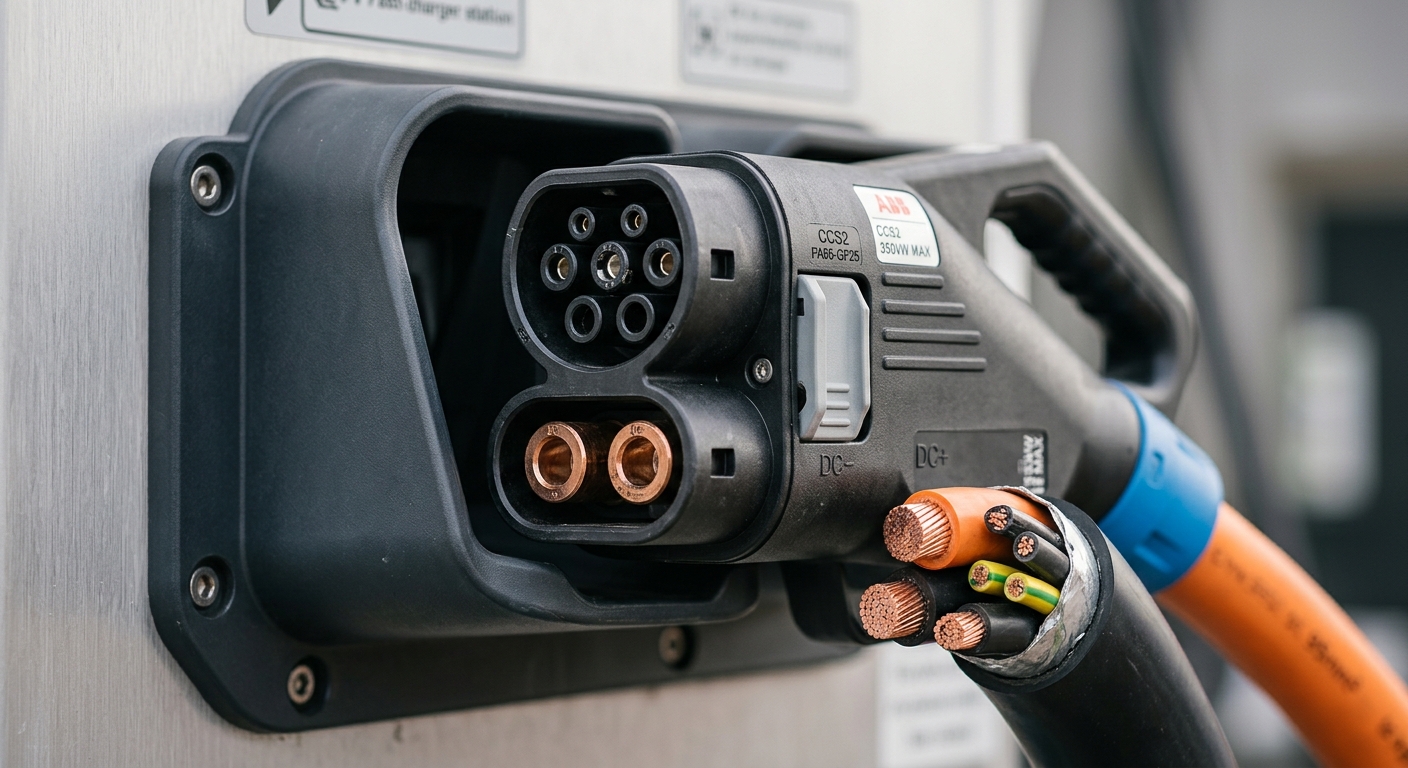
The CCS2 and NACS connectors both have temperature sensors built into the pins for exactly this reason. Hit 90°C at the contact, and the charger derates automatically. If your cable can't shed heat fast enough, your advertised “350 kW” station is really a 180 kW station after five minutes.
CCS2 DC fast charging connector close-up showing pin detail
How Air-Cooled DC Cables Actually Work
Air-cooled is a slight misnomer — these cables rely on passive convection and conductor mass, not forced air. The copper conductor itself acts as the heat sink, with the PVC or TPU jacket providing insulation and mechanical protection. Cross-sections typically run 50–95 mm² for currents up to 200A.
Where Air-Cooled Makes Sense
Workplace and destination charging: 50–120 kW stations where dwell times are 30+ minutes
Light commercial fleets: Vans and taxis that top up between shifts
Rural and low-traffic sites: Where CapEx matters more than charging speed
Industrial DC applications:forklift chargers and AGV systems that often run at 80–150A
For example, a distributor serving small retail parking lots in Southeast Asia might standardize on 120 kW air-cooled units — the math on cable cost alone can save $800–1,200 per unit compared to liquid-cooled variants.
Air-cooled DC charging cable coiled at a commercial charging station
How Liquid-Cooled Cables Remove Heat
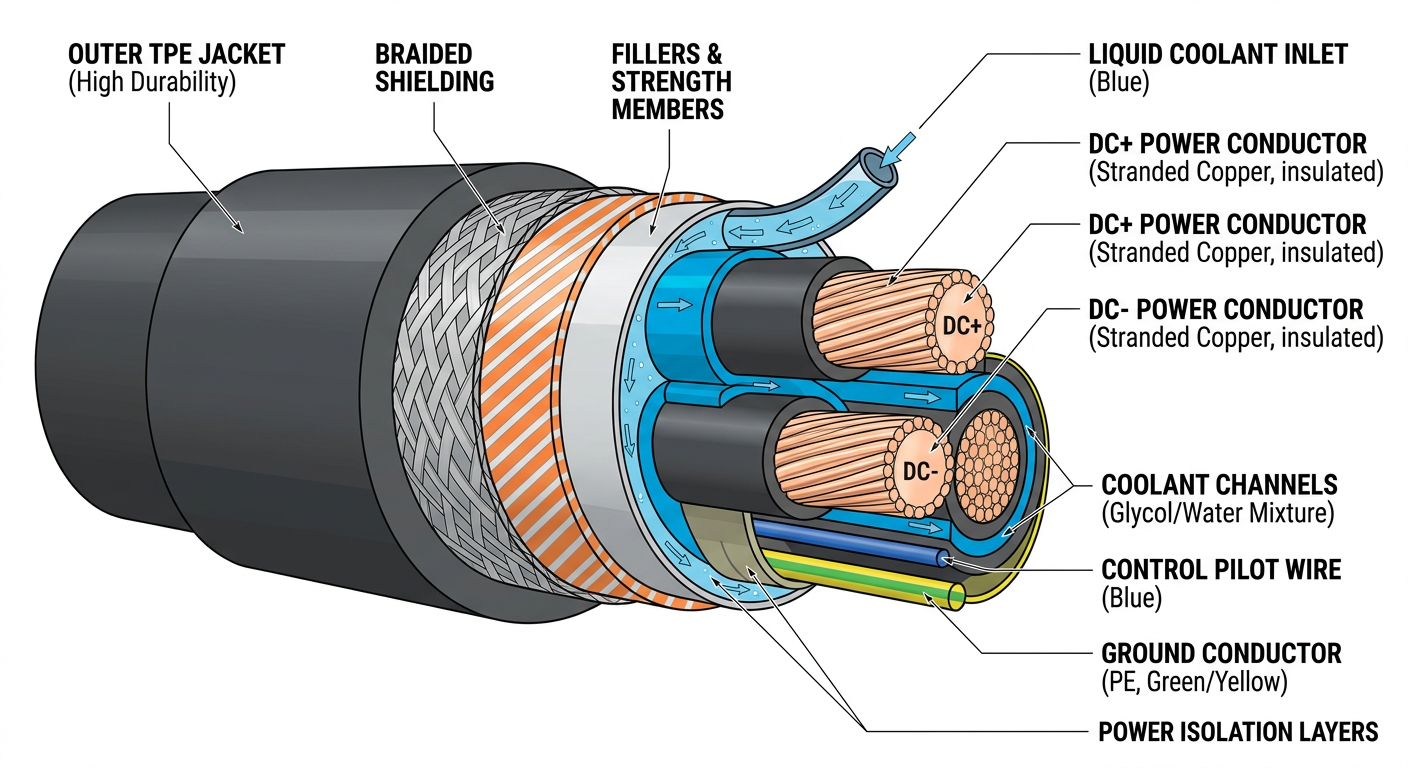
Inside a liquid-cooled cable, a dielectric coolant (usually a glycol-water mix or a specialized dielectric fluid) circulates through channels running alongside the copper conductors. The coolant absorbs heat from the conductors and carries it back to a heat exchanger in the charger cabinet, where a pump and radiator dump it to ambient air.
The clever part: because you're actively removing heat, you can use a smaller conductor cross-section — typically 35–50 mm² for 500A. That's how a 500A liquid-cooled cable ends up thinner and lighter than a 200A air-cooled one. The trade-off is system complexity: you now have a pump, reservoir, sensors, and coolant loop that all need to work reliably for 10+ years.
Key Components You're Adding
Coolant pump (typically 15–40W, brushless DC)
Expansion tank and fill port
Flow and temperature sensors
Heat exchanger with fan
Redundant sealing at the connector interface
Cutaway illustration of liquid-cooled DC charging cable internals
The Numbers Side-by-Side
Here's how the two approaches compare across the criteria that actually matter for procurement and system design:
Criteria
Air-Cooled
Liquid-Cooled
Continuous Current
Up to ~200A
400–600A+
Typical Power Range
50–150 kW
150–480 kW
Cable Diameter
30–45 mm
22–30 mm
Weight per Meter
1.8–2.8 kg/m
1.2–1.6 kg/m
Upfront Cost
Baseline
3–5x higher
Maintenance
Minimal
Coolant service every 2–5 years
Best Use Case
Destination, light commercial
Highway fast charging, depots
Ergonomics
Stiff, heavy at high amps
One-hand handling
Note the weight figure — a 5-meter air-cooled cable at 250A spec can weigh 13–14 kg. Elderly drivers and people with limited hand strength genuinely struggle with it. This isn't theoretical; it's a real complaint logged at public charging sites every day.
Duty Cycle: The Hidden Variable
Peak current ratings are easy to quote. Real-world duty cycles are what actually break cables. A highway charger averaging 12 sessions per hour at 350 kW lives a very different life than a destination charger doing 4 sessions per day at 100 kW.
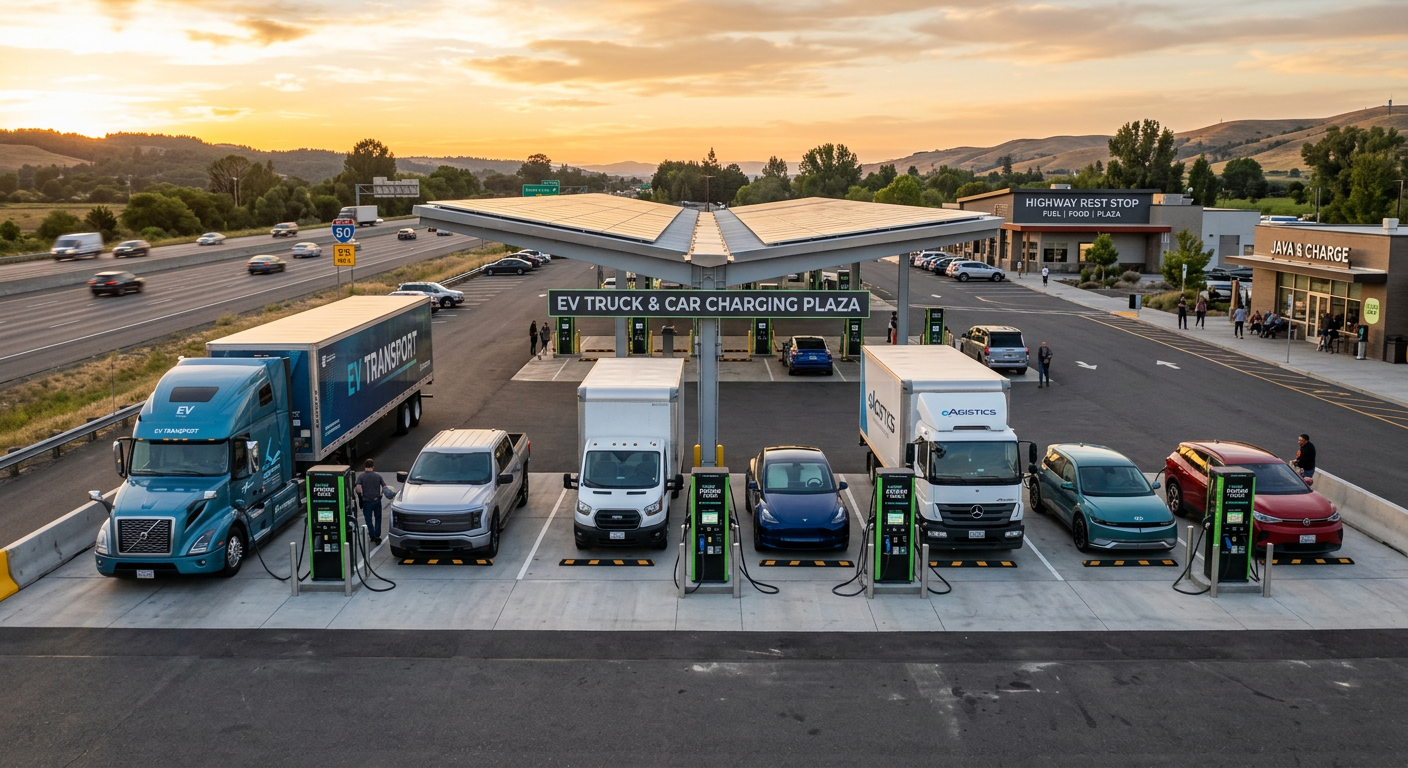
For high-throughput sites — think a truck stop running 20-minute sessions back-to-back — liquid cooling isn't optional. The cable never gets a chance to passively cool between sessions. We've seen air-cooled cables derate to 60% of rated current by midday during summer heat waves simply because the conductor hasn't returned to ambient temperature.
For fleet depot applications, duty cycle matters even more. If you're running a managed fleet charging operation with sequential charging at 200A, you might get away with air-cooled. Push to 400A simultaneous charging across multiple ports, and the thermal budget collapses quickly.
High-power DC fast chargers at a highway truck stop
What Goes Wrong — Real Failure Modes
Air-Cooled Failures
Jacket cracking from repeated flexing at the strain relief, especially in cold climates where the TPU stiffens
Pin overheating and derating when operators try to push cables beyond rated current
Connector melt events at poor-contact pins — rare but catastrophic
Liquid-Cooled Failures
Coolant leaks at the connector boot or internal fittings — triggers immediate shutdown
Pump failure — loss of flow causes near-instant derating
Coolant degradation — glycol breaks down over years, reducing dielectric properties
Air pockets after servicing — cause hot spots if not bled properly
A real scenario we've helped troubleshoot: a 180 kW liquid-cooled station kept derating to 90 kW mid-session. Turned out the coolant reservoir had dropped 15% below minimum after a slow seal leak. The pump was fine, flow rate was fine — but cavitation at low reservoir level was injecting microbubbles into the loop. Half a liter of top-up and a proper bleed, and it was back to rated power. That's the maintenance reality nobody mentions in the brochure.
Cost Analysis: Beyond the Cable Price
A liquid-cooled cable assembly costs roughly $800–1,500 versus $200–400 for air-cooled at comparable lengths. But cable price is the wrong comparison. Look at the whole charger:
Coolant system BOM: Add $300–600 for pump, heat exchanger, tank, sensors
Assembly labor: 1–2 extra hours for plumbing and bleed procedure
Spare parts inventory: Coolant stock, replacement pumps, seal kits
Field service training: Technicians need coolant handling procedures
On a 350 kW dual-cable charger, liquid cooling adds roughly $2,500–4,000 to the station BOM. That's meaningful, but it also enables a product you literally cannot build any other way. For a 120 kW single-cable unit, liquid cooling is $1,500+ of spend for a marginal ergonomics improvement — hard to justify. If you're running margin analysis for a charging station business, these numbers are worth modeling carefully.
Selection Framework: Which One for Your Project?
Skip the feature comparison and ask four questions:
What's your peak per-port current? Above 250A continuous, liquid-cooled only. Below 150A, air-cooled is fine. The 150–250A band is where judgment calls live.
How long is the cable? Beyond 5 meters, cable resistance climbs and ergonomics suffer. Long cables push you toward liquid cooling even at moderate currents.
Who's handling the connector? Public sites with diverse users need lightweight, flexible cables. Professional fleet yards can tolerate heavier cables.
What's the duty cycle? Back-to-back high-power sessions demand active cooling. Intermittent use gives conductor mass time to recover.
For example, a logistics operator building a 20-bay truck depot with 180 kW per bay might reasonably choose air-cooled if trucks charge overnight across 8 hours — plenty of thermal headroom. The same operator building a midday opportunity-charging lane at 350 kW has no choice but liquid-cooled. Same fleet, different charging infrastructure design, different cable strategy.
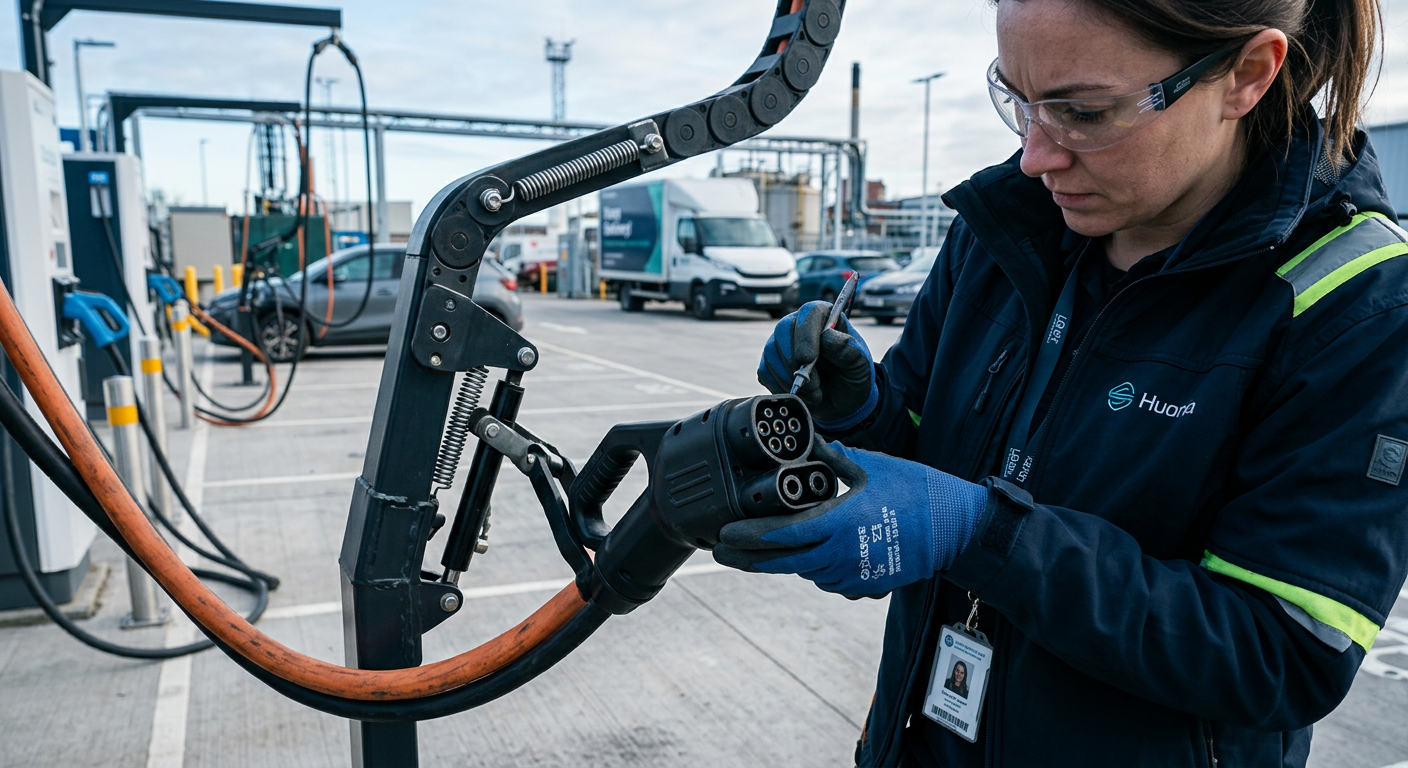
Engineer inspecting DC fast charging cable at fleet depot
Where the Technology Is Heading
Megawatt Charging System (MCS) for heavy trucks — up to 3.75 MW at 3,000A — has pushed liquid cooling to new extremes. Current MCS prototypes run coolant flow rates 3–4x higher than 350 kW CCS systems, with precision-machined coolant channels in the connector pins themselves. This technology will trickle down. We expect 500 kW CCS cables to become more efficient and cheaper over the next three to four years as MCS-derived thermal designs reach volume production.
On the air-cooled side, new conductor geometries — litz-style stranding and aluminum-copper hybrid conductors — are pushing the passive ceiling from 200A toward 250A. It's incremental, but it matters for the mid-power segment.
Getting the Specification Right
Cable cooling isn't a box to tick — it's a decision that ripples through your charger's power rating, form factor, service model, and customer experience. Get it wrong, and you either overspend on features nobody needs or ship a product that derates under real-world use. Get it right, and the cable becomes invisible — exactly what a good interface should be.
At evaisun, we work with distributors and project developers to match cable technology to actual site conditions rather than marketing spec sheets. If you're evaluating DC charger options for an upcoming project and want to pressure-test the cooling strategy against your duty cycle, reach out to our engineering team — we'll walk through the numbers with you.
Subscribe the newsletter to get updated to news and promotions
Cookies give you a personalized experience,Сookie files help us to enhance your experience using our website, simplify navigation, keep our website safe and assist in our marketing efforts. By clicking "Accept", you agree to the storing of cookies on your device for these purposes. Click "Adjust" to adjust your cookie preferences.For more information, review our Cookie Policy