AGV and Mobile Robot Charging: Designing Auto-Docking Systems That Actually Work in 24/7 Operations
Home / Blog / Guidelines / AGV and Mobile Robot Charging: Designing Auto-Docking Systems That Actually Work in 24/7 Operations
27 May, 2026
AGV opportunity charging
AMR charging station
automated charging contact
mobile robot charging
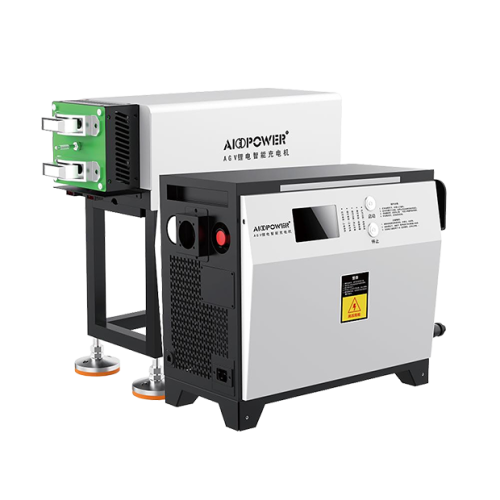
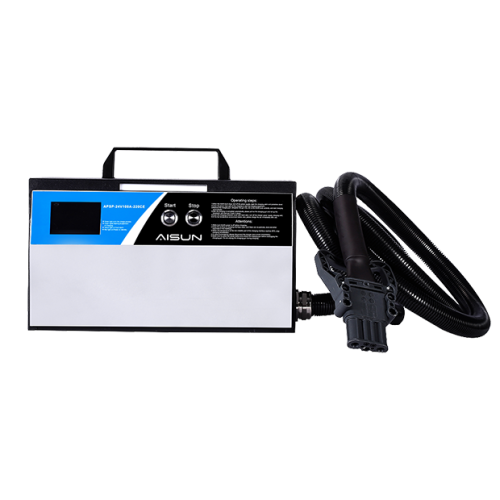
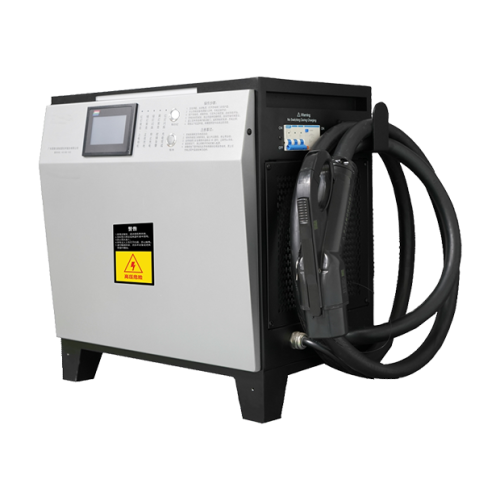
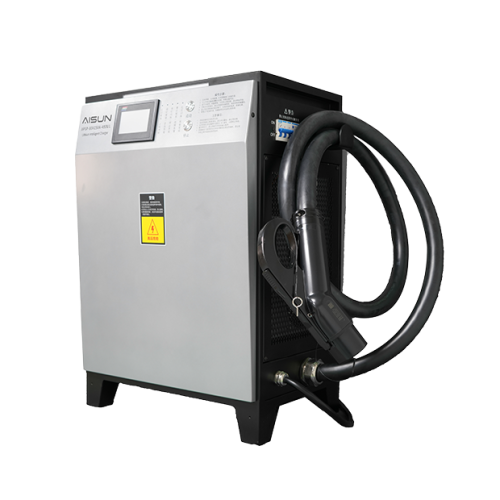
An auto-docking charging system that actually works in 24/7 operations comes down to three things: a contact mechanism that tolerates real-world misalignment, a control handshake that never leaves the robot stranded, and thermal headroom for back-to-back fast charges. Get those right and your AGV fleet runs without human intervention for months. Get them wrong and you'll spend more time troubleshooting docking faults than moving pallets.
Why Auto-Docking Is Where Most AGV Charging Projects Fail
Here's something nobody tells you in the sales deck: the charger itself is rarely the problem. The mechanical and electrical interface between the robot and the charging station is where 80% of field failures originate. Bent contacts, oxidized brushes, off-axis approaches, EMI on the CAN line — these are the issues that fill service tickets at 3 AM.
A typical AGV in a three-shift distribution center docks for charging 20–40 times per day. Multiply that across a 30-robot fleet and you're looking at over 300,000 docking events per year. Any mechanism with even a 0.01% failure rate generates 30 incidents annually — each one potentially halting a workflow.
The fix isn't more robust components in isolation. It's designing the entire docking sequence — approach, alignment, contact, handshake, charge, disengage — as one integrated system with deliberate tolerance budgets at every step.
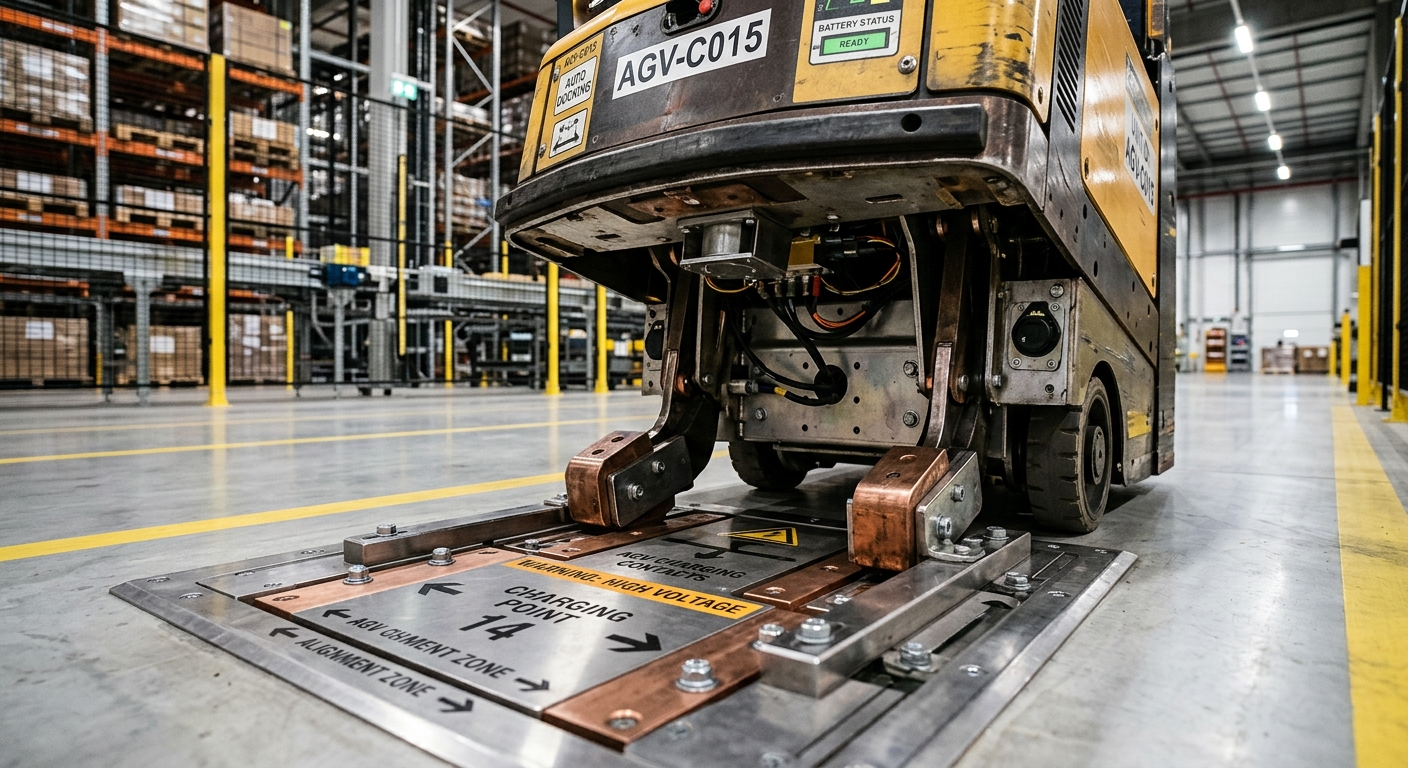
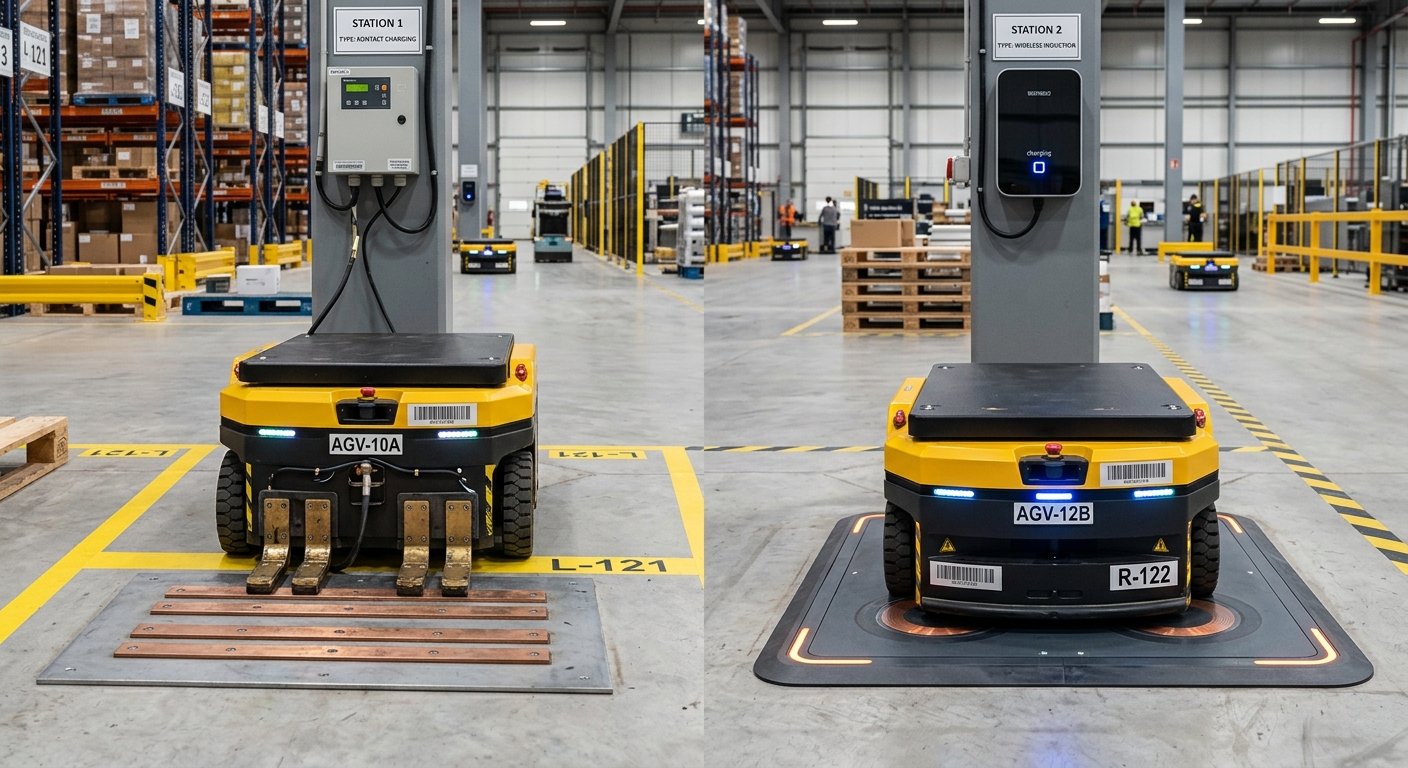
Close-up of AGV charging contact docking precisionComparison of contact-based and wireless AGV charging stations
Contact-Based vs. Wireless Charging: Pick Based on Duty Cycle, Not Hype
Wireless charging gets the magazine covers. Contact-based charging gets the work done. Both have legitimate roles — the question is which fits your duty cycle and floor environment.
For high-power opportunity charging above 20 kW, contact-based docking is still the engineering-honest answer. The efficiency gap (roughly 5–8 percentage points) translates directly into less waste heat, smaller transformers, and lower energy bills. For a fleet running 8,000 hours a year, that gap can mean tens of thousands of kWh annually.
Wireless makes sense in three specific scenarios: cleanrooms where exposed contacts are forbidden, food-grade environments needing daily wash-downs, and low-power AMRs (under 5 kW) where the convenience of sloppy alignment outweighs efficiency losses. For a pharma packaging line we've supported, sealed inductive pads were the only option — IP69K wash-down compatibility ruled out brushes from day one.
For everything else — automotive logistics, e-commerce fulfillment, cold storage with heavy tuggers — contact docking wins on TCO. Our broader take on this is covered in our piece on innovative charging solutions for AGVs and forklifts.
Mechanical Tolerance: The ±10 mm Rule That Saves Fleets
If your docking system requires the AGV to align within ±2 mm to make contact, you've already lost. Real warehouse floors aren't laser-flat. Wheels wear. Navigation drift accumulates between calibrations. A practical auto-docking design must tolerate ±10–15 mm of lateral and longitudinal misalignment, plus 2–3 degrees of yaw.
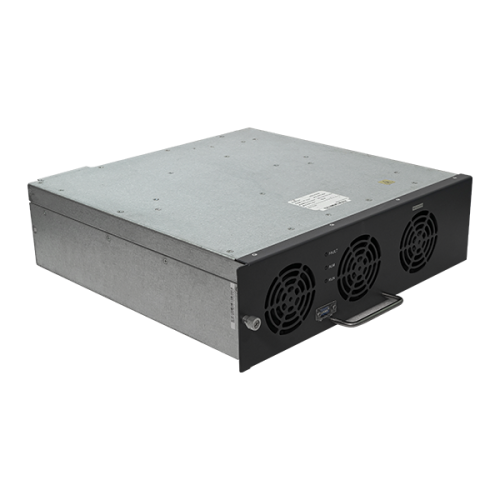
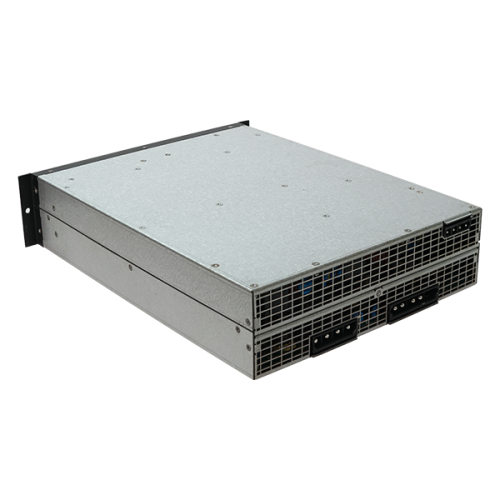
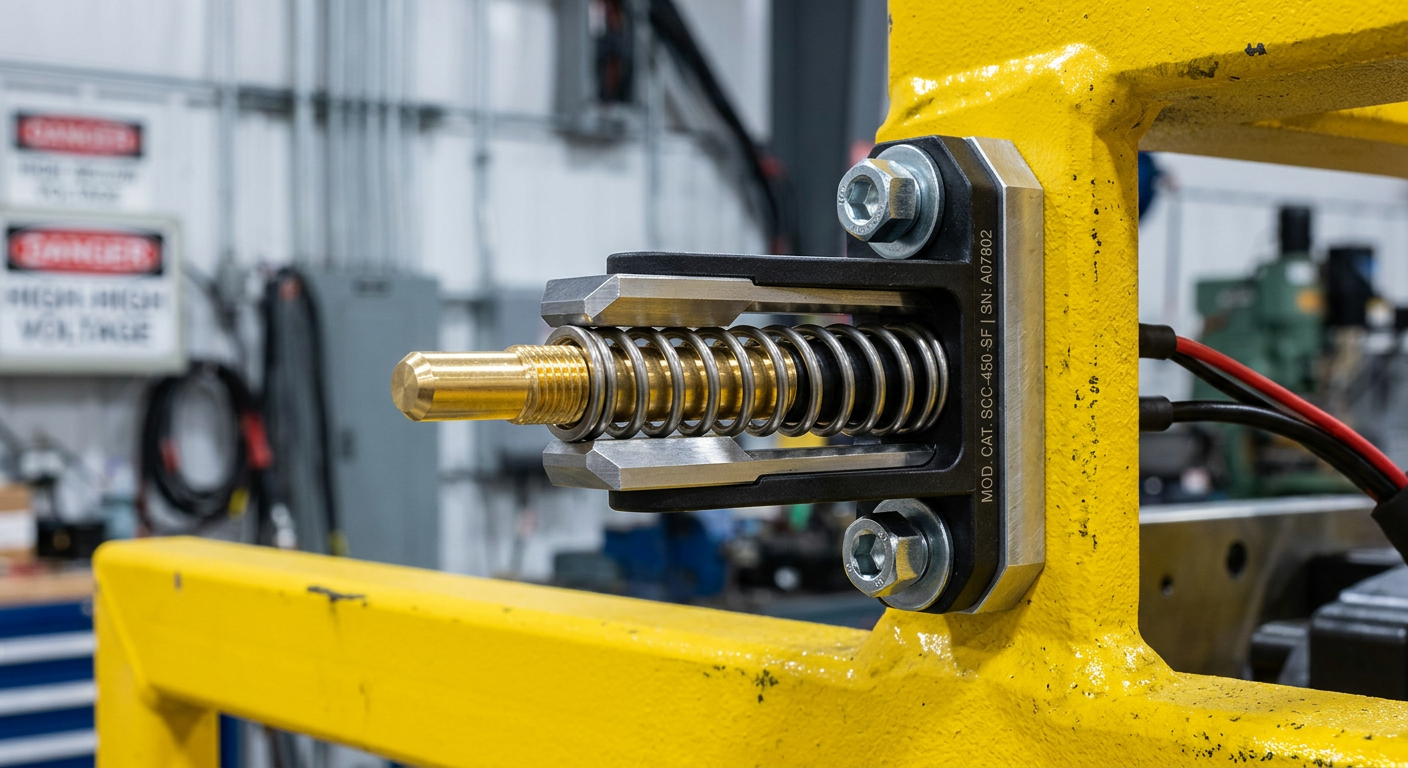
The way we get there is with spring-loaded contact assemblies — the charger-side contacts float on dampened guides, and the robot-side bus bars are wider than nominal contact width. Chamfered lead-ins on both sides convert approach error into smooth seating. A common spec on our heavy-duty AGV chargers: contact heads with 15 mm vertical compliance and 12 mm horizontal float, rated for 200,000 docking cycles.
Floor-Mounted vs. Wall-Mounted Contacts
Floor-mounted contacts are easier for the robot to find but accumulate dust and debris. Wall-mounted contacts (or low-profile bumper contacts) stay cleaner but demand tighter approach precision. For a 24/7 e-commerce fulfillment center, wall-mounted at 150–200 mm height is usually the sweet spot — high enough to avoid floor sweepings, low enough to keep the robot's center of mass stable during contact.
Spring-loaded charging contact assembly detail
Communication Handshake: Why CAN Bus Beats Simple Voltage Sensing
Voltage-detection charging — where the charger turns on as soon as it senses the battery — is fine for a forklift on a five-minute coffee break. It is not fine for an AGV that may dock 30 times a day with varying state-of-charge, battery temperature, and remaining shift load.
Modern AGV charging demands real CAN bus communication between the BMS and the charger. The handshake should happen in under 500 ms after physical contact and exchange at minimum: battery chemistry confirmation, current SOC, cell temperature distribution, allowable charge current curve, and a heartbeat signal that aborts charging if comms drop.
This matters because lithium AGVs benefit hugely from opportunistic charging — short, high-current top-ups during natural workflow pauses. Without BMS-driven current limiting, you either charge too conservatively (wasting opportunity) or too aggressively (cooking cells over time). Our deeper write-up on BMS CAN communication for lithium charging walks through the protocol details.
Practical tip: insist that your charger supports both CANopen and J1939 profiles, plus a configurable bitrate. AGV manufacturers don't standardize, and you'll inevitably mix fleets over a 5–7 year deployment.
Power Sizing: The Math Behind Opportunity Charging
Most fleet planners oversize their chargers by 30–50%. The reasoning sounds prudent — “we want headroom” — but it costs real money in transformer capacity, switchgear, and idle losses.
The honest sizing formula for opportunity charging: Charger power (kW) = (Daily energy demand per robot ÷ available charging hours per robot) × 1.15 safety factor.
For example, an AGV consuming 18 kWh per 16-hour shift, with 90 minutes of cumulative dock time spread across the shift, needs roughly 14 kW of charger output — not the 30 kW many integrators specify by default. Spec a 15 kW unit, save the cabling and panel costs, and use the savings to add a second backup dock instead.
For heavier applications — tugger AGVs moving 5-tonne loads, or autonomous straddle carriers — power scales fast. Container terminal AMRs we've configured run 60–120 kW per dock with active cable cooling. At those levels, the conversation shifts from contact mechanics to thermal management of the bus bars themselves.
Thermal Design for Back-to-Back Fast Charges
Here's a failure mode that surprises new fleet operators: the charger passes acceptance testing in February and starts derating in July. Why? The thermal envelope was sized for steady-state, not for the reality of 30 fast-charge cycles per day in an un-air-conditioned warehouse.
Three design choices separate chargers that hold rated power year-round from those that don't:
Oversized heatsinks with dedicated airflow paths — not shared with the cabinet's general ventilation. Look for chargers rated at full output up to 50°C ambient, not the typical 40°C.
IGBT/SiC junction temperature monitoring with predictive derating — the unit slows down gracefully instead of tripping offline.
Contact thermal sensors on the docking interface. A loose or oxidized contact creates a localized hot spot long before it fails. Catching this at 80°C means scheduling maintenance; missing it means a melted connector at 200°C.
For mission-critical 24/7 sites, consider liquid-cooled charging cables on docks above 50 kW. The capex bump is real but the duty-cycle gain is substantial.
Real-World Example: A 24-AGV Cold Storage Deployment
A frozen logistics operator running a -25°C cold store needed to replace lead-acid AGVs with lithium units across two shifts. Their original plan: 24 AGVs, 24 chargers, one per robot. We pushed back.
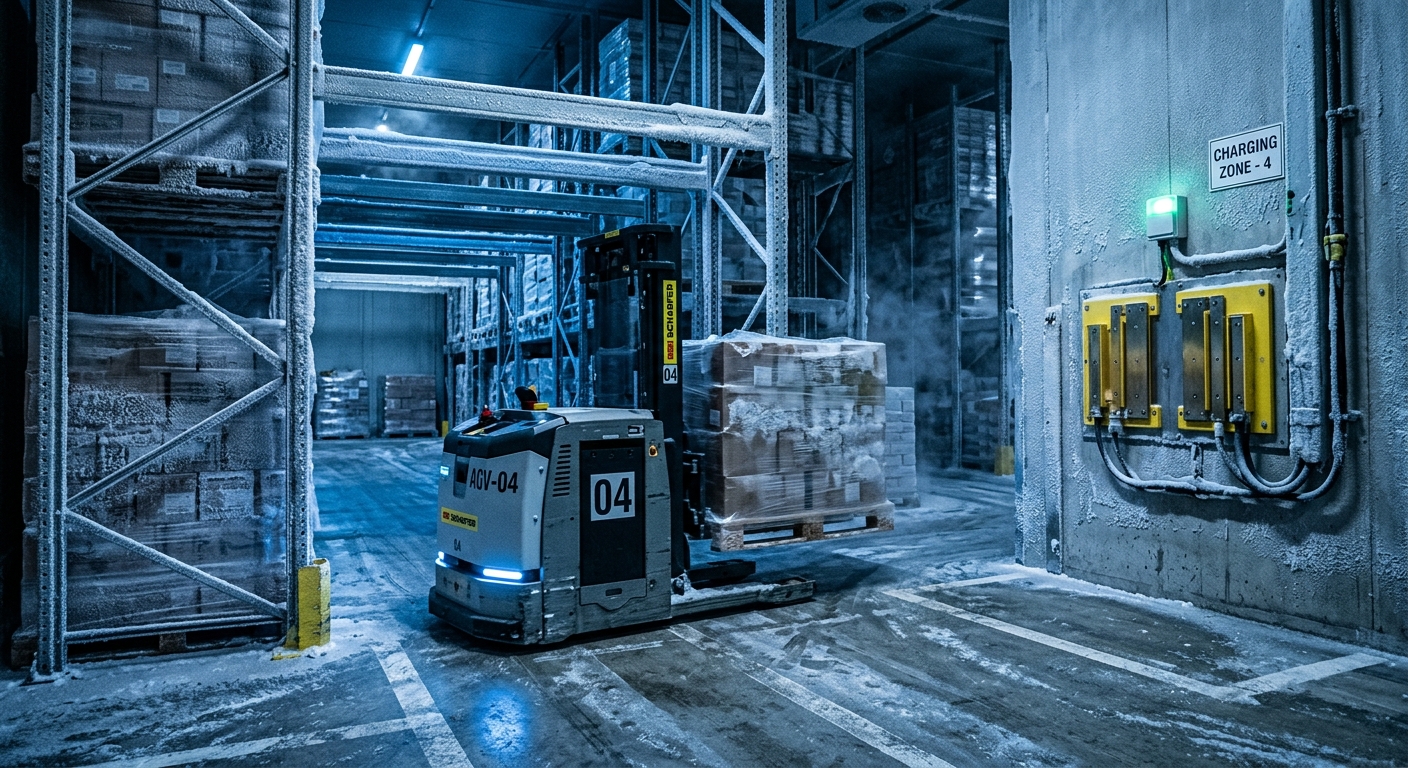
After mapping the actual duty cycle — robots spent 12% of their shift idle near cross-dock points — we redesigned around 9 shared opportunity charging docks rated at 20 kW each, positioned at natural workflow pause locations. Each dock used wall-mounted contacts at 180 mm height (above floor sweep level, below pallet impact zone) with heated contact housings to prevent ice buildup at the warm/cold threshold.
The CAN handshake included a custom field for “cold-soak compensation” — the BMS reported pack temperature, and the charger ramped current more conservatively when cells were below 5°C. Result: 38% lower charger capex, zero unplanned charging downtime in the first 14 months, and the fleet completed its expected daily throughput with 22 robots instead of 24. The two spare AGVs cover maintenance windows.
The lesson? Auto-docking design isn't just a hardware exercise. It's a duty-cycle optimization problem where the charging infrastructure becomes part of the warehouse choreography.
AGV charging in cold storage warehouse environment
Maintenance and Failure Modes Nobody Plans For
Three failure modes appear repeatedly in field data, and all three are preventable with five minutes of planning.
Contact oxidation. Copper contacts in humid environments form an insulating oxide layer within weeks if the dock isn't cycled regularly. Solution: silver-plated or gold-flashed contact tips, plus a scheduled “exercise” charge for spare docks left idle more than 72 hours.
Debris bridging. Metal swarf, packing staples, even a stray paperclip can short adjacent contact pads. Adequate spacing (minimum 25 mm between pads at 80 V), insulated barriers between live conductors, and ground-fault detection on the charger side all matter.
Connector arc damage. If the AGV's main contactor opens during charging — say, an emergency stop is hit — current interrupts at the docking contact, not inside the sealed contactor. Repeated arcing pits the contact surface. Designing the BMS handshake to ramp current to zero before mechanical disengagement (precharge/predischarge sequencing) extends contact life by an order of magnitude.
For a deeper operational checklist, our AGV charger operation guide covers the routine inspections that keep these issues from compounding.
Integrating Charging Into Fleet Management Software
The best auto-docking hardware in the world underperforms if the fleet manager can't see it. Modern AGV deployments demand the charger expose its data to the WMS or fleet orchestrator — typically via OCPP, Modbus TCP, or a vendor REST API.
At minimum, your fleet software should consume: real-time SOC per robot, charger availability state, fault codes with severity ranking, and predicted charge completion time. With that data, the orchestrator can dispatch the next available robot to the next available dock based on remaining battery range — instead of routing every robot to its “home” charger.
This pays off most in mixed fleets. A site running both electric forklifts and AGVs on overlapping routes can use shared dock infrastructure during off-shift hours, recovering capex from both fleets. We've seen sites cut total charger count by 30% just by unifying the charging dispatch logic across previously siloed equipment categories.
Designing for the Next Five Years, Not the Next Pilot
If you're specifying an auto-docking system today, plan for these realities: AGV battery capacities will keep growing (250 Ah is the new 150 Ah), charge rates will push from 1C toward 2–3C on lithium iron phosphate packs, and robot fleets will mix vendors over their lifespan.
That means your dock infrastructure should be modular, vendor-agnostic on the communication side, and provisioned with at least 50% headroom on incoming AC service. Future-proofing the panel and conduit is cheap; replacing it in three years isn't.
Whether you're scoping a 10-robot pilot or a 200-robot greenfield site, the auto-docking system deserves the same engineering rigor as the robots themselves. evaisun designs and manufactures DC charging hardware specifically for AGV, AMR, and industrial automation duty cycles — including custom contact assemblies, BMS-integrated control firmware, and high-power opportunity chargers tested for million-cycle reliability. Talk to our engineering team if you'd like a duty-cycle review of your fleet plan, or explore our work on advanced forklift chargers and warehouse efficiency for adjacent applications.
Subscribe the newsletter to get updated to news and promotions
Cookies give you a personalized experience,Сookie files help us to enhance your experience using our website, simplify navigation, keep our website safe and assist in our marketing efforts. By clicking "Accept", you agree to the storing of cookies on your device for these purposes. Click "Adjust" to adjust your cookie preferences.For more information, review our Cookie Policy