Three-Phase Power Quality Issues That Silently Damage DC Fast Chargers
Home / Blog / Guidelines / Three-Phase Power Quality Issues That Silently Damage DC Fast Chargers
17 Sep, 2026
harmonic distortion DC charger
power quality EV charging station
voltage imbalance EV charger
Three-phase power quality problems damage DC fast chargers not through dramatic failures, but through slow, cumulative stress that the charger’s own diagnostics often miss entirely. Voltage imbalance overheats rectifier diodes and DC bus capacitors, harmonic distortion accelerates insulation breakdown in input filters, and neutral shift corrupts sensitive control electronics — all while the charger keeps working, just a little worse each month. By the time a fault code finally appears, you’re usually looking at a power module replacement, not a simple fix.
Voltage Imbalance: The Silent Capacitor Killer
Here’s a number that surprises most site engineers: a 3% voltage imbalance across the three phases can produce a 9-15% imbalance in phase currents inside a three-phase rectifier. That’s not a typo — the relationship isn’t linear, it’s roughly a 6-10x amplification. And DC fast chargers, with their front-end rectification stages, are particularly exposed.
What actually happens: one phase runs hotter than the others because it’s carrying disproportionate current. That heat concentrates in the rectifier diodes and, more critically, in the DC bus capacitors sitting right behind them. Capacitors degrade faster with every degree above their rated operating temperature — electrolytic capacitors typically lose half their service life for every 10°C rise. A charger rated for 10 years of capacitor life under balanced conditions might see that cut to 4-5 years under a chronic 4% imbalance that nobody ever flagged.
Where Imbalance Actually Comes From
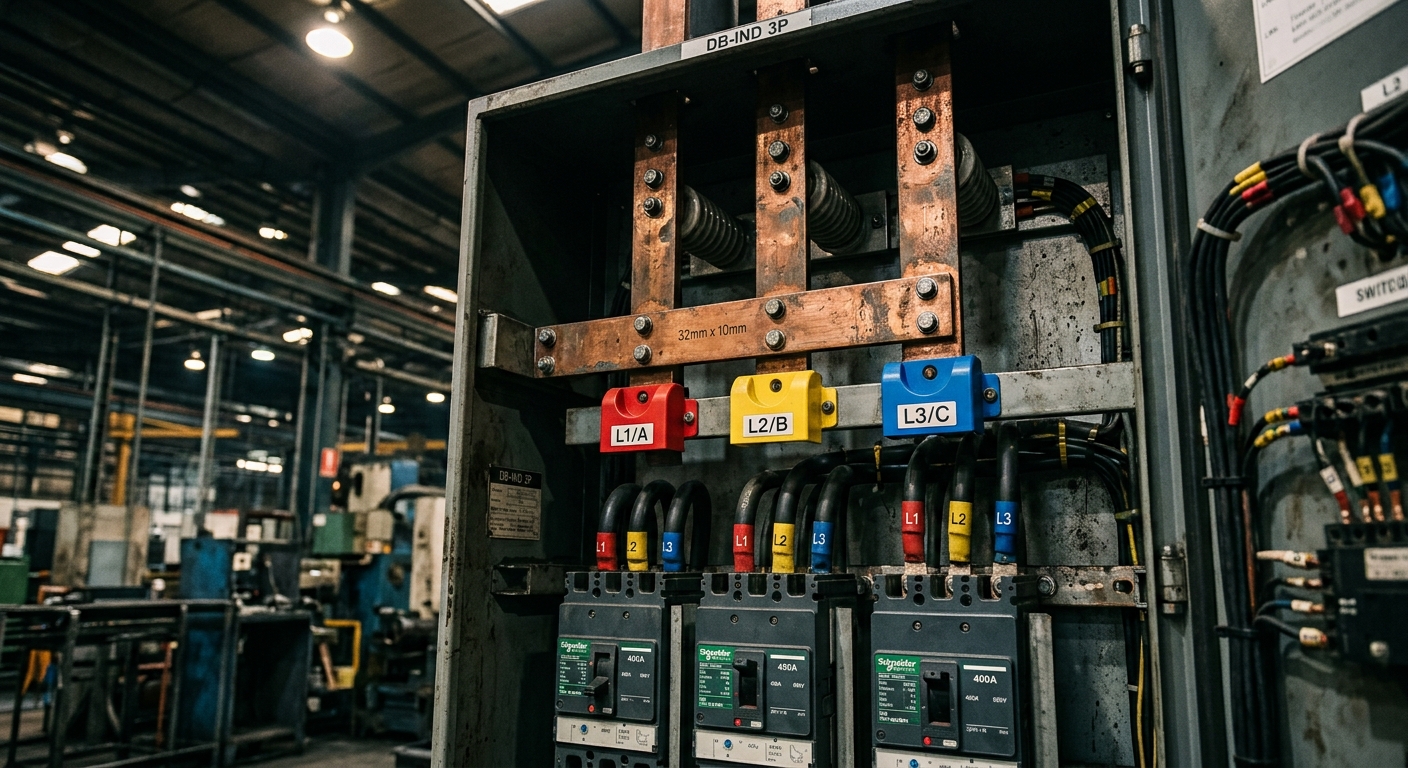
It’s rarely the utility feed itself. More often it’s site wiring — a depot with several single-phase loads (lighting, HVAC, office loads) unevenly distributed across the three phases feeding the same panel as the DC chargers. This is a known headache for teams designing overnight depot charging for large vehicle fleets, where dozens of loads share infrastructure and small imbalances compound across the site.
Three-phase electrical panel showing phase distribution for DC charger feed
Harmonic Distortion: When Neighboring Equipment Poisons Your Charger’s Input
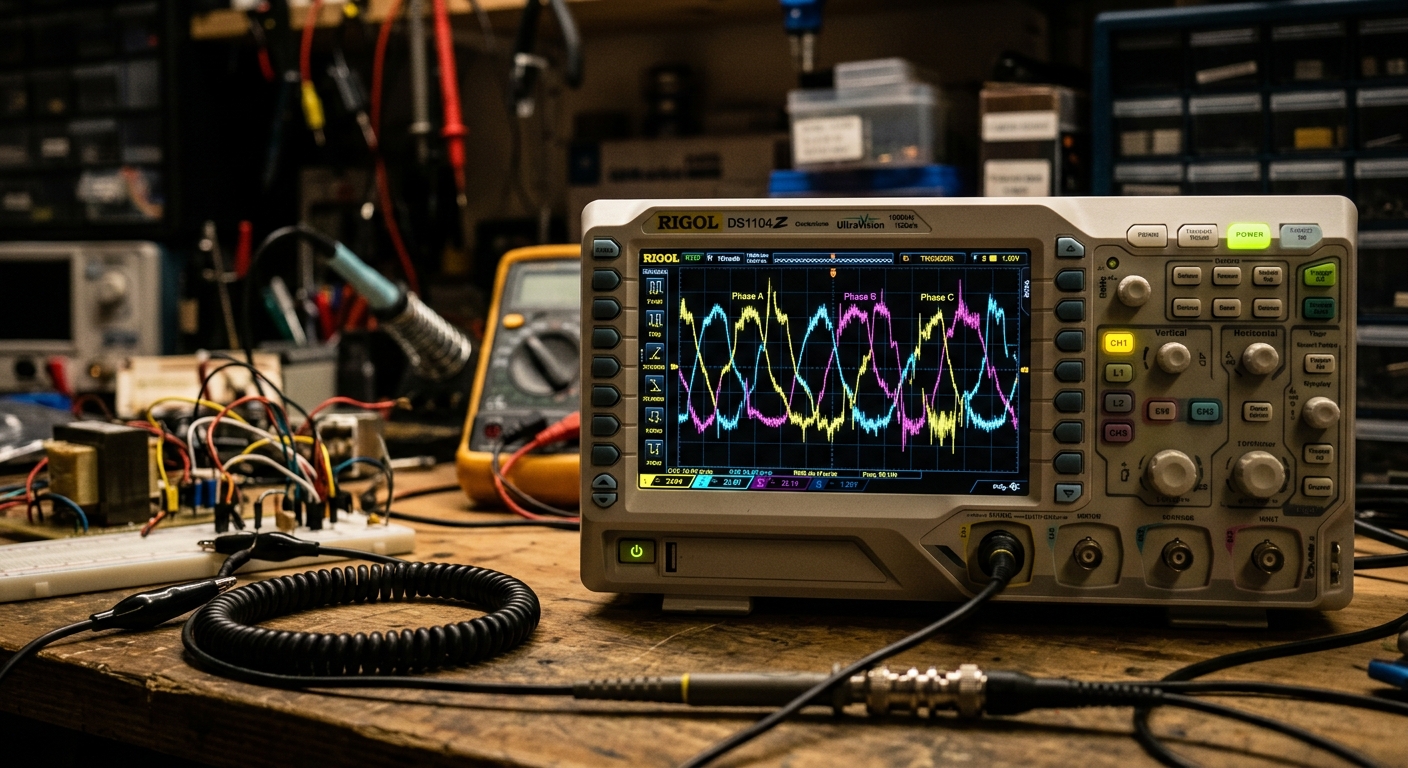
DC fast chargers are non-linear loads — they draw current in pulses, not smooth sine waves. So are variable frequency drives, other chargers, and large UPS systems. Put several of these on the same feeder and you get harmonic currents that circulate back and forth, stressing everything connected to that bus.
Total harmonic distortion (THD) above 5% on the voltage waveform starts to matter. Above 8%, you’re in real risk territory. Harmonics generate additional heat in transformer windings and input filter chokes — heat the charger’s thermal management wasn’t designed to dissipate, because it was designed assuming a clean sine wave input. Third-harmonic currents are especially troublesome because they add up in the neutral conductor instead of canceling out, which brings us to a separate but related problem.
A Real-World Case
A logistics hub running six 240 kW chargers alongside a bank of forklift battery chargers on the same substation started seeing premature EMI filter failures — roughly every 14 months instead of the expected 5+ years. A power quality audit found THD at 11% on that feeder, driven by the switch-mode forklift chargers. The fix wasn’t replacing the DC fast chargers; it was adding a harmonic filter at the substation level and separating the forklift charging circuit, similar to load-planning principles covered in our guide on matching DC chargers to warehouse duty cycles.
Oscilloscope showing distorted three-phase current waveform from harmonic distortion
Neutral Shift and Grounding Faults: The Problem That Confuses Everyone
Neutral shift happens when the neutral conductor’s connection to the transformer or ground reference degrades — through corrosion, a loose lug, or a poorly sized neutral in an unbalanced system. The result is a floating or offset neutral voltage that throws off every voltage reference the charger’s control board relies on.
This is one of the trickiest issues to diagnose because it doesn’t look like a power problem at all. It looks like a communication error, a random reboot, or a sensor reading that drifts for no reason. We’ve covered the communication-error symptoms in detail in why your EV charger keeps throwing communication errors — and a meaningful share of the “unexplained” cases we’ve seen trace back to a shifted neutral, not a software bug.
Why This Matters More for Outdoor Installations
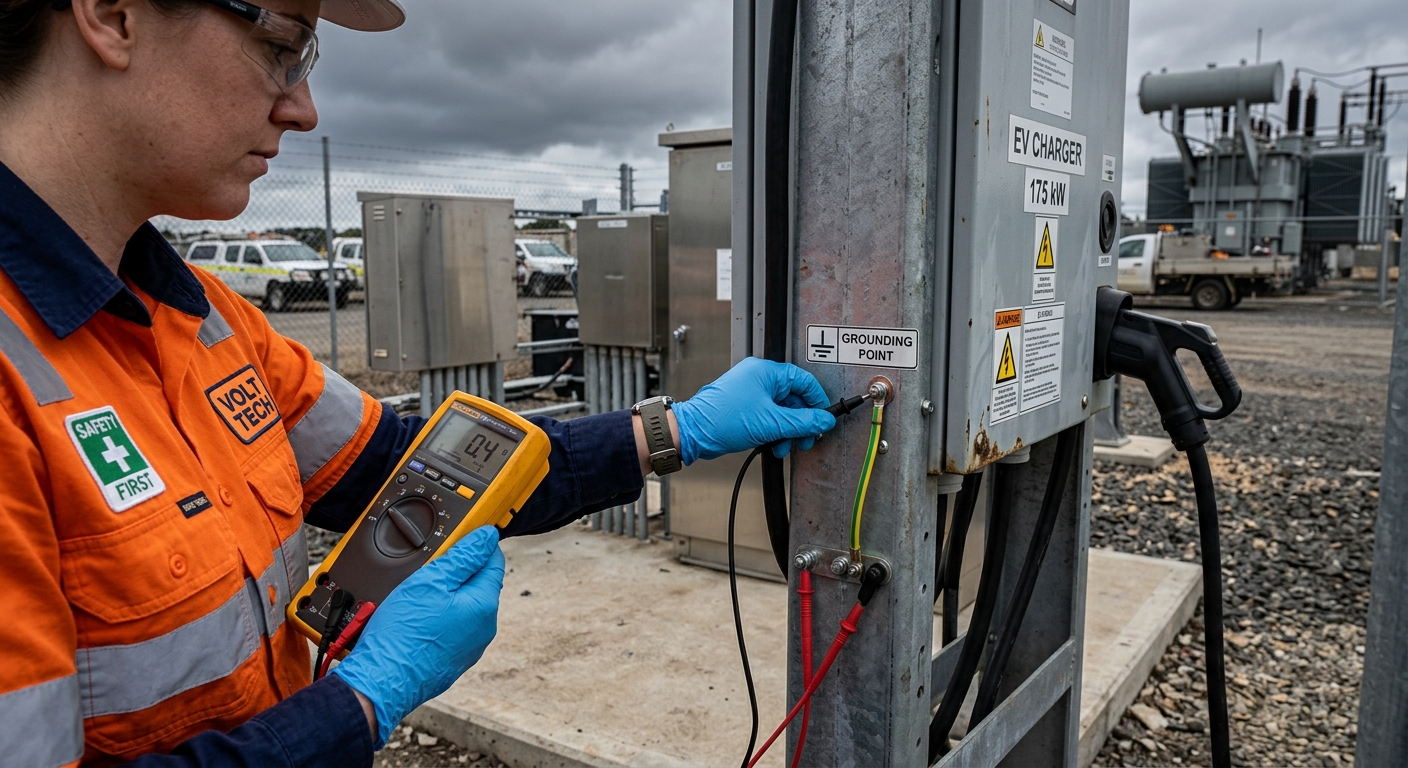
Outdoor DC chargers exposed to moisture and thermal cycling see grounding connections degrade faster than indoor units. Combine that with the wiring pitfalls discussed in ground fault errors and the wiring mistakes behind them, and you get a picture of why outdoor sites need more frequent grounding inspections than the charger’s own maintenance manual typically recommends.
Technician testing grounding connection on outdoor EV charger enclosure
Voltage Sags and Swells: The Grid Events You Never See Logged
A voltage sag lasting even 100 milliseconds — caused by a nearby motor starting, a utility switching event, or a fault clearing elsewhere on the grid — can cause a DC charger’s power modules to briefly draw excess current trying to maintain output. Do this a few hundred times a year, and you’re accumulating thermal cycling stress on IGBTs that eventually shows up as premature module failure, often flagged incorrectly as a manufacturing defect.
Most sites don’t log these events because standard charger diagnostics aren’t built for power quality monitoring — they’re built for charging session data. This is exactly the kind of hidden stressor that separates chargers that last 8+ years from ones that need module replacement at year 3, a distinction we explore further in the hidden cost of cheap EV chargers.
How Power Quality Interacts With Load Balancing Design
Here’s a connection most site designers miss: poor load balancing doesn’t just risk oversizing your transformer — it actively worsens phase imbalance. If your dynamic power sharing algorithm shifts current between chargers without accounting for phase-level distribution, you can create transient imbalances every time vehicles arrive or leave a charging bay.
Well-designed systems monitor per-phase current, not just total site load. This is a core principle in load balancing and dynamic power sharing — and it’s worth asking your equipment vendor directly whether their power sharing logic is phase-aware or just aggregate-aware. The difference shows up years later as capacitor and diode wear, not as an immediate fault.
What Actually Protects a Charger’s Power Stage
You can’t control utility-side power quality, but you can design the installation to absorb its punches. A few measures make an outsized difference:
Dedicated feeders for DC fast chargers, separated from variable-load equipment like HVAC compressors or welding equipment.
Active harmonic filters at the panel level when THD consistently exceeds 5%, rather than relying on the charger’s built-in passive filtering alone.
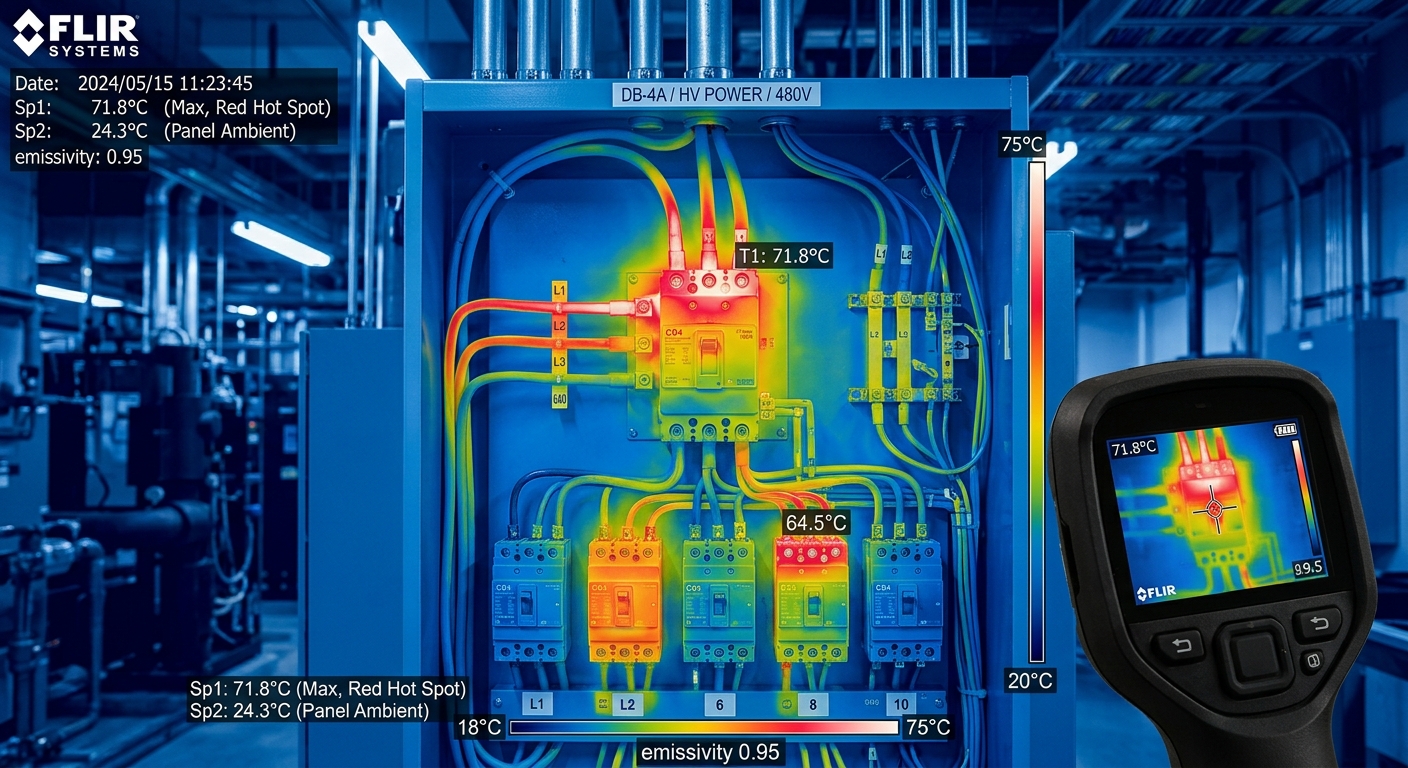
Annual thermal imaging of panel connections and neutral bonds — most neutral degradation shows up as a hot spot long before it causes a fault code.
Phase current logging as part of routine maintenance, not just voltage checks. Imbalance in current matters more than imbalance in voltage.
For teams specifying new installations, it’s worth putting these requirements directly into the procurement documents — our RFP procurement checklist for fleet and site operators covers where power quality clauses should sit in a technical spec.
Thermal imaging scan of electrical panel connections showing heat buildup
Why Some Chargers Handle Bad Power Better Than Others
Not every DC fast charger responds to poor power quality the same way. The difference usually comes down to the front-end rectifier and filter design — a topic we go deep on in power module architecture and reliability. Chargers with active front-end (AFE) rectification and higher-rated DC bus capacitors tolerate imbalance and harmonics far better than budget units running passive rectification close to component limits.
For example, a distributor stocking chargers for sites in regions with known grid instability — parts of Southeast Asia and Latin America, for instance — should treat power quality tolerance as a specification line item, not an assumption. Asking manufacturers for their rated imbalance tolerance and THD immunity level is a fair, and increasingly necessary, procurement question.
Subscribe the newsletter to get updated to news and promotions
Cookies give you a personalized experience,Сookie files help us to enhance your experience using our website, simplify navigation, keep our website safe and assist in our marketing efforts. By clicking "Accept", you agree to the storing of cookies on your device for these purposes. Click "Adjust" to adjust your cookie preferences.For more information, review our Cookie Policy