Load Balancing and Dynamic Power Sharing: How to Avoid Oversizing Your Site Transformer
Home / Blog / Guidelines / Load Balancing and Dynamic Power Sharing: How to Avoid Oversizing Your Site Transformer
02 Jun, 2026
EV charging load management
power sharing EV chargers
site transformer sizing
You almost never need to oversize your transformer for EV charging — you need to manage the load you already have. Dynamic power sharing allocates available amperage across chargers in real time based on actual building demand, letting a 400 kVA service support what might otherwise demand 800 kVA of new capacity. The trick is knowing how to configure it, what hardware to specify, and where the engineering traps hide.
Why Transformer Oversizing Is the Default Mistake
Walk onto most new charging sites and you'll see the same pattern: an electrical consultant added up the nameplate kW of every charger, applied a 1.25 NEC multiplier, and quoted a transformer twice the size of what's actually needed. The result? A six-figure utility upgrade and a transformer that runs at 30% load for its entire service life.
The reason is simple — nameplate ratings assume every charger runs at full power simultaneously, forever. In reality, EV charging is wildly non-coincident. A 10-stall depot might see peak simultaneous draw of 60% of nameplate on its busiest hour, and average 25% over a 24-hour cycle. Sizing for the worst-case theoretical condition wastes capital that could fund 3–4 additional chargers instead.
Dynamic load management flips the logic. Instead of oversizing the supply to match dumb hardware, you make the hardware smart enough to live within the supply you have.
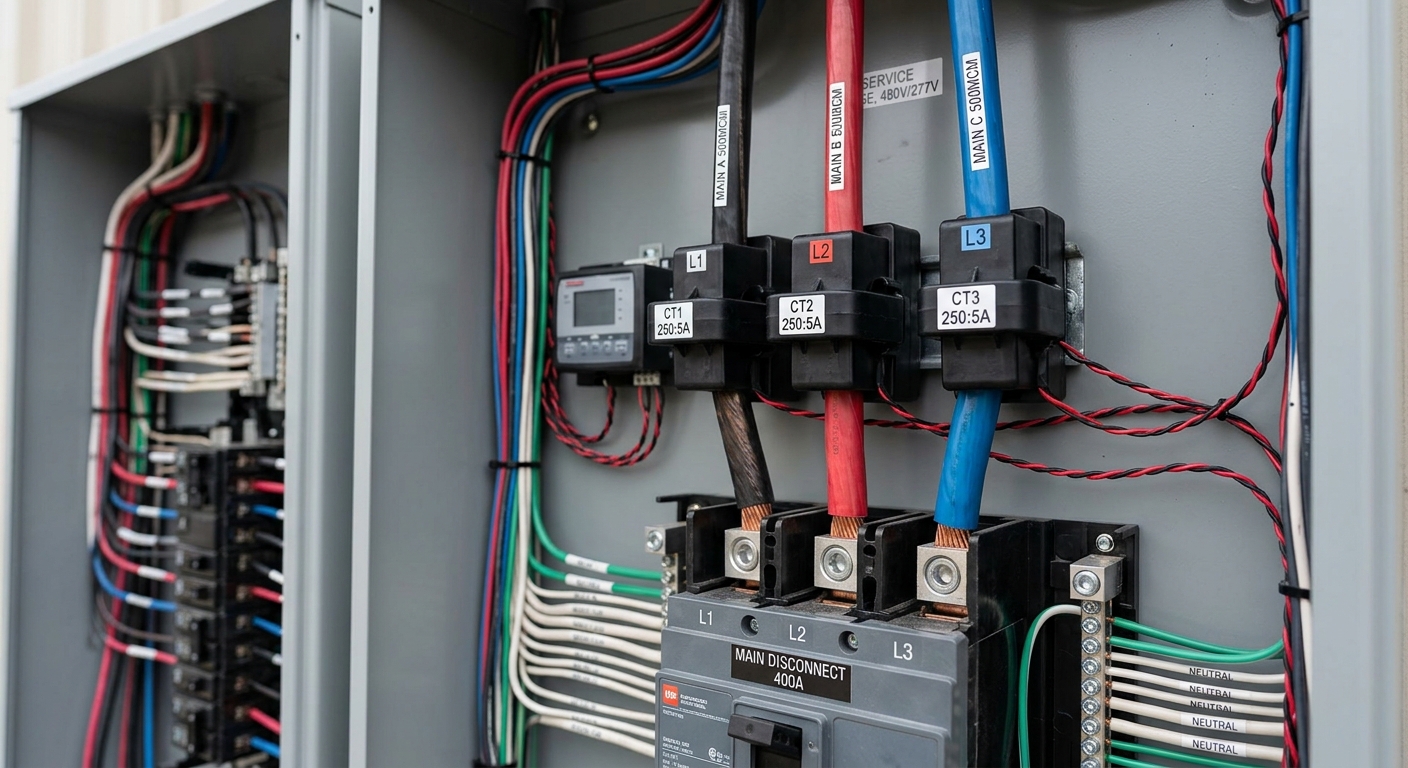
Current transformer clamps installed on main electrical feeders
Static vs. Dynamic Load Balancing: Know the Difference
These two terms get used interchangeably, but they solve very different problems.
Static load balancing
A fixed ceiling is programmed into the charger group — say, 200 A across eight chargers. The group will never exceed that cap, but it has no idea what the rest of the building is doing. If the HVAC kicks on and the main panel is already at 350 A of a 400 A service, static balancing won't care. You'll trip the main.
Dynamic load balancing
A current transformer (CT) clamps on the service main and reports actual building consumption to the charger controller every 1–5 seconds. The charger group is given whatever headroom remains. When the HVAC starts, the charger group throttles down within milliseconds. When a tenant shuts off for the night, chargers ramp up.
For any site with mixed loads — retail, office, warehouse with production — dynamic is the only defensible choice. Static works only when the chargers have a dedicated circuit with nothing else on it.
The Math: How Much Transformer Can You Really Save?
Let's run real numbers. Imagine a logistics hub wanting to install 12× 22 kW AC chargers for a light-duty van fleet. Nameplate total: 264 kW, or roughly 380 A at 400 V three-phase.
Without load management: You'd size for 380 A plus 25% margin = 475 A dedicated EV service. Likely a new 500 kVA transformer and a utility upgrade.
With dynamic load balancing set to 150 A EV headroom: The 12 chargers share 150 A. Each van still gets 11–22 kW depending on how many others are plugged in. Over an 8-hour overnight window, every van still reaches full charge.
The transformer upgrade disappears entirely. The site uses its existing 250 kVA service and saves an estimated $80,000–$140,000 in utility contribution fees, feeder cable, and switchgear. The only added cost is roughly $1,500–$3,000 for the CT meter and smart controller.
This same principle is why thoughtful EV charging station design always starts with a load study — not a product catalog.
How Power Sharing Allocates Amps Between Chargers
Once the controller knows how much total current is available, it has to divide it among active sessions. Three algorithms dominate the market:
Equal split
The simplest: available current ÷ number of active chargers. If 150 A is free and 6 cars are plugged in, each gets 25 A. When one finishes, the remaining five each jump to 30 A. Predictable, fair, and works for most depot scenarios.
Priority-based
Certain ports (say, shift-critical delivery vans) are flagged high-priority and get full power first; lower-priority sessions absorb whatever is left. Useful when not all vehicles need to be ready at the same time.
State-of-charge aware
The charger communicates with the vehicle (via ISO 15118 or OCPP smart charging profiles) to see battery SOC and departure time. A van at 20% SOC leaving in 2 hours gets prioritized over a van at 80% SOC leaving in 10 hours. This is the most efficient but requires OCPP 2.0.1-capable back-end logic.
For most commercial and fleet operators, starting with equal split and layering priority rules as the operation matures is the pragmatic path.
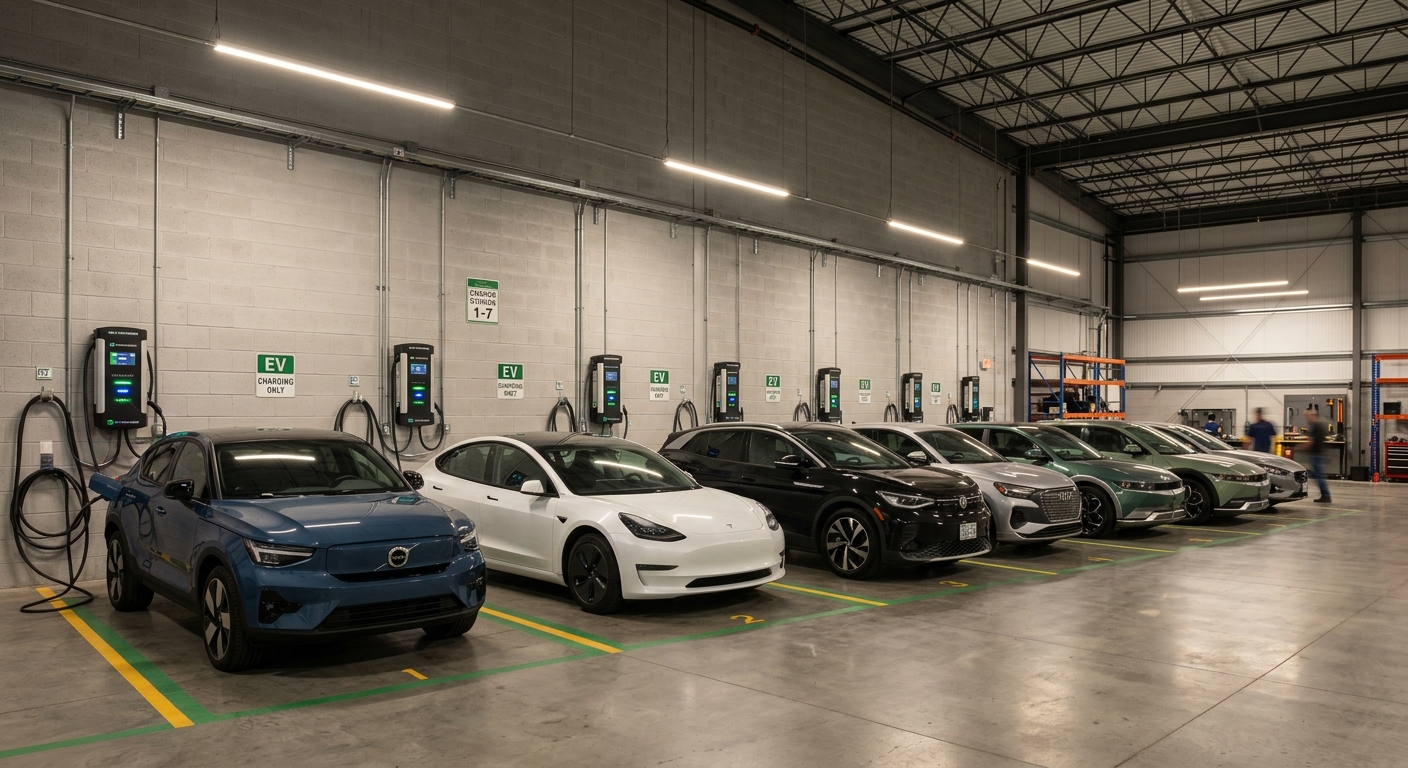
Multiple AC EV chargers sharing power in an industrial charging bay
Communication Protocols That Make It Work
Load balancing only works if chargers, meters, and the site controller actually talk to each other reliably. The three protocols you'll encounter:
Modbus RTU/TCP — the workhorse for reading CT meters and legacy switchgear. Deterministic and simple.
OCPP 1.6J with smart charging profile — the most widely deployed protocol for charger-side allocation. Sufficient for 80% of projects.
OCPP 2.0.1 — adds improved smart charging schedules, local authorization lists, and ISO 15118 plug-and-charge. Worth specifying on new builds with complex tariff or V2G plans.
The gotcha: not every charger claiming “OCPP support” actually implements the smart charging profile fully. When evaluating suppliers, ask for the OCPP compliance certificate and test the SetChargingProfile command before you buy at scale. This is one of the unglamorous but critical points covered in our guide to choosing the right EV charger suppliers.
Real-World Example: A Cold-Storage Warehouse Retrofit
A cold-storage operator in the Netherlands came to us planning to add 16 forklift chargers and 8 van chargers to a facility already running at 78% of its 630 kVA transformer during daytime refrigeration peaks. The initial electrical consultant had quoted a second 400 kVA transformer plus a new medium-voltage feeder — a €185,000 project.
Instead, we deployed dynamic load balancing with two independent CT groups: one for the forklift charging bay and one for the van chargers. The forklift group was capped at 80 A during production hours (10:00–18:00) and released to 180 A overnight when refrigeration demand dropped. The van chargers were given priority from 19:00 onward based on next-day dispatch schedules.
Total cost of the DLM rollout: roughly €7,000 in controllers, CTs, and commissioning. Transformer upgrade avoided entirely. All 24 charging points operational, and peak service utilization never exceeds 92%. The same philosophy applies whether you're charging forklifts in a busy warehouse or a mixed fleet of delivery vans.
Electric forklifts charging inside a cold-storage warehouse
Where Dynamic Load Balancing Breaks Down
It's not a silver bullet. Three conditions defeat it, and you need to know them before selling a client on the approach.
Insufficient minimum charge rate
Most EVs won't accept below 6 A (roughly 1.4 kW on single phase). If you have 20 chargers sharing 100 A, the moment all 20 are active, each wants 5 A — below the minimum. Good controllers handle this by rotating sessions on and off in a queue. Cheap controllers just stall the group.
DC fast charging sites with short dwell times
A DC fast charging hub with 5–20 minute sessions has almost no time to redistribute load. If two 180 kW dispensers are both ramping to peak during a 10-minute window, you need either the transformer capacity or on-site battery buffering. Load balancing alone won't save you.
Unstable grid voltage
If the upstream utility voltage sags under load, the controller may misinterpret the sag as headroom disappearing and throttle unnecessarily. Voltage-based dispatch logic should always be backed by current-based measurement.
Specification Checklist When You Buy
When you're specifying a charging system with dynamic load management, your RFP should explicitly call out:
CT accuracy class (0.5 or better for billing-grade systems)
Response time from load change to charger throttle (target: under 2 seconds)
Fallback behavior if the CT link fails (charger should default to a safe fixed limit, not full power)
OCPP version and smart charging profile compliance
Maximum number of chargers per controller group (typically 16–32)
Support for multi-phase load balancing — critical in European 3-phase installations where phase imbalance can trip the main even when total kW looks fine
That last point trips up more installations than any other. A single-phase EV charger on L1 can overload one phase while L2 and L3 sit idle. True dynamic load balancing tracks per-phase current, not just total kW.
Putting It All Together
The correct mental model: your transformer is a bank account, and every load in the building is making withdrawals. Dumb chargers withdraw their full balance the moment they're plugged in. Smart chargers check the balance first, take what's available, and release it when other loads need it. Over a year, the difference is a six-figure capital savings and a site that actually scales as your fleet grows.
If you're planning new charging infrastructure, start with a week of 15-minute interval data from your existing service. That single dataset will tell you exactly how much unused capacity you already have — and usually it's a lot more than the nameplate math suggests.
evaisun designs OEM and ODM charging hardware with native dynamic load management and OCPP 1.6/2.0.1 smart charging support across AC and DC platforms. If you're scoping a site and want a second opinion on transformer sizing, browse our technical blog or reach out to our engineering team — we'd rather save you the upgrade than sell you more chargers than you need.
Subscribe the newsletter to get updated to news and promotions
Cookies give you a personalized experience,Сookie files help us to enhance your experience using our website, simplify navigation, keep our website safe and assist in our marketing efforts. By clicking "Accept", you agree to the storing of cookies on your device for these purposes. Click "Adjust" to adjust your cookie preferences.For more information, review our Cookie Policy