Home / Blog / Guidelines / Industrial Lithium Battery Charger Selection Guide: Voltage, BMS & Duty Cycle
24 Nov, 2026
AGV charger
BMS CAN communication
Forklift Battery Charger
industrial lithium battery charger
material handling
Introduction
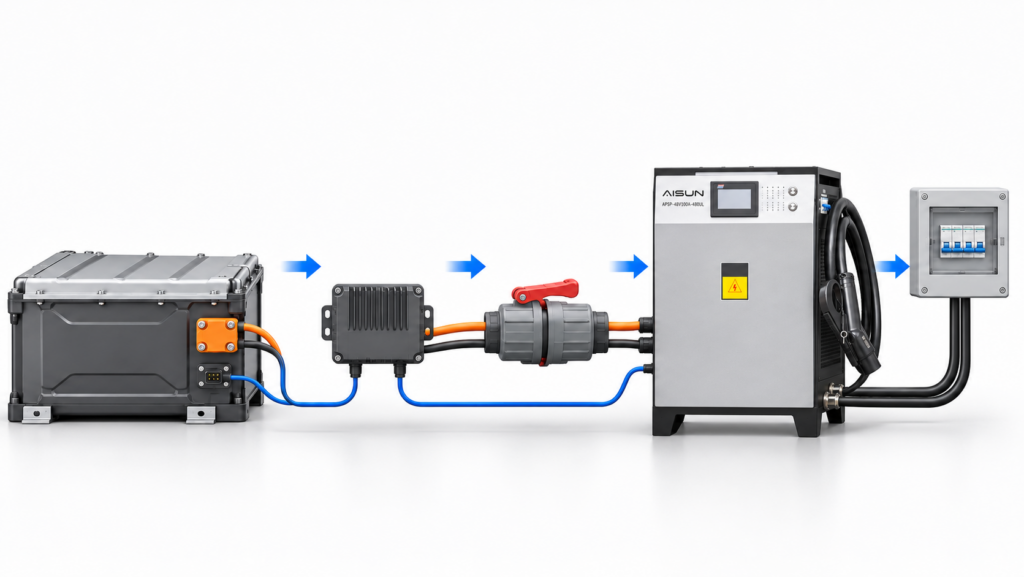
Choosing an industrial lithium battery charger is not simply a matter of matching the nominal battery voltage. For forklifts, AGVs, AMRs and other material-handling equipment, the charger must work with the battery management system (BMS), the vehicle connection method, the available site power and the real operating schedule.
The right configuration helps a project team plan reliable charging without selecting more power, more charging points or more site infrastructure than the operation actually needs. This guide explains the information to confirm before comparing an industrial lithium battery charger or requesting a project quotation.
Quick answer: Start with the battery chemistry, nominal voltage, permitted charging voltage and maximum current. Then verify BMS/CAN communication, the connector or docking interface, available AC input, charging windows and required vehicle uptime.
1. Start with the battery system, not the charger label
The battery defines the charging profile. A charger must be configured around the battery’s permitted limits rather than selected from voltage alone.
Before selecting a charger, record:
Battery chemistry and battery manufacturer
Nominal voltage and permitted charging-voltage range
Battery capacity in Ah and usable energy in kWh
Maximum permitted charging current
BMS communication requirements and available protocol documentation
Temperature limits and battery-side restrictions
A battery marked as 48V, for example, still needs its charge-voltage range, current limit and BMS logic checked. Two battery packs with the same nominal voltage may not accept the same charging configuration.
2. Match charger output to the real duty cycle
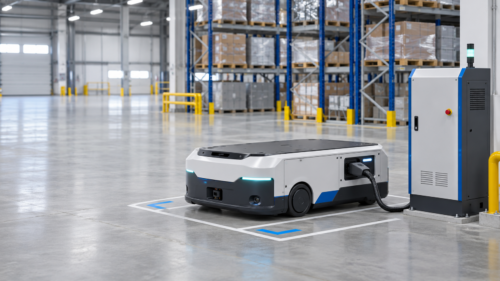
Charger output should reflect how the vehicle works, not only the highest output rating available. A forklift used during one shift with a long overnight charging window requires a different approach from an AGV that receives short opportunity charges throughout the day.
Document the number of vehicles, operating shifts, daily energy use, expected state of charge, available charging windows and acceptable downtime. These factors help determine whether the project needs one charger per vehicle, shared charging points or a phased expansion plan.
A useful planning question is: how much energy must each vehicle receive during its actual charging window? The answer should be checked against battery acceptance limits, site capacity and the vehicle’s required availability.
3. Confirm BMS and CAN communication requirements
Lithium battery systems commonly use a BMS to manage current limits, temperature protection, fault conditions and charge completion. Where communication is required, the charger and battery must use compatible hardware, connector pinout and protocol settings.
Confirm the following with the battery and vehicle supplier:
Whether CAN communication is required, optional or not used
Required protocol, message definitions and bitrate
Connector and pinout information
Charging-enable, fault and emergency-stop logic
A commissioning test procedure for the selected battery and charger
Do not assume that matching voltage and current ratings guarantee compatibility. The communication handshake and protection logic must be validated for the specific vehicle and battery system.
4. Choose the connection method around the workflow
AGV charging interfaces commonly include manual industrial connectors, vehicle-side charging sockets aThe charging interface affects safety, uptime and maintenance. Manual industrial connectors can suit scheduled charging and straightforward service access. Vehicle-side sockets, automated contact charging or docking interfaces may suit operations that require frequent, repeatable charging without an operator connecting a plug.
For an automated workflow, provide vehicle drawings or photos that show the charging position, available space, approach direction and expected connection cycles. For manual charging, confirm the connector type, current rating, cable length, keying and operator-access requirements.
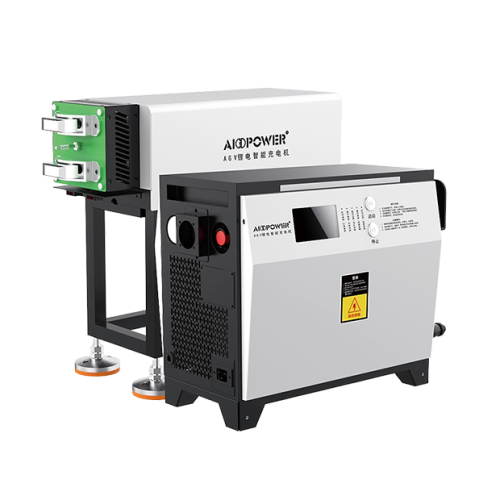
Projects using automatic charging can also review the AGV and AMR lithium battery charger configuration with the vehicle’s docking and BMS requirements in mind.
5. Check site electrical input before finalizing the charger
The charging system must fit the site electrical supply as well as the AGV battery. Confirm available input voltage, phase arrangement, service capacity, protection devices and cable routing before finalizing a chAn industrial lithium battery charger also has to fit the site. Confirm the available AC voltage, frequency, phase arrangement, distribution-board capacity, protection devices and cable route before a final configuration is selected.
For larger fleets, it is useful to plan the charging layout together with the site’s electrical design. The project team can then evaluate staged expansion, site metering and any project-specific energy-management requirement before installation begins.
The industrial battery chargers product range provides an overview of applications and voltage options; final suitability should be confirmed against the battery, vehicle and site details.
6. Prepare a clear request-for-quotation package
A complete RFQ reduces avoidable back-and-forth and makes technical evaluation more accurate. Include:
Vehicle type, fleet quantity and operating schedule
Battery datasheet and BMS/CAN documentation
Target charging time or available charging window
Connector or docking drawings and photos
Available AC input and installation conditions
Required standards, documentation and regional market requirements
This information allows the charger supplier to review compatibility before a configuration is proposed.
FAQ: Industrial Lithium Battery Chargers
How do I choose the right voltage for an industrial lithium battery charger?
Start with the battery manufacturer’s nominal voltage and permitted charging-voltage range. The final charger configuration must also match the battery’s BMS limits and approved charging profile.
Can one industrial charger work with every lithium battery?
No. Battery chemistry, permitted voltage and current, BMS protocol, connector arrangement and charging logic must be checked for each selected battery and vehicle system.
What information is needed before requesting an AGV or forklift charger?
Prepare the battery chemistry, voltage, capacity, current limit, BMS/CAN requirements, vehicle charging position, connector or docking details, AC input and operating duty cycle. For AGV projects, use the AGV battery charger selection checklist to organize the information.
Conclusion
An industrial lithium battery charger should be selected as part of the complete vehicle, battery and site system. Confirm battery limits, communication, connection method, site power and duty cycle before comparing products. This approach improves technical fit and gives project teams a clearer basis for charging-system planning.
Subscribe the newsletter to get updated to news and promotions
Cookies give you a personalized experience,Сookie files help us to enhance your experience using our website, simplify navigation, keep our website safe and assist in our marketing efforts. By clicking "Accept", you agree to the storing of cookies on your device for these purposes. Click "Adjust" to adjust your cookie preferences.For more information, review our Cookie Policy