How to Read a DC Charger Datasheet Without Getting Misled by Marketing Numbers
Home / Blog / Guidelines / How to Read a DC Charger Datasheet Without Getting Misled by Marketing Numbers
10 Oct, 2026
charger datasheet marketing numbers
DC fast charger power rating
EV charger specifications
how to read charger specs
The fastest way to get misled by a DC charger datasheet is to trust the single biggest number on the cover page. That 360 kW, 96% efficiency, or -30°C rating is almost always a best-case figure measured under conditions your site will rarely replicate. Read a datasheet properly and you’ll find the real story buried three pages deep — in derating curves, footnotes, and test conditions that the marketing summary conveniently leaves out.
The Power Rating Is a Ceiling, Not a Promise
A charger labeled 240 kW doesn’t deliver 240 kW to your vehicle most of the time. That number is the theoretical maximum output under optimal voltage matching, ambient temperature, and grid conditions — a scenario that happens maybe 10% of the time in real operations.
What actually determines delivered power is the vehicle’s battery management system, its state of charge, and the charger’s power curve at that specific voltage. A truck battery sitting at 80% state of charge might only accept 60 kW regardless of what the charger can push. If the datasheet doesn’t include a power-vs-voltage curve, ask for one before you commit to a spec sheet number.
We’ve covered this exact trap in detail in why distributors should stop comparing chargers by kW alone — the short version is that two 180 kW chargers from different manufacturers can deliver meaningfully different real-world charging sessions.
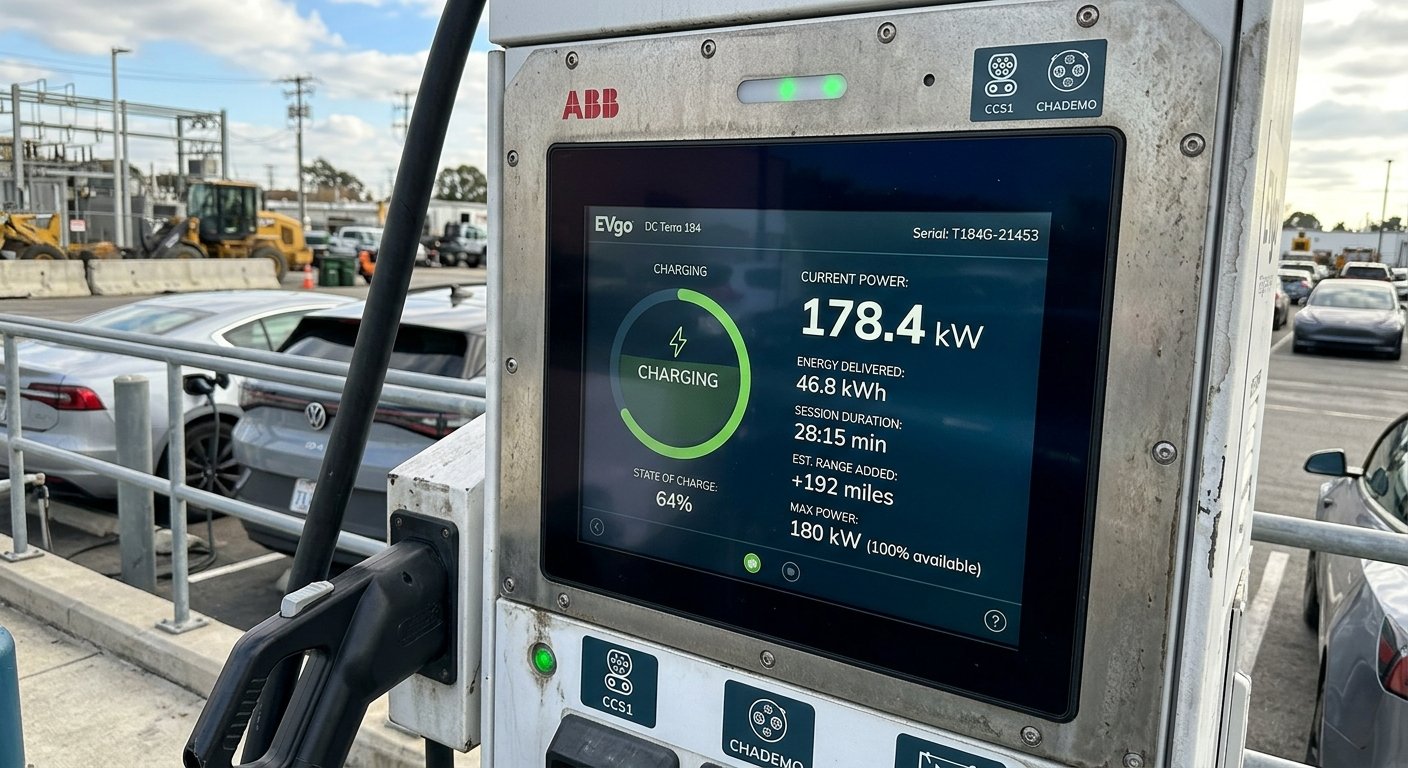
DC fast charger display showing real-time power output data
Efficiency Percentages Hide the Partial-Load Problem
A 96% efficiency rating almost always refers to full-load performance — the single condition where power electronics run most efficiently. Drop to 30% load, which is extremely common in real depot operations with mixed vehicle sizes, and efficiency can fall to 85% or lower depending on the topology.
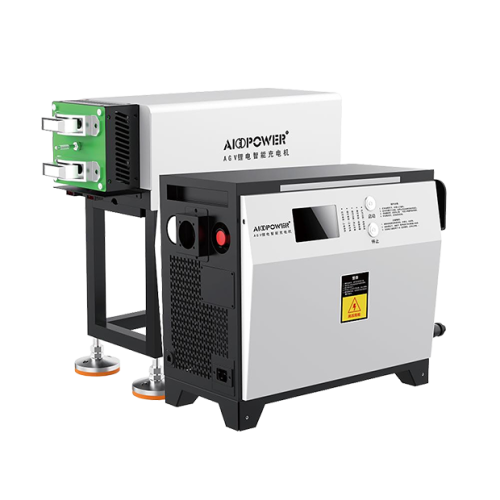
That gap matters financially. On a site running chargers at partial load for most of the day — think forklift fleets or AGV charging bays where battery packs are smaller — a 10-point efficiency drop translates directly into wasted electricity costs over a multi-year contract. We go deep into this exact issue in why your DC charger’s efficiency curve matters at partial load.
What to ask the supplier
Request the efficiency curve across 20%, 50%, 80%, and 100% load — not just the peak number
Ask which topology (modular vs. monolithic) the rating is based on
Confirm whether the figure includes auxiliary loads like cooling fans and the control board
Operating Temperature Range vs. Rated Performance Range
Most datasheets list an operating temperature range — say, -30°C to 50°C — as if the charger performs identically across that entire span. It doesn’t. That range usually describes where the unit survives and functions, not where it hits its rated power output.
Dig into the derating table, usually a small chart on page 4 or 5, and you’ll often find the charger starts reducing output above 35-40°C ambient. For a site in Phoenix or Dubai running chargers in direct sun, that derating curve is far more relevant than the headline range. We’ve written extensively about this in why DC fast chargers derate in summer and the cold-climate equivalent in how cold climates break EV chargers.
For example, a logistics operator in Texas ordered chargers rated to 50°C, assuming full performance through summer. By July, afternoon output had dropped nearly 25% because the real derating point kicked in at 38°C — a detail buried in a footnote, not the summary spec box.
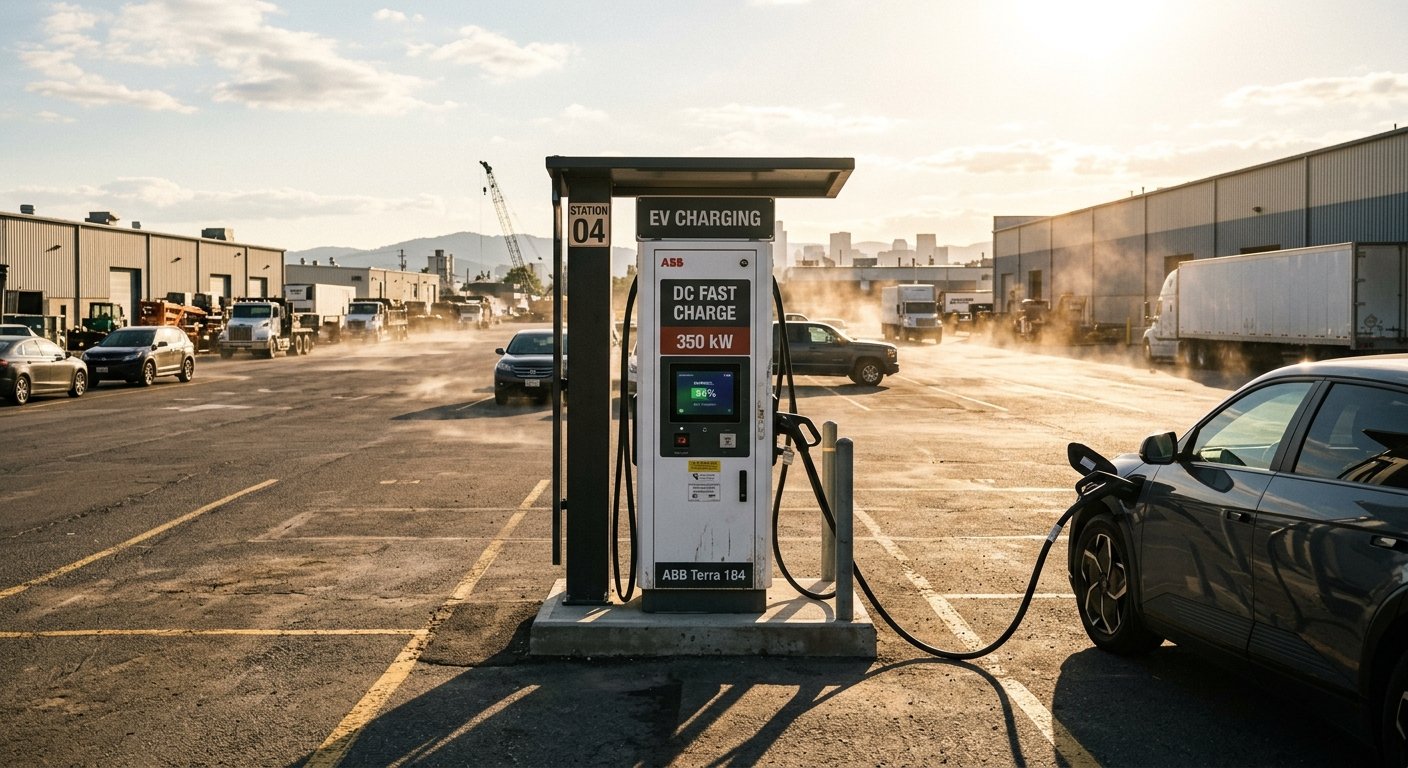
Outdoor DC EV charger operating under direct sunlight in a commercial lot
IP Ratings Tell You Less Than You Think
An IP55 or IP65 rating describes resistance to dust and water ingress at the moment of testing — nothing about long-term durability, UV exposure, or corrosion resistance over years of outdoor service. Two chargers can carry the same IP rating and age completely differently depending on enclosure material and gasket quality.
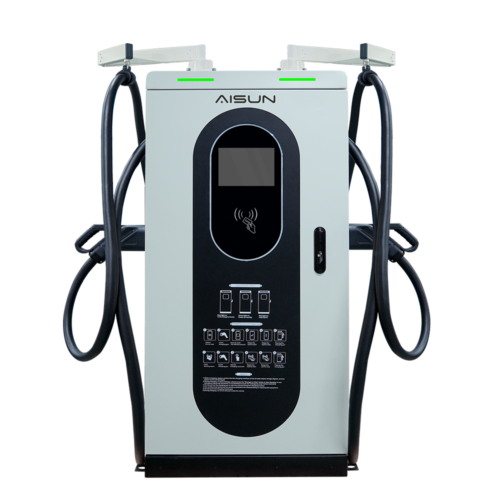
A dual-gun charger listed as 2×120 kW rarely delivers 120 kW to each vehicle simultaneously. In most architectures, the two connectors share a common power pool — so if one vehicle is pulling 100 kW, the second connector might be capped at 20-40 kW, not a clean split.
This matters enormously for fleet depot planning. If you’re sizing a site for overnight charging across 50+ vehicles, assuming full simultaneous power on every connector will leave you dramatically undersized. Ask the manufacturer for the dynamic power-sharing logic and whether it’s static split, first-come-first-served, or priority-based.
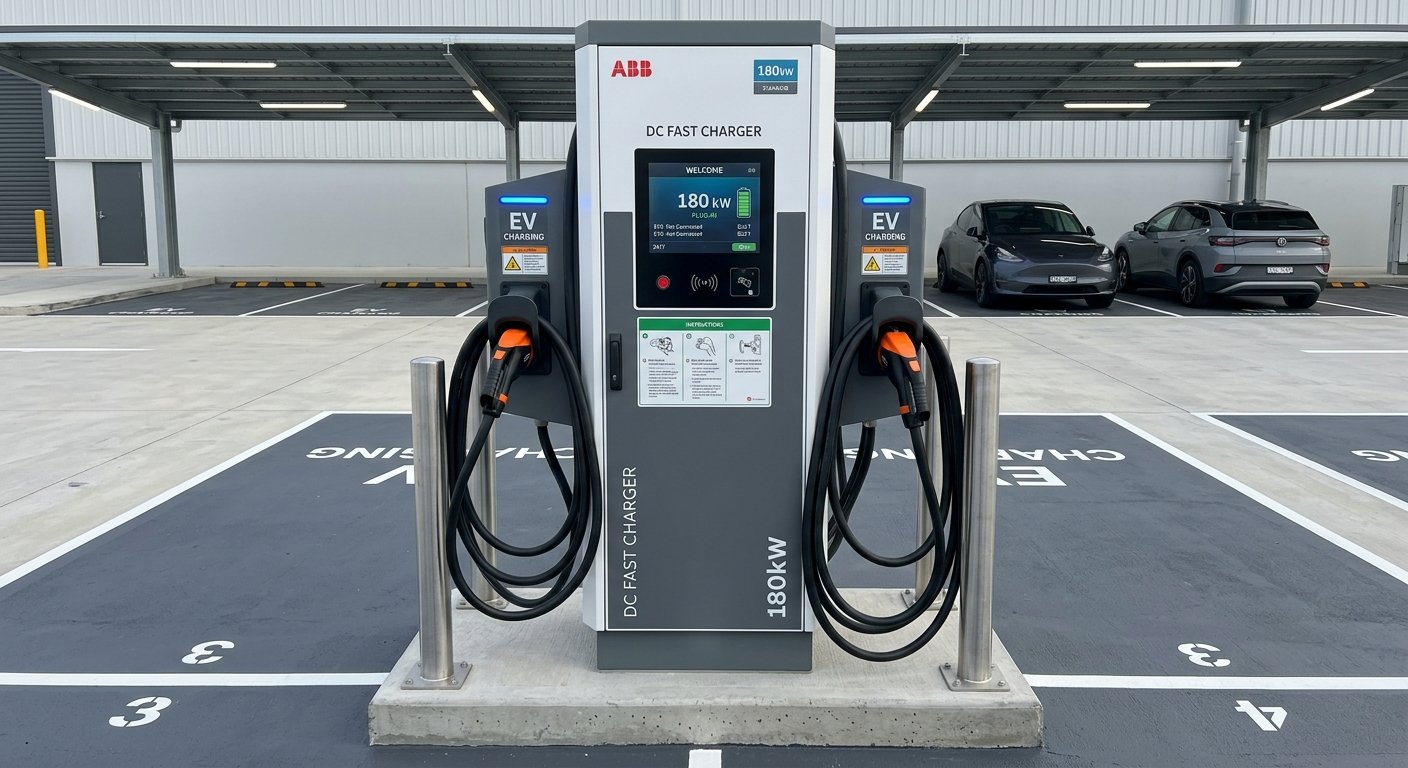
Dual-connector DC fast charger in an industrial charging bay
Certification Lists Without Context Are a Red Flag
Seeing a wall of certification logos — CE, UL, CQC, TUV — on a datasheet feels reassuring, but certifications vary enormously in scope. A UL listing might cover the enclosure’s electrical safety, not the communication protocol’s cybersecurity posture or OCPP compliance level.
Datasheets rarely include warranty terms at all — but when they do, a ‘3-year warranty’ line can mean wildly different things depending on what’s excluded. Power modules, cooling systems, and connector cables often carry separate, shorter warranty periods than the main unit.
Before trusting any spec sheet, run it through these questions:
Is the power rating given at a specific voltage, or as a flat peak number?
Does the efficiency figure include a partial-load curve, or just peak load?
Is there a temperature derating table separate from the operating range?
What exactly does the IP rating cover, and what’s the enclosure material?
If multi-connector, is power dynamically shared or fixed-split?
Which certifications apply to which subsystem — power stage, communication, or enclosure?
Is the warranty uniform across all components, or tiered?
If a supplier’s datasheet answers all seven without you having to ask, that’s usually a sign of an engineering-led company rather than a marketing-led one. For a broader procurement framework, our EV charger RFP procurement checklist walks through how to formalize these questions into a bid document.
Engineer reviewing a printed EV charger specification sheet with a clipboard
Subscribe the newsletter to get updated to news and promotions
Cookies give you a personalized experience,Сookie files help us to enhance your experience using our website, simplify navigation, keep our website safe and assist in our marketing efforts. By clicking "Accept", you agree to the storing of cookies on your device for these purposes. Click "Adjust" to adjust your cookie preferences.For more information, review our Cookie Policy