How Cold Climates Break EV Chargers: Heater Design and Startup Reliability Below -20°C
Home / Blog / Guidelines / How Cold Climates Break EV Chargers: Heater Design and Startup Reliability Below -20°C
28 Jul, 2026
cold weather EV charging
EV charger heater design
EV charger startup below -20C
low temperature charging failures
Most EV chargers that die in cold climates aren’t killed by the cold itself — they’re killed by design teams who tested at -10°C and called it done. Below -20°C, three things break in sequence: the display goes unresponsive, the internal relays hesitate or stick, and the vehicle’s own BMS refuses to accept current until the battery warms up. Fixing this isn’t about throwing a bigger heater at the problem — it’s about placing the right heat, at the right sensor point, at the right startup sequence.
Why -20°C Is the Real Threshold, Not -10°C
Charger datasheets love to quote a -30°C operating range, but that number is almost always a survival spec, not a functional one. There’s a big difference between a charger that survives -30°C sitting idle and one that can actually deliver 60A within two minutes of a driver plugging in at that temperature.
The inflection point for most components sits around -20°C. Above that, standard automotive-grade electronics behave predictably. Below it, liquid crystal displays slow to a crawl, electrolytic capacitors lose 15-30% of their rated capacitance, and mechanical relays — especially ones with any residual moisture in the housing — can physically stick closed or open. If your charger’s spec sheet doesn’t separate ‘-30°C storage’ from ‘-20°C operational startup,’ ask the manufacturer directly. It’s a red flag if they can’t.
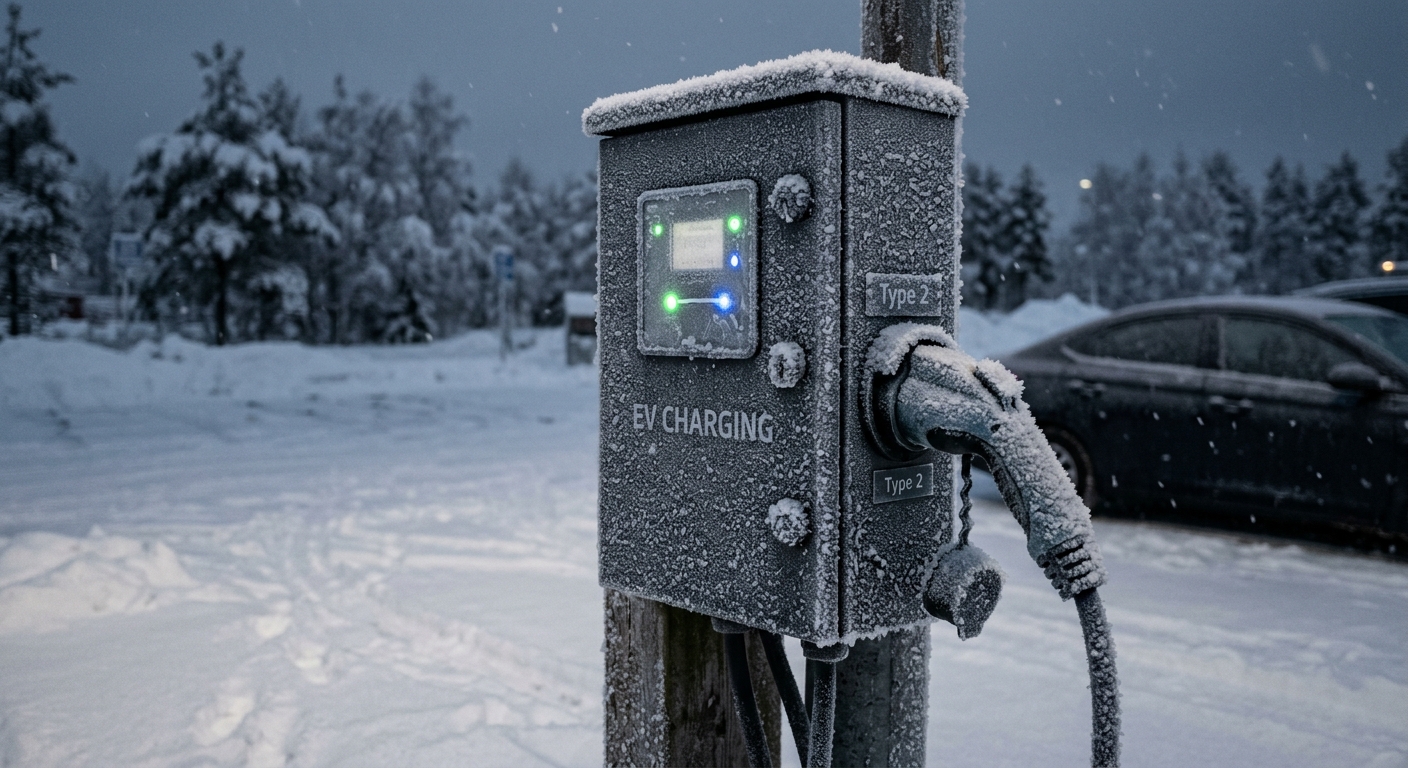
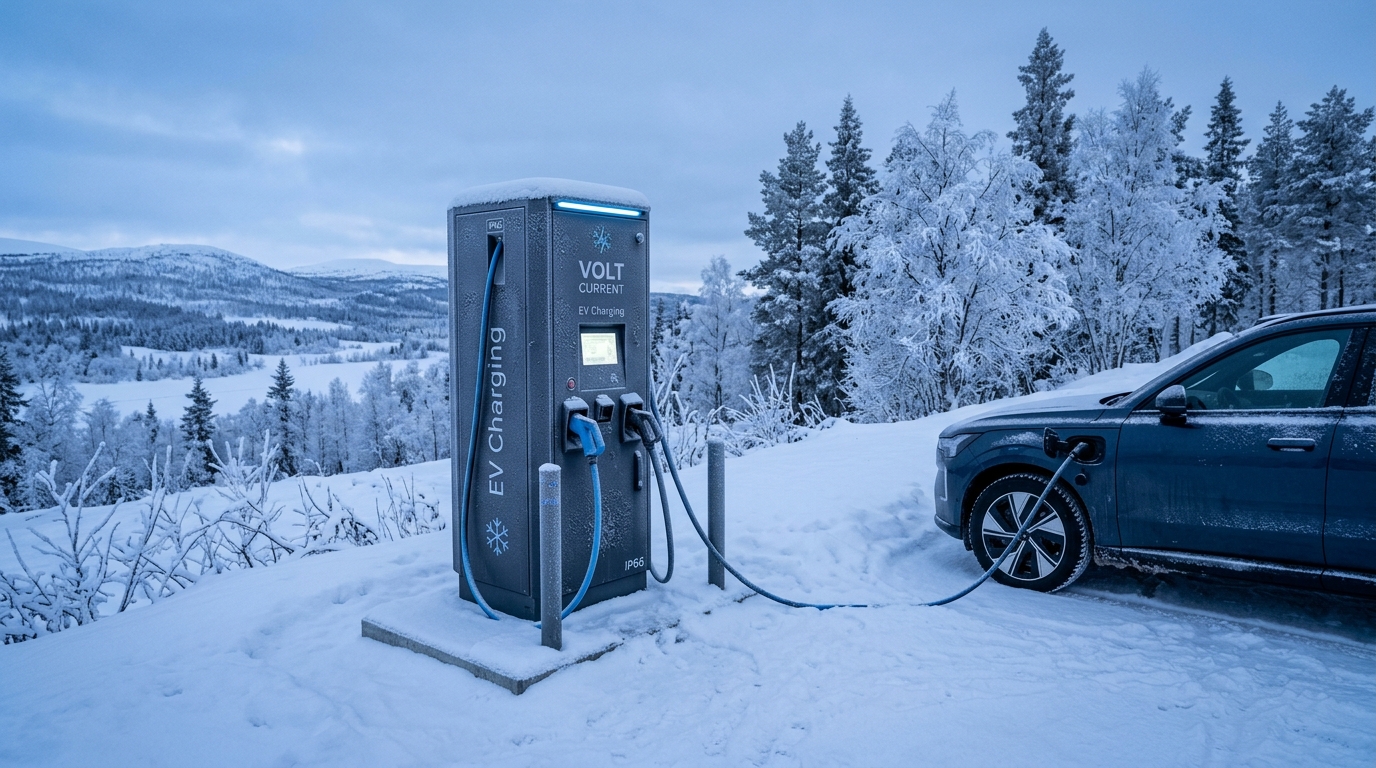
Frost accumulating on an outdoor EV charger housing in extreme cold
The Display Problem Nobody Talks About
Here’s a failure mode that rarely makes it into RFP requirements but causes real service calls: the LCD screen goes blank or unresponsive before anything else fails. Liquid crystal fluid becomes viscous in deep cold, and standard automotive touchscreens are rated to roughly -20°C for reliable touch response — below that, drivers see a frozen or ghosted display and assume the whole unit is dead.
The fix is a small resistive heating film laminated behind the display glass, triggered by a dedicated temperature sensor separate from the main board sensor. This adds maybe $8-15 in BOM cost per unit but eliminates one of the most common ‘charger is broken’ service tickets in northern fleet deployments. If you’re sourcing units for a depot charging deployment in a cold region, ask specifically whether the display heater is independently controlled.
Relay and Contactor Behavior in Deep Cold
Contactors are mechanical devices, and mechanical devices don’t like ice. Two things go wrong here: lubricant inside the contactor housing thickens and slows the switching action, and any trace condensation from a previous thermal cycle can freeze the contact points shut or open.
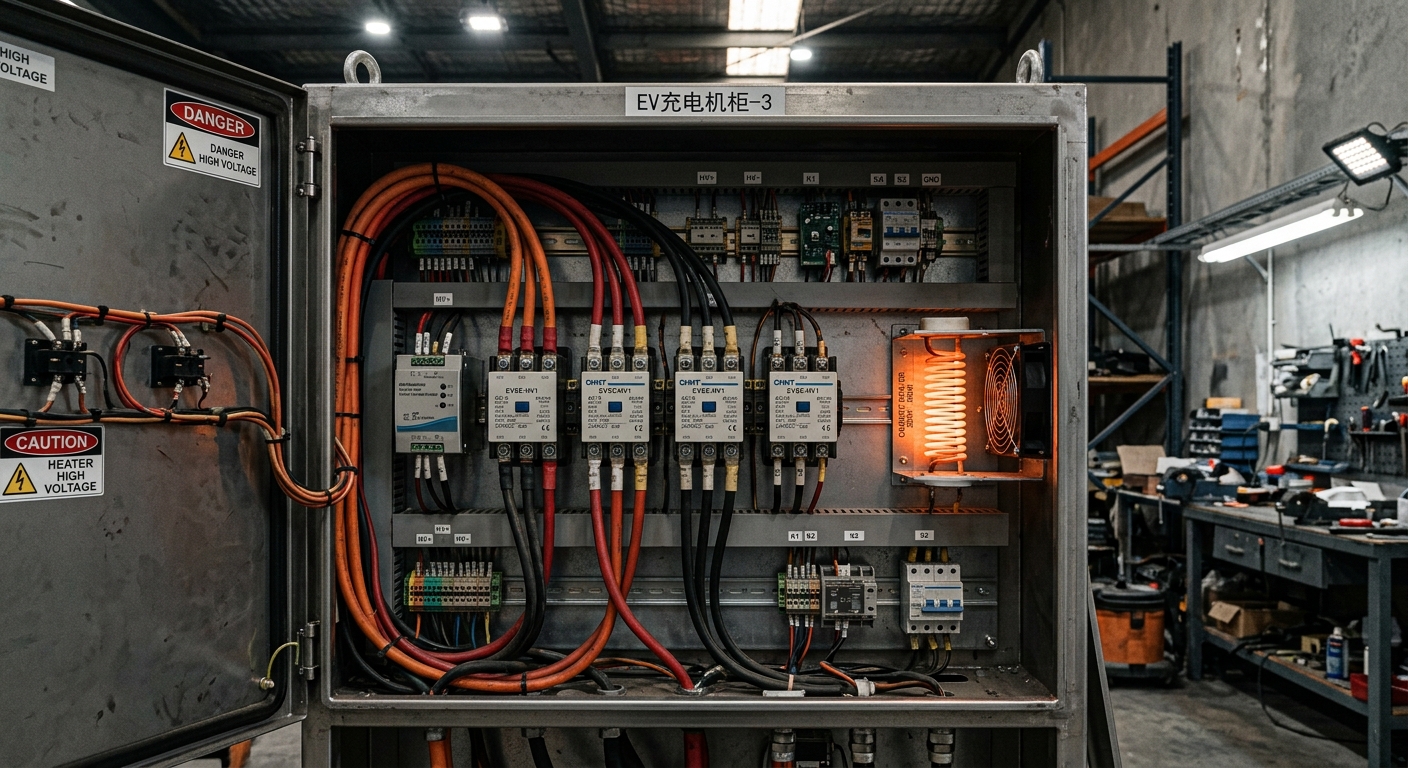
A well-designed charger isolates the relay compartment from the main power electronics bay and gives it a dedicated low-wattage heater loop — typically 20-40W, enough to keep the local ambient above -15°C even when the outdoor air is at -30°C. Cheaper designs share one heater across the entire enclosure, which means the relay compartment often sits several degrees colder than the sensor reading near the main board, because heat doesn’t distribute evenly in a sealed metal box. This is the same principle discussed in ground fault troubleshooting for outdoor DC chargers — uneven internal thermal zones cause problems that look electrical but are actually mechanical.
A logistics fleet operator running electric delivery vans out of a depot near Edmonton reported intermittent ‘charger fault’ errors every morning between December and February, but only on the coldest days — consistently below -25°C. The charger itself wasn’t malfunctioning. The contactor was taking an extra 400-600ms to fully close because of cold-thickened grease, and the charger’s firmware treated that delay as a fault condition rather than expected cold-weather behavior.
The fix was two-part: a relay compartment heater retrofit, and a firmware update that extended the contactor confirmation timeout specifically when ambient temperature readings were below -20°C. No hardware failure occurred — the software simply hadn’t accounted for cold-weather mechanical lag. This is a good reminder that reliability below -20°C is as much a firmware problem as a hardware one.
Internal relay compartment of an EV charger with heating components visible
The Vehicle-Side Bottleneck: BMS Pre-Conditioning
Even a flawless charger can’t force a cold battery to accept current. Most EV battery management systems restrict charge current — sometimes to zero — when cell temperature drops below roughly -10°C to -20°C, depending on the chemistry. This isn’t a charger fault at all, but drivers experience it as one, and that confusion generates support calls that distributors end up fielding.
The better chargers handle this gracefully with a pre-conditioning handshake: the charger detects the BMS’s low-temperature charge rejection via CAN or the communication protocol, displays a clear ‘battery warming’ message instead of an error code, and ramps current up progressively as the BMS reports rising cell temperature. This kind of intelligent handshake matters more with OCPP 2.0.1 communication, which supports richer status reporting than OCPP 1.6.
Enclosure Design: Fighting Condensation, Not Just Cold
Cold alone rarely kills electronics outright — condensation from thermal cycling does. Every time a charger heats up during operation and then cools down overnight, moist air inside the enclosure can condense on internal surfaces. In freeze-thaw cycles, that condensation turns to ice, expands, and stresses connectors and PCB traces.
The better approach is a slightly positive-pressure enclosure with a breather membrane — a Gore-Tex-style vent that allows pressure equalization without letting bulk moisture in. This matters more than raw IP rating, a point covered in more depth in why IP rating alone doesn’t predict outdoor charger lifespan. A charger can be IP65-rated and still accumulate internal condensation damage over three winters if the enclosure isn’t managing pressure differentials correctly.
Weatherproof EV charger enclosure standing in a winter environment
Sizing the Heater: More Watts Isn’t Automatically Better
It’s tempting to think a bigger heater solves everything. It doesn’t — oversized heaters waste standby power (a real cost across a fleet of 50+ chargers) and can create localized hot spots that stress components on one side of the enclosure while the other side stays cold.
A well-engineered cold-climate charger uses zoned heating: a small heater near the display, a separate one in the relay bay, and a third managing the power module compartment, each with its own thermostat threshold. Total heater draw for a 60kW DC unit typically runs 80-150W in standby cold-weather mode — a small fraction of the unit’s rated output, but it’s the difference between a charger that’s ready to deliver full power on demand and one that needs a five-minute internal warm-up first.
What to Ask Your Supplier Before Winter Deployment
Is the -30°C rating a storage spec or a functional startup spec?
Is the display heater independently controlled from the main enclosure heater?
Does the firmware account for cold-weather contactor delay, or will it fault on slow relay closure?
What’s the enclosure’s condensation management strategy — pressure equalization or just sealing?
Has the unit been field-tested in an actual cold climate, or only in a chamber test?
These questions separate manufacturers who engineered for cold climates from ones who simply extended a spec sheet number. If you’re building an RFP for fleet or site charging in a northern region, cold-weather startup reliability deserves its own line item, not a footnote.
Subscribe the newsletter to get updated to news and promotions
Cookies give you a personalized experience,Сookie files help us to enhance your experience using our website, simplify navigation, keep our website safe and assist in our marketing efforts. By clicking "Accept", you agree to the storing of cookies on your device for these purposes. Click "Adjust" to adjust your cookie preferences.For more information, review our Cookie Policy