EV Charger Manufacturing Audits: What ODM Partners Should Inspect Before Signing a Contract
Home / Blog / Guidelines / EV Charger Manufacturing Audits: What ODM Partners Should Inspect Before Signing a Contract
13 Oct, 2026
EV charger factory audit checklist
EV charger quality control inspection
EV charger traceability batch QC
OEM ODM EV charger contract
A proper EV charger manufacturing audit means verifying four things on-site or via documented evidence: incoming component inspection records, in-process QC checkpoints on the production line, final safety test data (hipot, ground continuity, burn-in), and a traceability system that ties every unit back to its batch. A certificate on a datasheet proves a sample passed a lab once. It doesn’t prove the factory making your order has repeatable process control. That distinction is what separates buyers who get consistent chargers from buyers who get a warranty claim six months in.
Key takeaways
A certification confirms a sample unit passed a lab test once; it does not confirm the production line building your order has repeatable process control.
Request incoming inspection records on a recent batch, in-process QC checkpoint logs, and per-unit final test data (hipot, ground continuity, burn-in) rather than summary reports.
A real traceability system ties every unit’s serial number to its component lot and test results, letting a factory isolate a bad batch instead of risking a blind recall.
For OEM/ODM orders, verify firmware version control across batches and get a committed bill of materials in writing to prevent silent component substitutions.
Write batch sampling protocols and pre-shipment inspection terms into the contract itself so the audit continues after signing, not just before it.
Why a CE or UL Certificate Doesn’t Prove What You Think It Proves
A certification tests a sample unit under lab conditions on a specific date. It says nothing about whether the production line building your actual order follows the same process, sources from the same suppliers, or catches a bad batch before it ships. CE and UL marks confirm that the design meets a standard. They don’t confirm that every unit off the line matches that design, month after month.
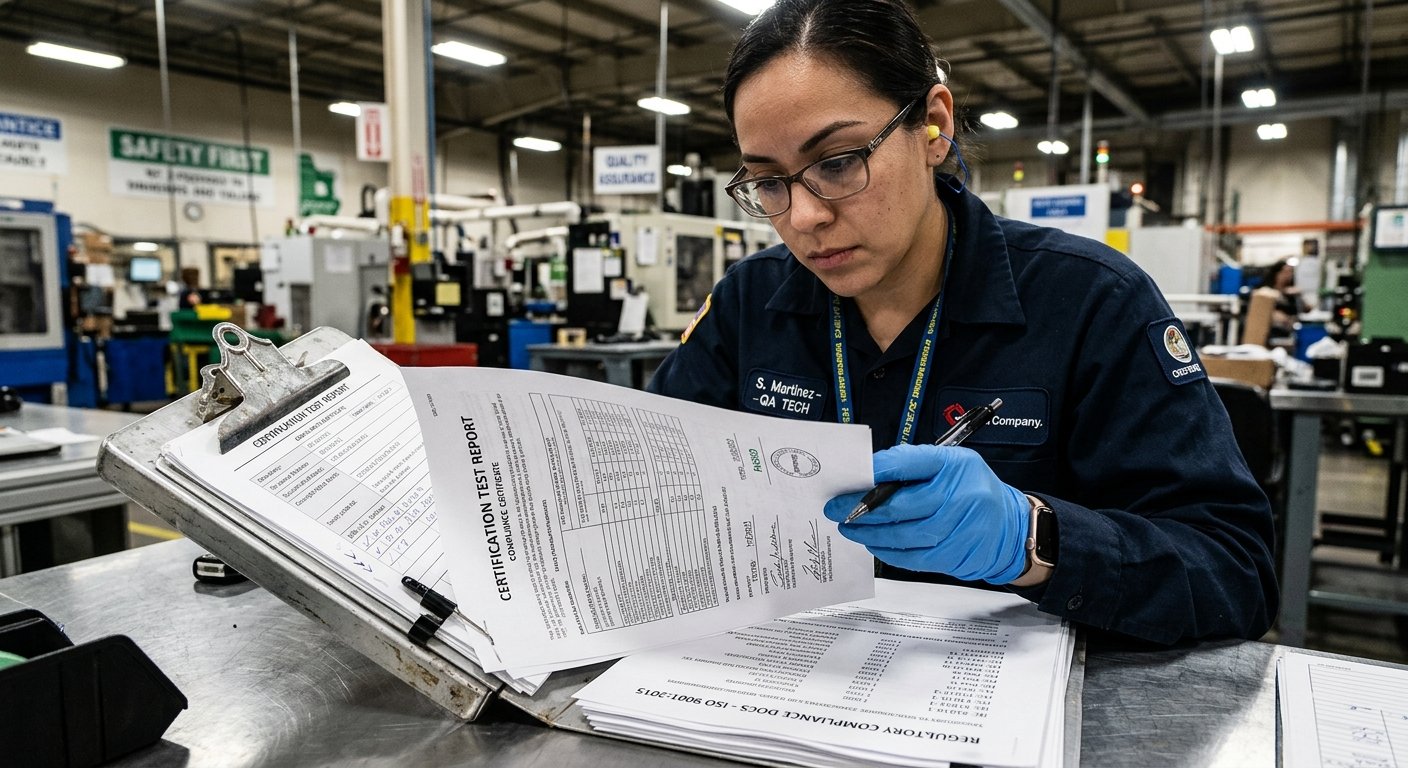
So what should you actually request instead of a glossy certificate image? Ask for the test report itself, not the summary page. Check the scope: does it cover the exact SKU and configuration you’re ordering, or a sibling model with a different power module or enclosure? Factories sometimes certify one baseline unit and quietly extend the claim across a product family.
Also ask a question most buyers skip: was certification renewed after any design or component change? A connector swap, a PCBA revision, or a firmware update can technically take a unit outside the scope of its original test report. AiPower’s solutions hold UL and CE certifications, and its industrial chargers carry CE by TUV on the 24V 80A/100A line and UL by TUV on the 48V/72V/80V line, each tied to the specific product it covers rather than a blanket brand claim.
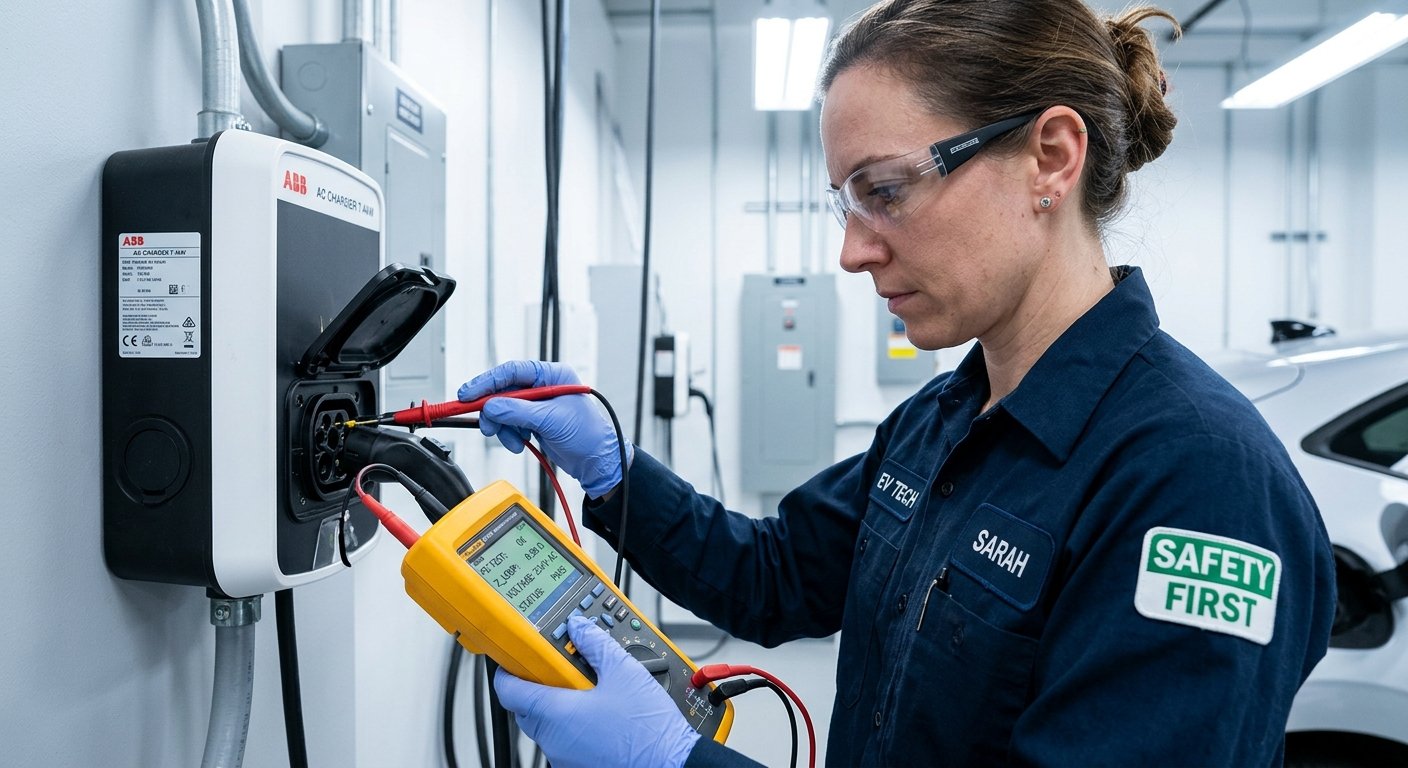
Technician reviewing EV charger certification test report documentsTechnician performing hipot and ground continuity safety test on EV charger
What to Physically Inspect on the Production Line
This is the part most buying guides skip entirely, because it requires walking a factory floor, not reading a spec sheet. Here’s what to check, in order:
Incoming component inspection: are PCBAs, connectors, and enclosures measured against spec before assembly, or just visually scanned for obvious damage?
Ask for incoming inspection records on a recent production batch, not a one-off sample report pulled for visitors.
In-process QC checkpoints: identify exactly where a defective unit gets caught on the line, and what gets logged at each station.
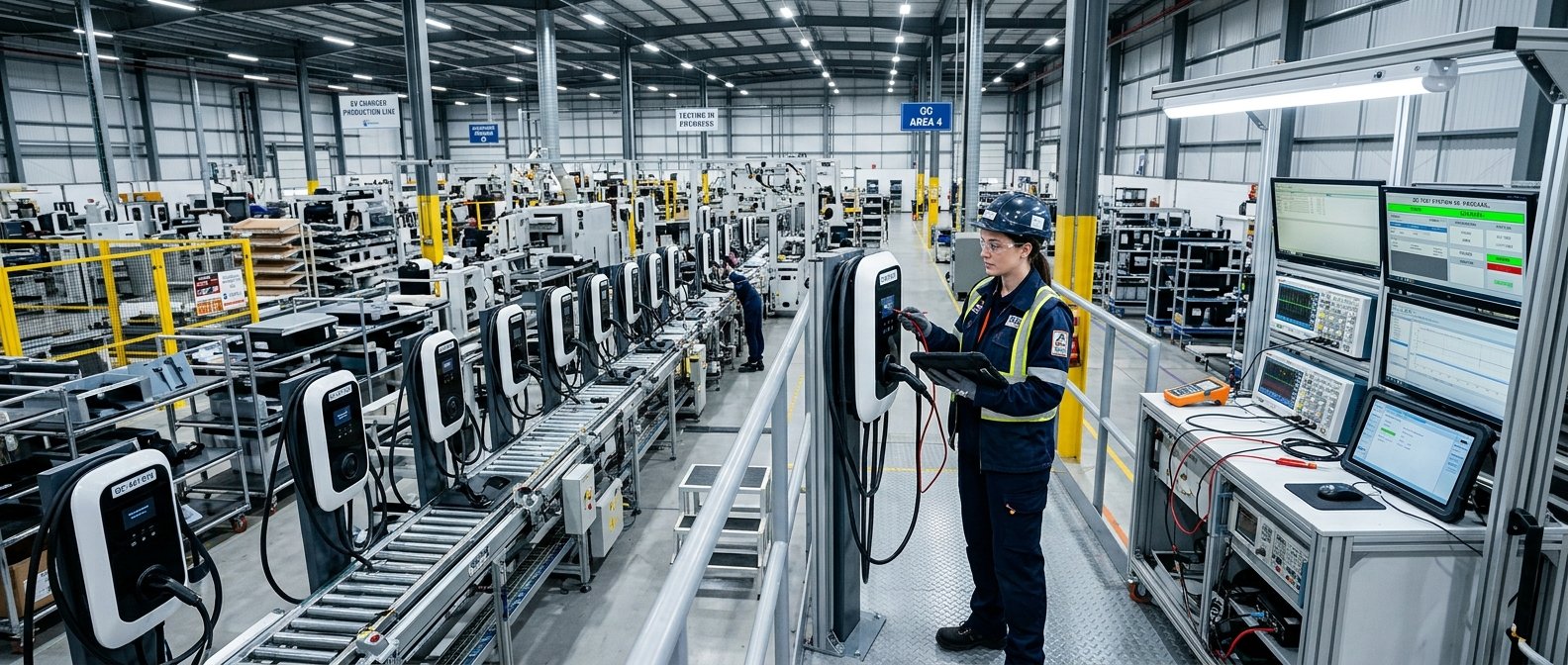
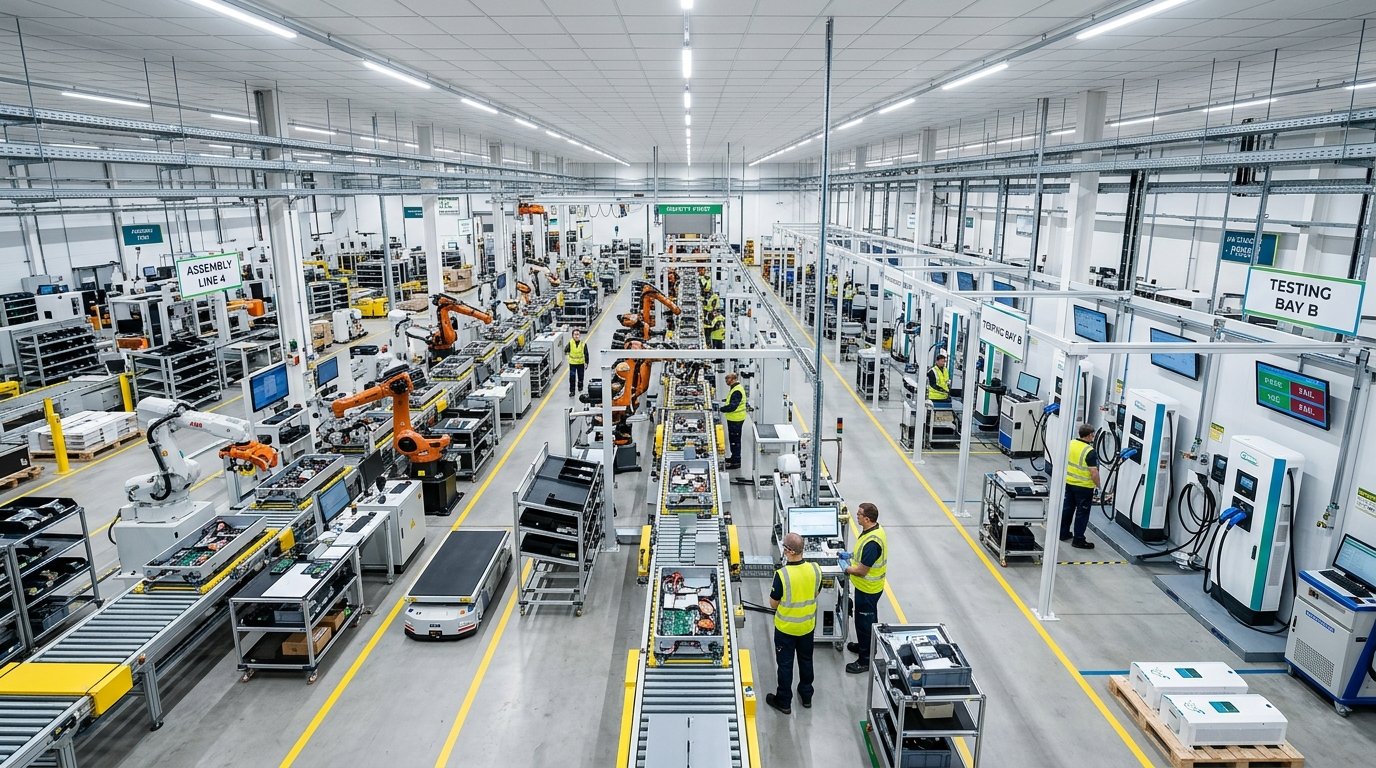
Check whether SMT, assembly, and final test happen in distinct zones with documented handoffs between them, or whether it’s one undifferentiated floor where problems can slip through unnoticed.
Facility scale and automation level matter less as a vanity metric and more as a proxy for process consistency: a large automated facility with dedicated zones behaves very differently batch to batch than a cramped workshop.
Ask to see the burn-in test area directly and how long units are soak-tested under load before packing.
AiPower runs its production across a 20,000 m² automated facility supported by a team of 60+ engineers.
Automated EV charger production line with separated assembly and test zones
Final Test Data You Should Demand Before Shipment: Hipot, Ground Continuity, Burn-In
Hipot (dielectric withstand) test: confirms the insulation can handle voltage stress without breakdown. Every unit should have this logged individually, not just sampled from a batch.
Ground continuity test: verifies the protective earth path. This is critical for outdoor DC chargers exposed to moisture and temperature swings over years of service.
Burn-in / soak testing under load: reveals early-failure components, the ones that would otherwise fail in the field within the first weeks of use, before they ever leave the factory.
Request the actual test log format: does it show unit serial number, measured values, and a pass/fail result per unit, or just a stamped “tested OK” with no traceable data behind it?
A multi-layer protection scheme is only meaningful if the final test actually exercises it functionally, not just lists it on a spec sheet. AiPower’s DC EV chargers include an 8-layer protection scheme covering over-current, under-voltage, and related fault conditions, which is exactly the kind of protection layer a final test should be verifying in practice, not just on paper. If a factory can’t show you what that test looked like on the unit it’s shipping, the spec sheet claim is unverified.
Traceability: Why You Need to Know Which Batch Built Your Charger
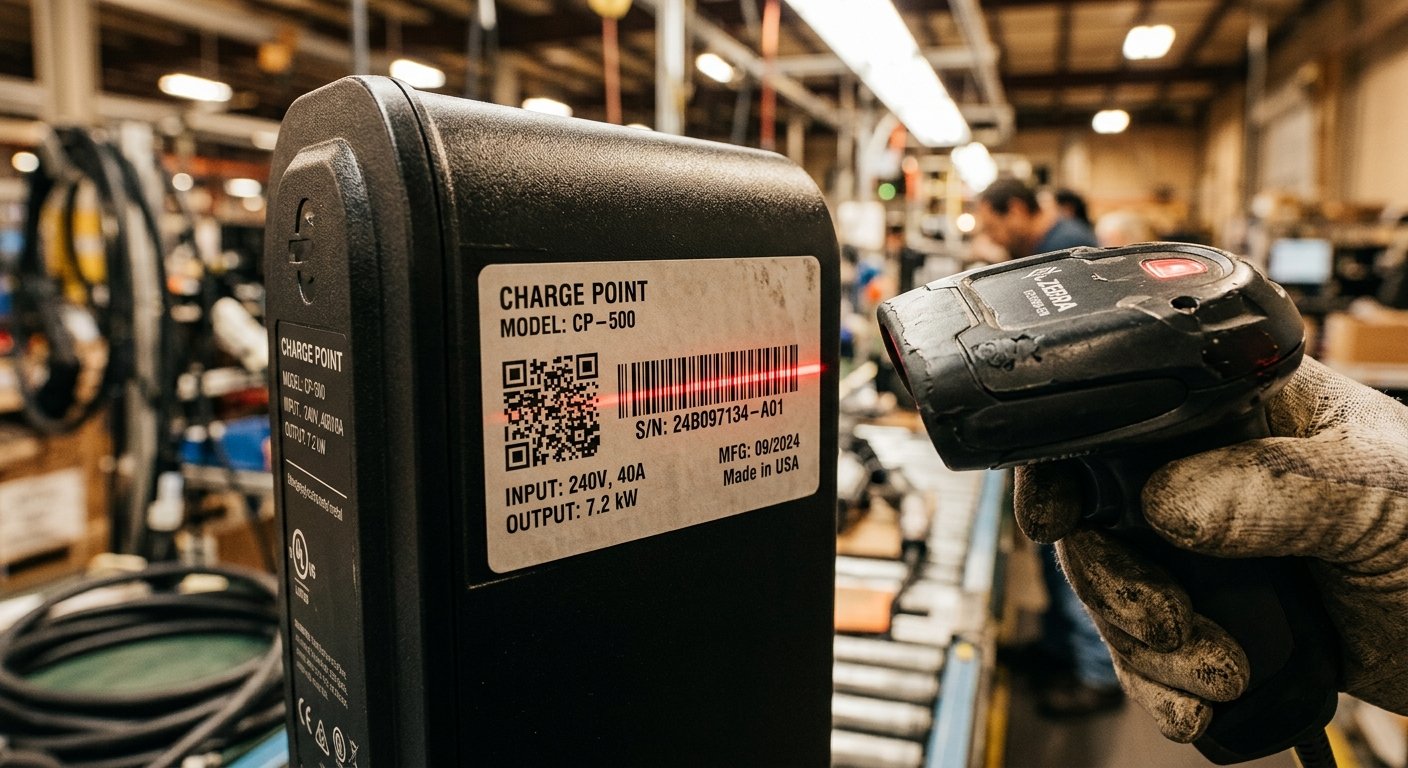
A traceability system ties each unit’s serial number back to its component lot, its test results, and its assembly date. Without it, a single bad component lot from a connector supplier can’t be isolated to specific units, which means a quality issue in one batch can force a much wider recall or leave you exposed on warranty claims you can’t even scope correctly.
Ask the factory directly: if a connector supplier sends a bad lot, can you tell me exactly which shipped serial numbers contain it? A factory with real traceability answers that in minutes with a lookup. A factory without it has to guess, or worse, assumes every unit in that date range is suspect.
This matters more for ODM buyers running multiple SKUs or private-label orders than for a distributor stocking a single model, because the risk of cross-contamination between product lines multiplies with every additional configuration running through the same facility. If you’re weighing OEM against ODM arrangements in the first place, see OEM vs. ODM EV chargers: what global distributors should know for how traceability expectations differ between the two models.
Serial number and barcode label on EV charger enclosure being scanned for traceability
OEM/ODM-Specific Risks: Customization Control, Firmware Consistency, and Sourcing Transparency
Custom branding, enclosure modifications, or power configuration tweaks can silently diverge from the certified baseline design if nobody documents the change. That divergence is where most ODM warranty disputes actually originate, not from the original design but from an undocumented tweak made three batches in.
Ask how the factory version-controls firmware across production batches. A charger shipped in month one should run the same logic as one shipped in month six, unless you specifically requested a change. If the factory can’t tell you which firmware version shipped in which batch, you have no way to diagnose a field issue months later.
Component sourcing transparency is the other half of this. Will the factory commit in writing to a fixed bill of materials, or can it substitute a cheaper PCBA or connector mid-run without notifying you? For buyers running multiple SKUs, also ask how the factory prevents cross-contamination of specs between product lines sharing a production floor, since a mislabeled component bin has caused more than one cross-SKU mix-up in facilities without strict zone separation.
AiPower holds 100+ patents and delivers tailored solutions to over 30 countries. If firmware governance across your deployed fleet is a concern, the related questions in ISO 15118 Plug & Charge: what OEM partners need to implement are worth reviewing alongside this audit.
Vendor Evaluation Beyond the Factory Floor: Capacity, Service Model, and Track Record
Production capacity relative to your order volume: can the factory scale your run without quietly subcontracting to a third party you never audited?
Regional spare parts and service support, especially important for distributors reselling under their own brand who need fast turnaround on claims.
Ask for reference deployments and how long the vendor has actually operated, not just a glossy case study with no dates or figures attached.
Engineering team size and in-house R&D capacity signal whether the factory can support firmware updates and custom requests years into the relationship, not just at launch.
Guangdong AiPower New Energy Technology Co., Ltd. was founded in 2015 and runs a team of 60+ engineers in-house. AiPower also presented DC fast chargers, AC EV chargers, portable EV chargers, and forklift battery chargers at Power2Drive Europe 2025.
Who Are the Leading EV Charger Manufacturers, and Why That Ranking Doesn’t Answer Your Audit Question
Market-size rankings tell you who ships the most units globally. They don’t tell you whether that specific factory’s QC process will suit your specific order, your region’s certification requirements, or your SKU mix. “Biggest” is a volume metric, not a process-control metric, and the two don’t correlate as tightly as buyers assume.
A smaller ODM partner with transparent, documented audit records can be a far better fit than a large brand name that subcontracts production to facilities you’ll never see. Scale without visibility is actually a bigger risk than smaller scale with full transparency, because you can’t audit what you can’t access.
The real question isn’t who’s biggest. It’s whether this specific factory can show you its QC records for the last batch it actually shipped. If a vendor hesitates on that one request, no amount of brand recognition should offset it.
Auditing Doesn’t Stop at Signing: Batch QC Sampling and Pre-Shipment Inspection
A one-time pre-contract audit is only half the job. Ask for a defined batch sampling protocol, such as AQL-based sampling, applied to every single production run, not just the first one.
Pre-shipment inspection should be a contractual checkpoint, not an afterthought: specify who inspects, exactly what gets checked, and who signs off before the container is sealed.
Define a non-conformance process upfront. What happens when a batch fails sampling? Spell out rework terms, replacement terms, and who covers the cost of re-inspection.
Build periodic re-audits into long-term ODM contracts, especially after any design revision or component substitution, so you’re not relying on the original factory visit a year later.
This is where most buyers lose leverage. They treat the factory visit as a box to check once, then never revisit the process until a complaint lands. Writing batch sampling and pre-shipment inspection into the contract itself, rather than trusting it as a verbal commitment, is what actually protects you across years of reorders.
Putting the Audit Checklist to Work
Four layers make up a real EV charger manufacturing audit: certification verification against the exact SKU you’re buying, a physical factory floor inspection covering incoming materials and in-process QC, final test data showing hipot, ground continuity, and burn-in results per unit, and a post-contract batch QC process with defined pre-shipment inspection terms. Skip any one of these and you’re trusting a glossy brochure instead of a documented process.
Build this checklist into your RFP and contract language directly, rather than treating it as a one-off site visit before signing. Ask for sample incoming inspection logs, final test report formats, and traceability examples as part of the quoting process itself, not after the purchase order is already issued.
AiPower operates a 20,000 m² automated facility, holds UL and CE certifications on its product lines, and delivers solutions to over 30 countries. If you’re structuring your next RFP, the ultimate guide to choosing an electric vehicle charger and the current product lineup are useful starting points alongside this checklist.
Frequently asked questions
Who are the leading manufacturers of EV chargers?
Rankings vary by region and are usually based on shipped unit volume, which measures scale, not whether a specific factory’s QC process fits your order. Instead of chasing a market-leader list, ask any candidate factory to show incoming inspection records and final test logs for its most recent production batch.
What should I look for during an EV charger factory audit?
Check four things: incoming component inspection records, in-process QC checkpoints on the line, final safety test data covering hipot, ground continuity, and burn-in per unit, and a traceability system linking serial numbers to batches. A certificate alone doesn’t confirm any of these are in place.
What is the difference between a factory certification and a factory audit?
A certification tests one sample unit in a lab on a given date and confirms the design meets a standard. A factory audit examines whether the production line actually building your order follows consistent, documented quality control for every unit, not just the one that was tested.
Subscribe the newsletter to get updated to news and promotions
Cookies give you a personalized experience,Сookie files help us to enhance your experience using our website, simplify navigation, keep our website safe and assist in our marketing efforts. By clicking "Accept", you agree to the storing of cookies on your device for these purposes. Click "Adjust" to adjust your cookie preferences.For more information, review our Cookie Policy