School Bus Electrification: Sizing Overnight Charging for Seasonal Duty Cycles
Home / Blog / Guidelines / School Bus Electrification: Sizing Overnight Charging for Seasonal Duty Cycles
11 Sep, 2026
EV school bus charging depot
school bus charger sizing
school bus electrification
seasonal duty cycle charging
Size your overnight school bus charging system for the coldest, longest-route days of the year — not the annual average — and add at least 20% reserve capacity on top of that worst-case number. Most fleet operators who get this wrong don’t discover the mistake until the first hard freeze in January, when buses that charged fine every night since September suddenly can’t finish their AM routes. Seasonal duty cycles for school buses swing far more than commercial fleets realize, and the charging infrastructure has to be built around the extremes, not the mean.
Why School Bus Duty Cycles Aren’t Actually Predictable
Here’s the mistake almost every district makes during procurement: they calculate energy needs using a single average daily mileage figure. A 65-mile route sounds simple until you realize that number changes dramatically depending on outside temperature, HVAC use, and idle time at stops.
In winter, battery-electric buses can lose 30-40% of their usable range to heating demand alone. Diesel buses get heat as a byproduct of the engine — EVs have to generate it separately, usually with resistive heaters or heat pumps that pull directly from the traction battery. A route that consumes 45 kWh in October might consume 65-70 kWh in January with sub-freezing morning starts and defrost running the entire trip.
Summer isn’t free either. Air conditioning adds load, but it’s a much smaller draw than winter heating — typically 5-8% extra energy use versus 15-25% in cold months. This asymmetry is exactly why sizing off an annual average charging figure gets fleets into trouble.
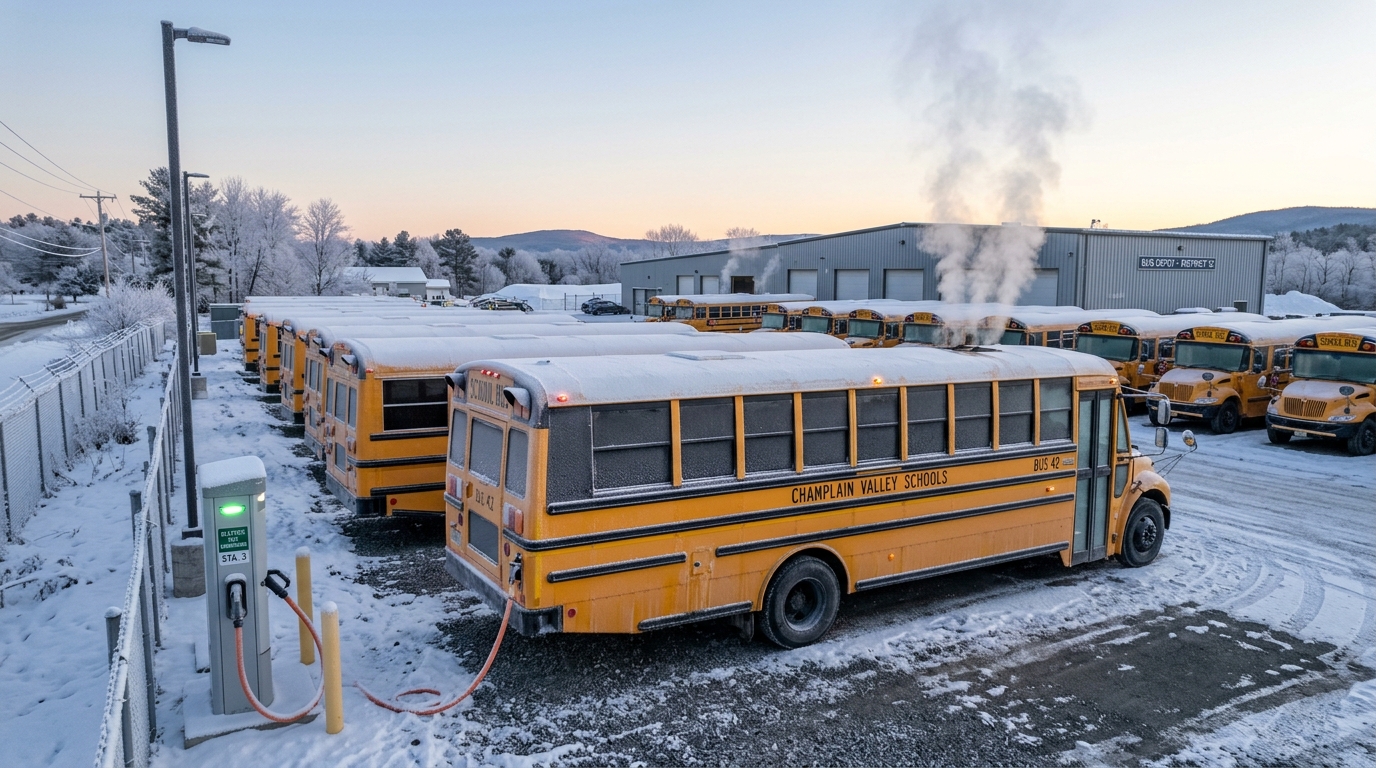
Electric school bus at depot charging station on a frosty winter morning
The Overnight Charging Window: Doing the Math That Actually Matters
Most districts have an 8-12 hour overnight window between the last afternoon route and the first morning pickup. That’s your charging budget — and it’s fixed. Your job is to fit worst-case winter energy demand inside that fixed window, not the other way around.
A Practical Sizing Example
Take a 36-bus depot where each bus needs 70 kWh recovered overnight during peak winter conditions (accounting for heating draw and route length). With a 10-hour charging window, each bus needs roughly 7 kW of continuous charging power minimum. But buses don’t all plug in at the same instant — stagger arrival times, and you can use smaller per-vehicle power draws with smart scheduling instead of brute-forcing everything to full power simultaneously.
This is where load balancing and dynamic power sharing becomes essential rather than optional. Without it, you’re either oversizing your transformer connection to handle simultaneous peak draw across all 36 buses, or you’re risking buses that don’t finish charging before the morning bell.
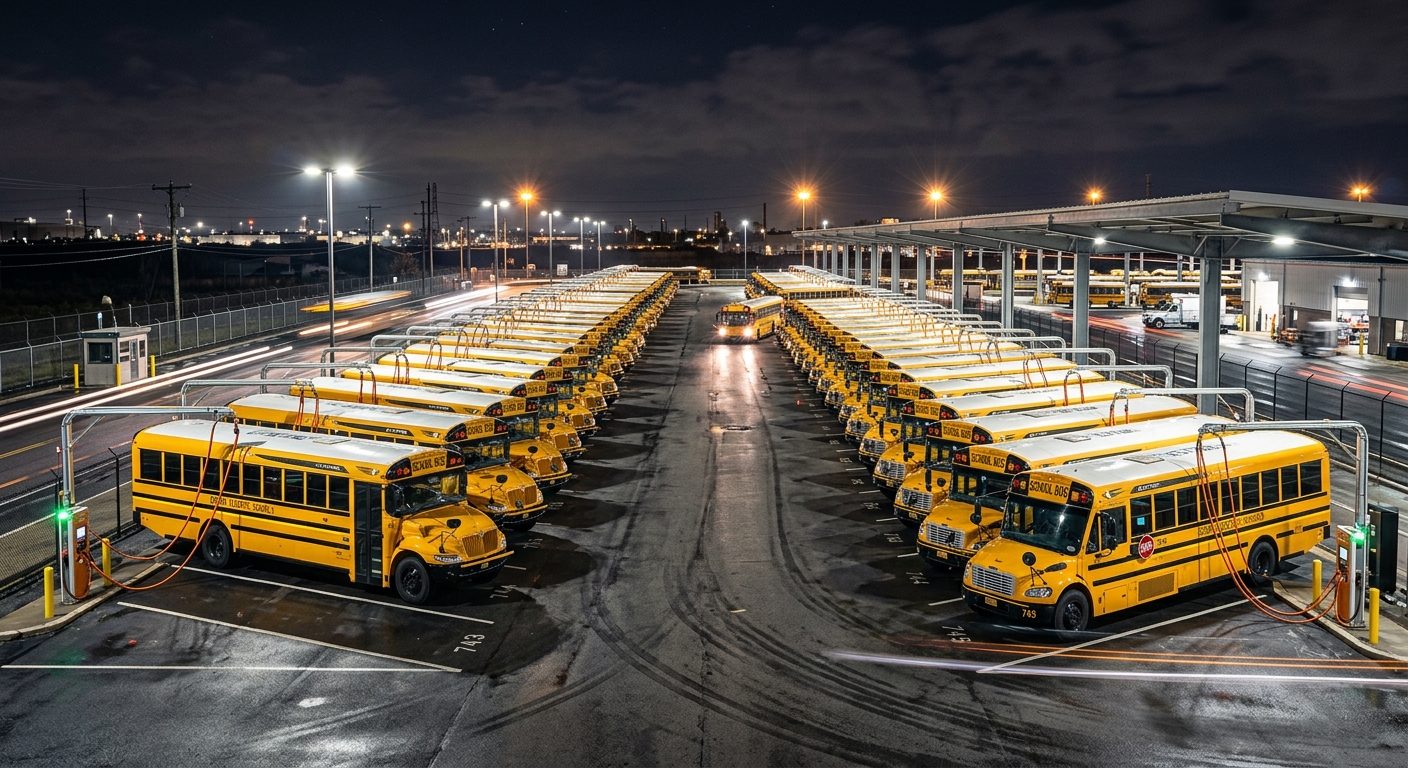
Electric school buses lined up overnight at a depot with charging cables connected
Real-World Example: A Midwest District’s Winter Wake-Up Call
A transit contractor operating 22 electric buses across a Midwest district sized their depot charging system based on manufacturer-published range figures — numbers generated in mild test conditions. Through fall, everything ran fine. Then temperatures dropped below 15°F in December, and six buses failed to reach full charge overnight, forcing the district to pull diesel spares for morning routes.
The fix wasn’t more chargers — it was smarter allocation. The contractor implemented preconditioning schedules (warming the battery pack starting at 4 AM before dispatch) and increased per-bus overnight power allocation for buses assigned to the longest rural routes, while shorter in-town routes kept lower power tiers. Total site power stayed the same; it was redistributed based on actual seasonal route data instead of a flat rate.
The lesson: sizing isn’t just about total kW capacity at the site. It’s about how that capacity gets allocated across a fleet with different route lengths and different seasonal sensitivity.
Preconditioning: The Overlooked Load That Breaks Morning Schedules
Preconditioning — warming the battery pack and cabin before departure — is often left out of charging capacity calculations entirely, and that’s a costly oversight. If your charging management system triggers preconditioning at 5 AM but your last bus doesn’t finish its overnight charge until 5:15 AM, you’ve created a scheduling conflict that delays dispatch.
Build preconditioning into your charging schedule as a distinct phase, not an afterthought. A reasonable approach: reserve the final 30-45 minutes of the overnight window exclusively for preconditioning on buses assigned to early, cold-weather routes, and complete bulk charging before that window begins. This requires charging hardware with flexible scheduling logic — something worth confirming during your RFP process rather than discovering after installation.
AC Level 2 vs. DC Charging for Depot Applications
Most school bus depots don’t need DC fast charging — and that’s a genuinely good thing for your budget. With an 8-12 hour overnight window, Level 2 AC charging in the 19.2-kW range per bus is usually sufficient, even accounting for winter heating loads, because you have time on your side rather than needing a 30-minute turnaround.
DC charging becomes relevant only in specific scenarios: split-shift routes where buses need a midday top-up, or districts running routes long enough that overnight AC charging genuinely can’t recover enough energy even with the full window. If you’re evaluating which approach fits your depot, the fundamentals are covered in our Level 1, 2, and 3 charging comparison guide.
Choosing AC over DC for standard overnight depot use also simplifies your electrical infrastructure significantly — lower per-unit cost, simpler installation, and fewer thermal management concerns than DC hardware requires.
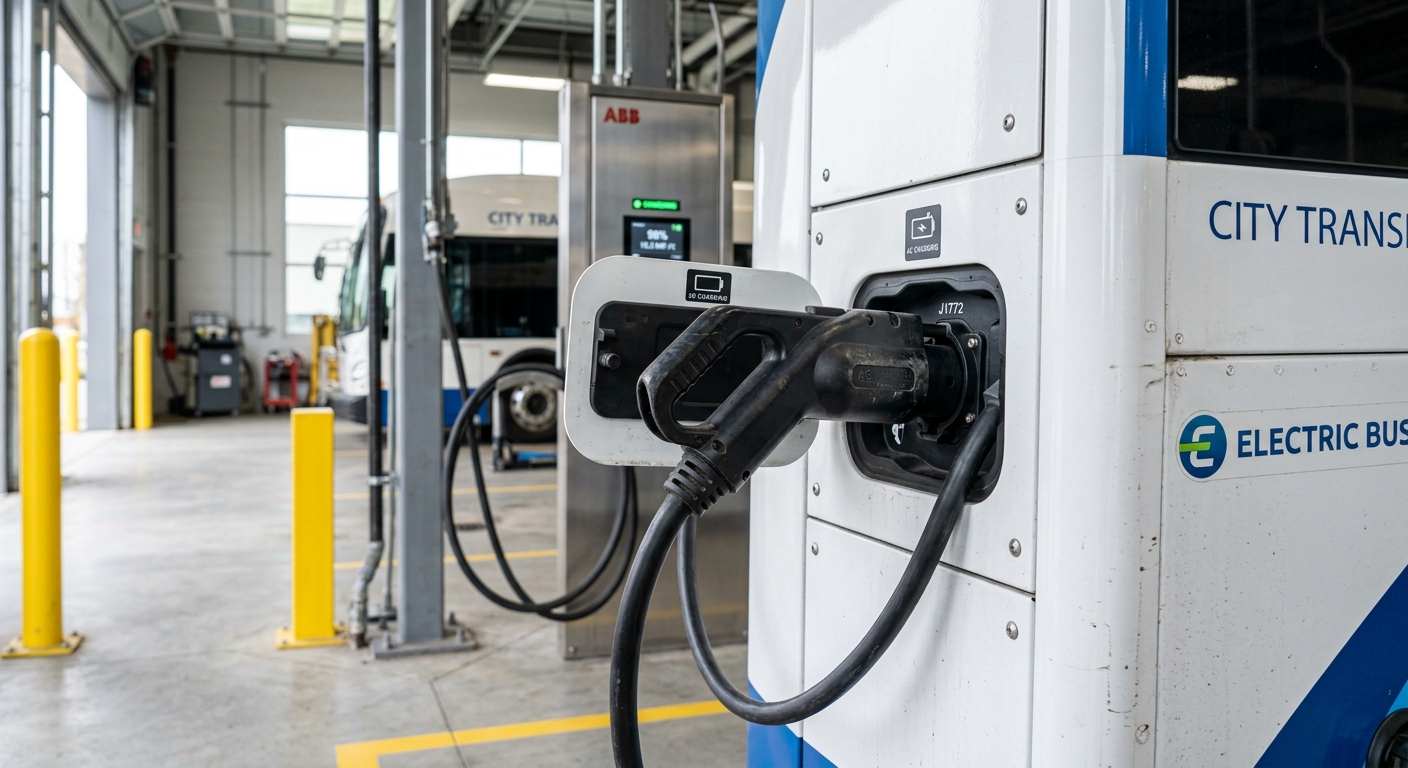
Level 2 AC charging connector plugged into an electric school bus
Sizing the Site Transformer Without Overbuilding
This is where a lot of district budgets get blown unnecessarily. If you size your transformer connection assuming every bus needs full winter-peak power simultaneously, you’ll end up requesting a utility service upgrade that costs far more than it needs to — sometimes six figures more.
Instead, calculate your aggregate site demand using staggered arrival and departure data, not simultaneous worst-case draw. Most depots see buses return within a 60-90 minute window in the afternoon, but they don’t all need full power at the same moment — some have shorter routes and lower energy deficits than others.
Pair this staggered approach with dynamic power sharing hardware, and you can often serve 30+ buses on a transformer sized for far less than 30 times peak per-bus draw. This is the same principle covered in our fleet depot overnight charging design guide for larger commercial fleets, and it applies just as directly to school bus depots.
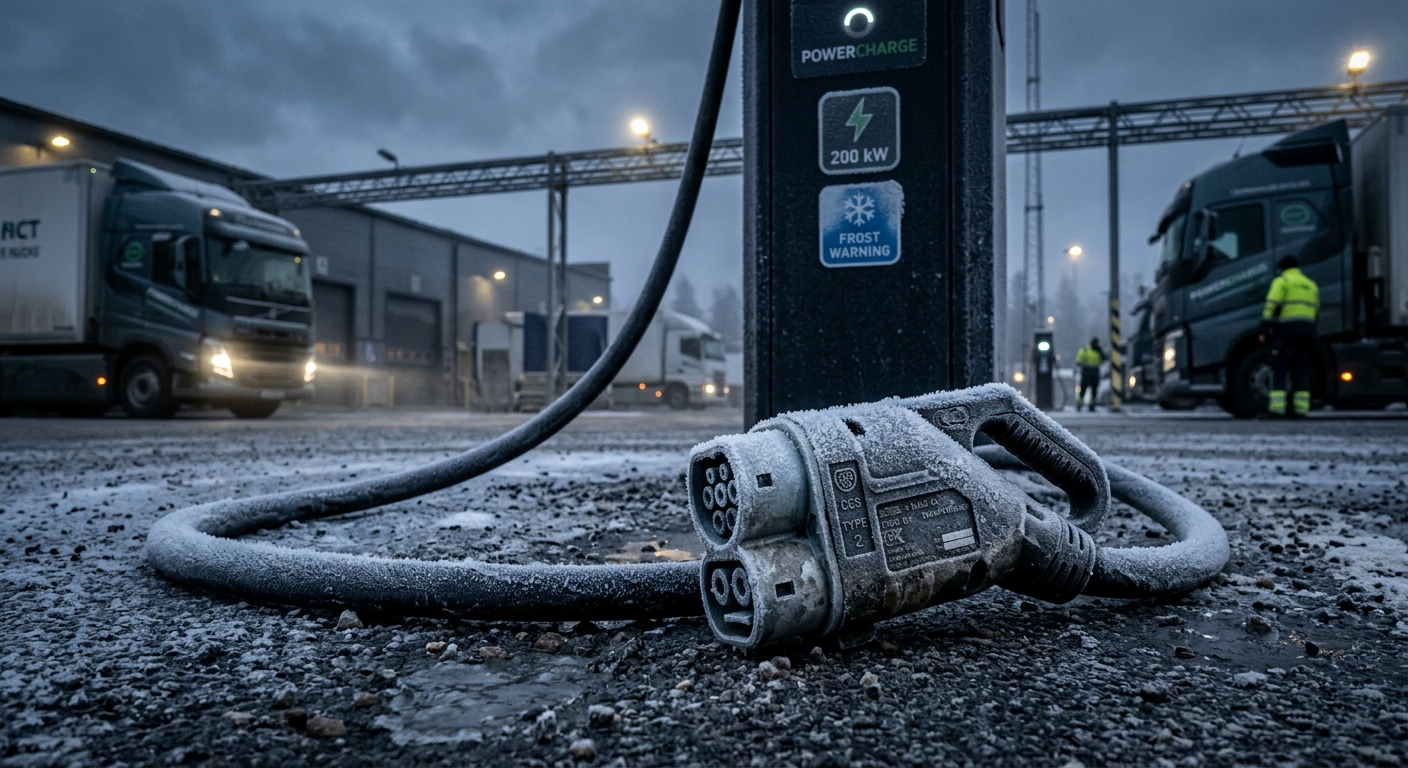
Sizing capacity correctly solves half the problem. The other half is making sure the charging hardware itself performs reliably in the temperatures your buses actually operate in. Charger enclosures, cabling, and connectors all behave differently below freezing, and standard commercial-grade equipment isn’t always rated for the extremes some districts face.
If your depot regularly sees temperatures below -20°C, review how your charger handles cold-start reliability — startup delays and heater design failures are common failure points that have nothing to do with capacity sizing. We cover this in detail in how cold climates break EV chargers, which is worth reviewing alongside your sizing plan before finalizing hardware specs.
Frost-covered EV charging cable and connector at a winter depot
Building a Seasonal Charging Schedule, Not a Static One
The most resilient depot charging setups don’t run the same schedule year-round — they shift allocation seasonally based on actual route data collected from the previous winter and summer. This means your charging management software needs to support seasonal profile switching, ideally automated based on outdoor temperature thresholds rather than manual calendar dates.
Practically, this looks like: a winter profile that allocates higher per-bus power and reserves preconditioning windows, and a summer profile that spreads charging more evenly since energy demand is lower and there’s more slack in the schedule. Districts that build this flexibility in from day one avoid the retrofit costs of districts that discover the need for it only after their first hard winter.
Subscribe the newsletter to get updated to news and promotions
Cookies give you a personalized experience,Сookie files help us to enhance your experience using our website, simplify navigation, keep our website safe and assist in our marketing efforts. By clicking "Accept", you agree to the storing of cookies on your device for these purposes. Click "Adjust" to adjust your cookie preferences.For more information, review our Cookie Policy