Why Charger Enclosure Material Choice Affects Total Cost of Ownership
Home / Blog / Guidelines / Why Charger Enclosure Material Choice Affects Total Cost of Ownership
18 Sep, 2026
aluminum vs steel EV charger enclosure
charger total cost of ownership
corrosion resistant charger housing
outdoor EV charger durability
Enclosure material determines how much a charger costs you after the invoice is paid — not before. A cheap mild-steel box with a thin powder coat can shave 10-15% off unit price, but it often triggers corrosion-related warranty claims, thermal derating, and field replacements within three to five years, wiping out any upfront savings. If you’re buying at volume for fleet or public deployment, the enclosure material is arguably a bigger TCO lever than the power electronics inside it.
The Warranty Claim Nobody Budgets For
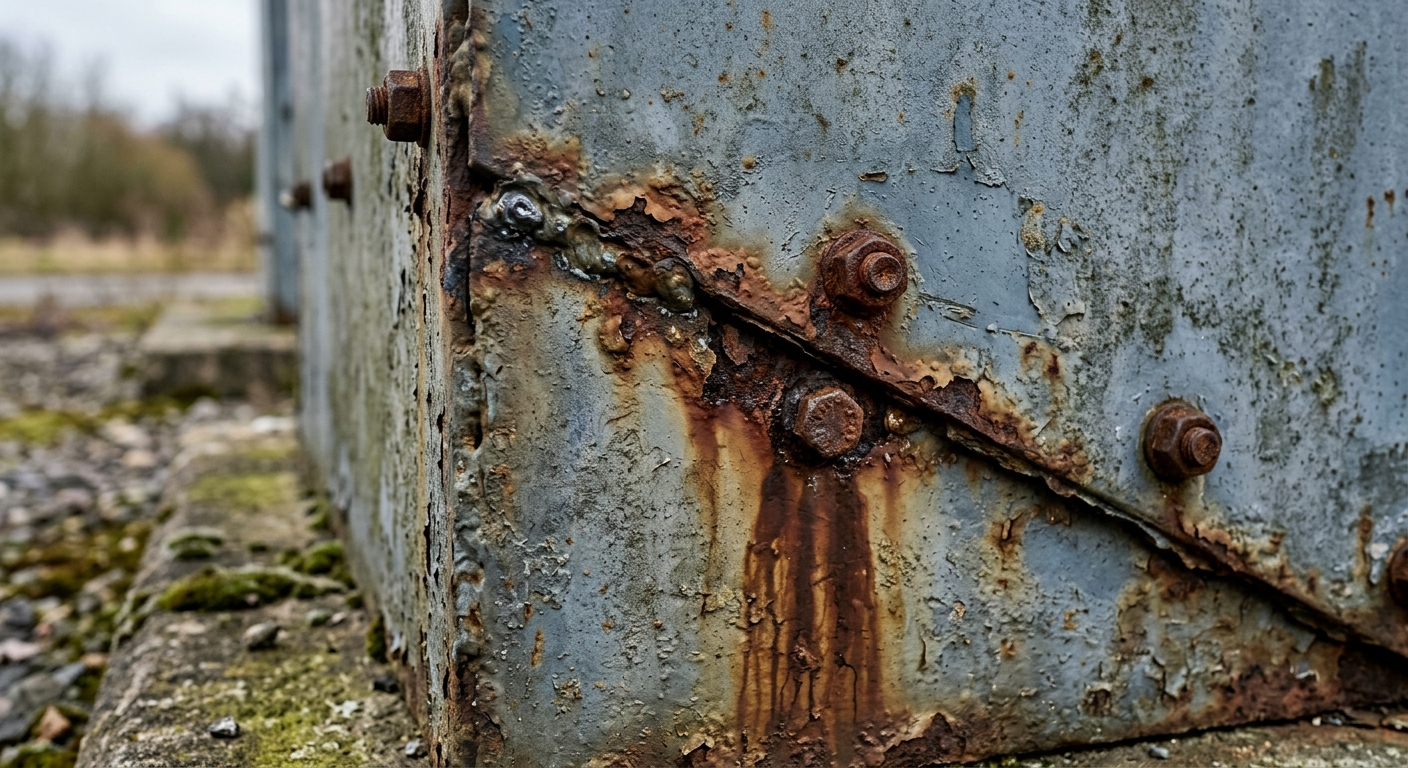
Ask any distributor who’s fielded returns after year two: the failure isn’t usually the power module. It’s rust bleeding through a seam weld, a hinge that’s seized from oxidation, or a door gasket that’s failed because the substrate underneath was flexing and cracking the coating. None of that shows up in a spec sheet comparison, but it shows up on your service invoice.
This is exactly the pattern we cover in the hidden cost of cheap EV chargers — the warranty claim rarely hits in month one. It hits after the first monsoon season, or the first winter of road salt exposure, once the coating has had time to fail.
Corroded seam on an outdoor equipment enclosure showing rust bleed
Aluminum: The Default for a Reason
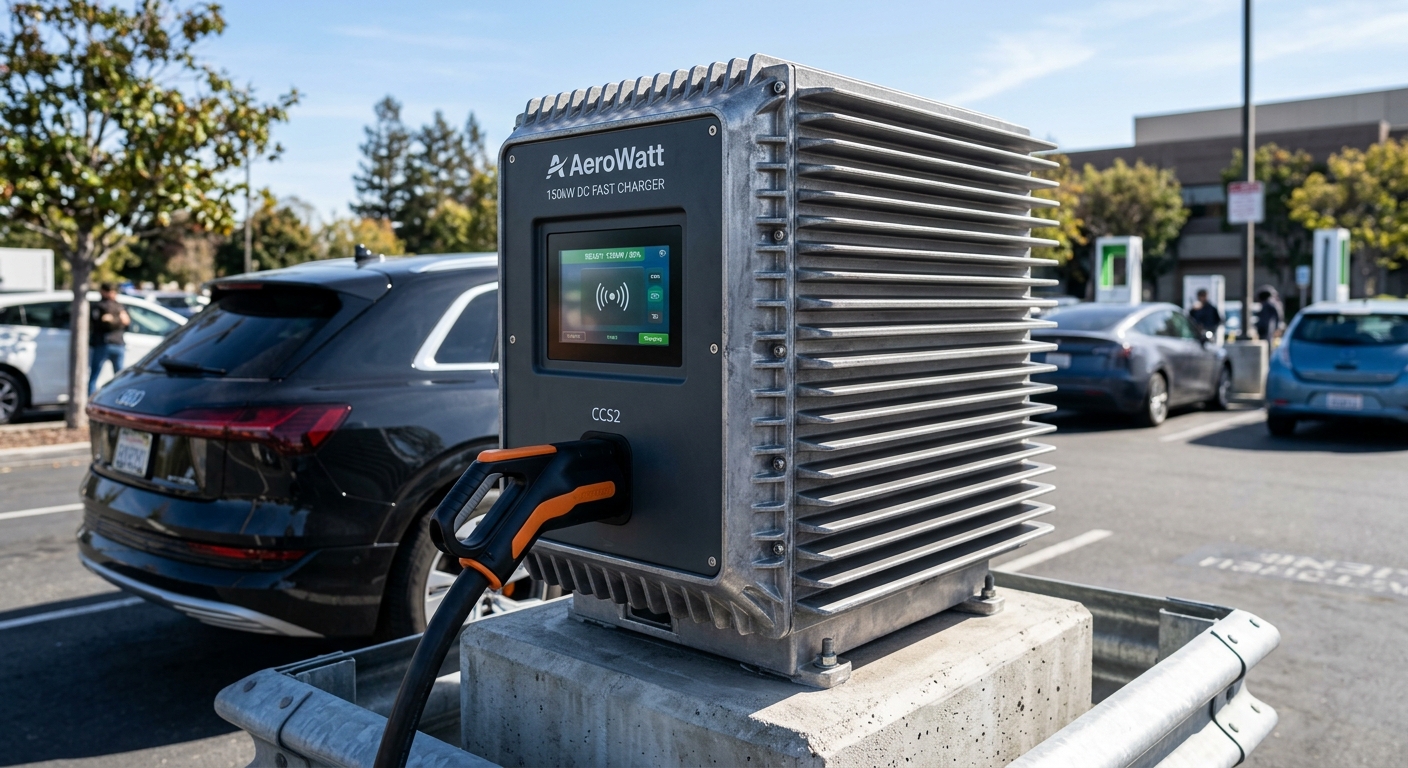
Die-cast or extruded aluminum has become the default enclosure material for good reason: it forms a natural oxide layer that self-passivates against corrosion, it’s roughly one-third the weight of steel, and it conducts heat about 4x better than mild steel — which matters enormously for passive-cooled DC chargers pulling 60-180 kW.
Where aluminum actually helps thermal design
A charger enclosure doing double duty as a heat sink reduces the load on fans, which reduces dust ingress points, which reduces maintenance visits. This ties directly into why DC fast chargers derate in summer — a poorly conductive enclosure traps heat internally and forces earlier, more aggressive derating curves. Aluminum buys you thermal margin without adding a single active cooling component.
The tradeoff: aluminum die-casting tooling costs more upfront, and repair welding in the field is harder than with steel. For high-volume OEM production runs, that tooling cost amortizes quickly. For low-volume custom enclosures, it doesn’t.
Aluminum EV charger enclosure with heat sink fins for passive cooling
Mild Steel: Cheap Until It Isn’t
Powder-coated mild steel is the lowest-cost option and performs fine — indoors, in dry climates, or in short-lifecycle deployments. The problem is that its corrosion resistance depends entirely on coating integrity. One scratch from a forklift, one poorly sealed cable entry, one freeze-thaw cycle that flexes a weld joint, and the substrate starts oxidizing from the inside out, invisible until the coating blisters.
For fleet depot chargers exposed to constant physical contact — cable drags, vehicle proximity, cleaning equipment — mild steel’s coating gets compromised faster than most buyers expect. If you’re designing a depot charging setup for 50+ vehicles, the cumulative physical abuse across dozens of units makes coating failure a statistical certainty, not an edge case.
Stainless Steel: Expensive Insurance for Harsh Sites
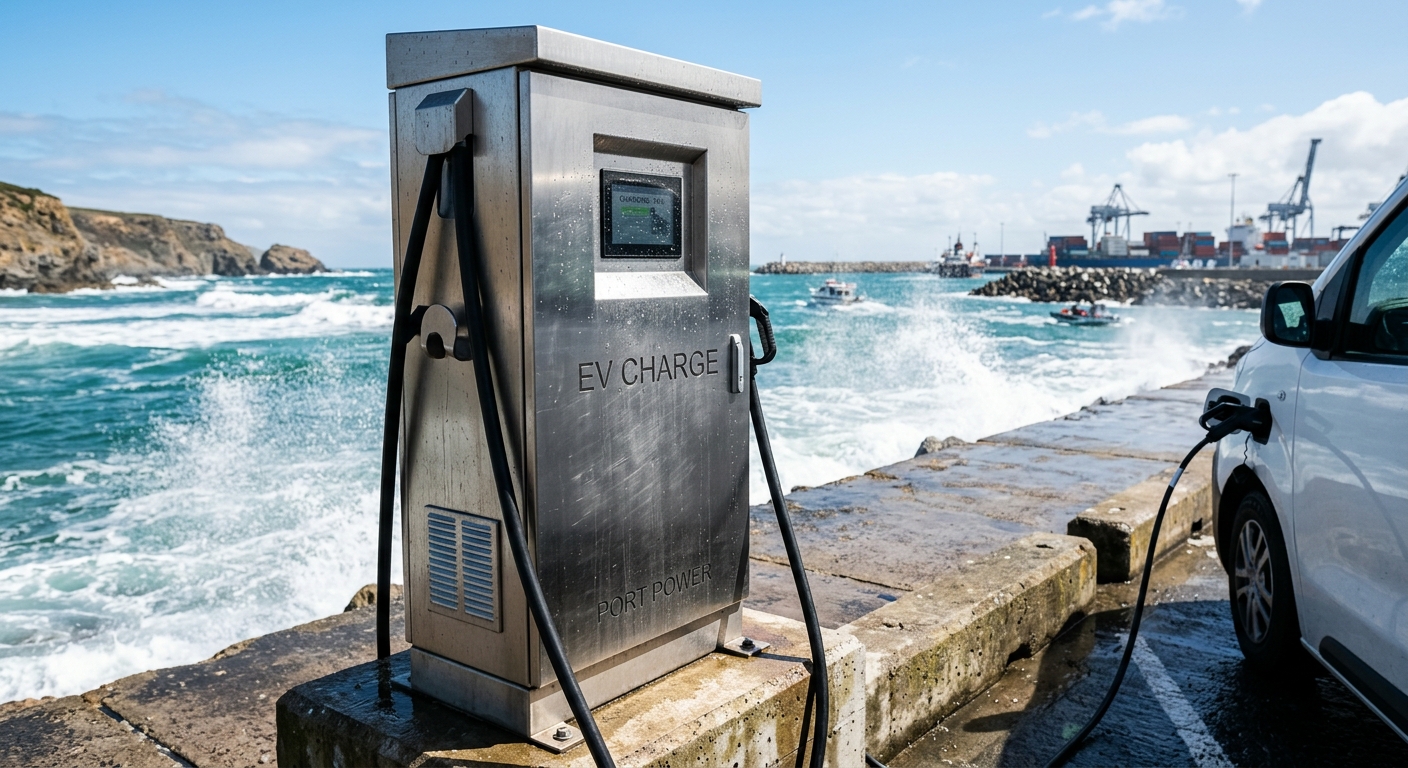
304 or 316 stainless steel costs 30-50% more than aluminum for an equivalent enclosure, but in coastal, marine, or chemical-exposure environments, it’s the only material that reliably outlasts a 10-year deployment without visible corrosion. Salt spray testing tells the story: mild steel with standard powder coat typically fails ASTM B117 salt spray testing at 500-1000 hours, aluminum holds to roughly 1500-2000 hours, and 316 stainless steel routinely exceeds 3000 hours with no red rust.
A real-world example
A port electrification project we’ve discussed in shore power design for container terminals illustrates this well — salt-laden air, constant humidity, and washdown cleaning cycles mean any enclosure below 316-grade stainless will show corrosion within 18-24 months. The material premium there isn’t optional; it’s the only thing standing between the electronics and a saltwater environment that actively wants to destroy them.
Stainless steel EV charger enclosure installed at a coastal port location
IP Rating Doesn’t Tell You What You Think It Does
An IP54 or IP55 rating tells you how well the enclosure resists dust and water ingress on day one, under lab conditions. It says nothing about how the seal performs after 500 thermal cycles, or whether the gasket compresses evenly against a warped mild-steel door versus a rigid aluminum one. We go deeper into this gap in why IP rating alone doesn’t predict outdoor charger lifespan — but the short version is that enclosure material dictates how well that IP rating holds up over years, not just at commissioning.
Aluminum and stainless steel resist warping under thermal cycling far better than mild steel, which means gasket seals stay compressed correctly longer. A charger that starts at IP55 but warps slightly over three summers can quietly become an IP44 charger — and nobody notices until water gets into the DC bus.
Cold Climate Considerations Layer On Top
Material choice interacts directly with cold-weather performance. Steel becomes more brittle at low temperatures, increasing the risk of hairline cracks at stress points during transport or installation in sub-zero regions. Aluminum retains more ductility in cold conditions but has a higher thermal expansion coefficient, meaning seal design has to account for more movement across seasonal swings.
This matters for anyone deploying in the conditions described in cold climate charger heater design — the enclosure material affects how much thermal cycling stress the internal heater and gasket system has to absorb over a 10-year service life.
How to Actually Calculate the TCO Delta
Run the numbers over a realistic service life instead of comparing sticker price. For a 10-year deployment horizon:
Mild steel: Lower unit cost, but budget for enclosure replacement or major refurbishment around year 5-6 in outdoor/humid climates, plus higher service call frequency for door and hinge issues.
Aluminum: Moderate unit cost, minimal enclosure-related service calls, thermal benefits reduce fan wear and derating-related downtime.
Stainless steel: Highest unit cost, but near-zero enclosure-related failures across the full service life in harsh environments — the premium is recovered by year 4-5 in avoided replacements and truck rolls.
For most standard outdoor deployments — retail lots, depots, highway corridors — aluminum wins on TCO. Reserve stainless steel for genuinely harsh environments where the corrosion risk is proven, not theoretical.
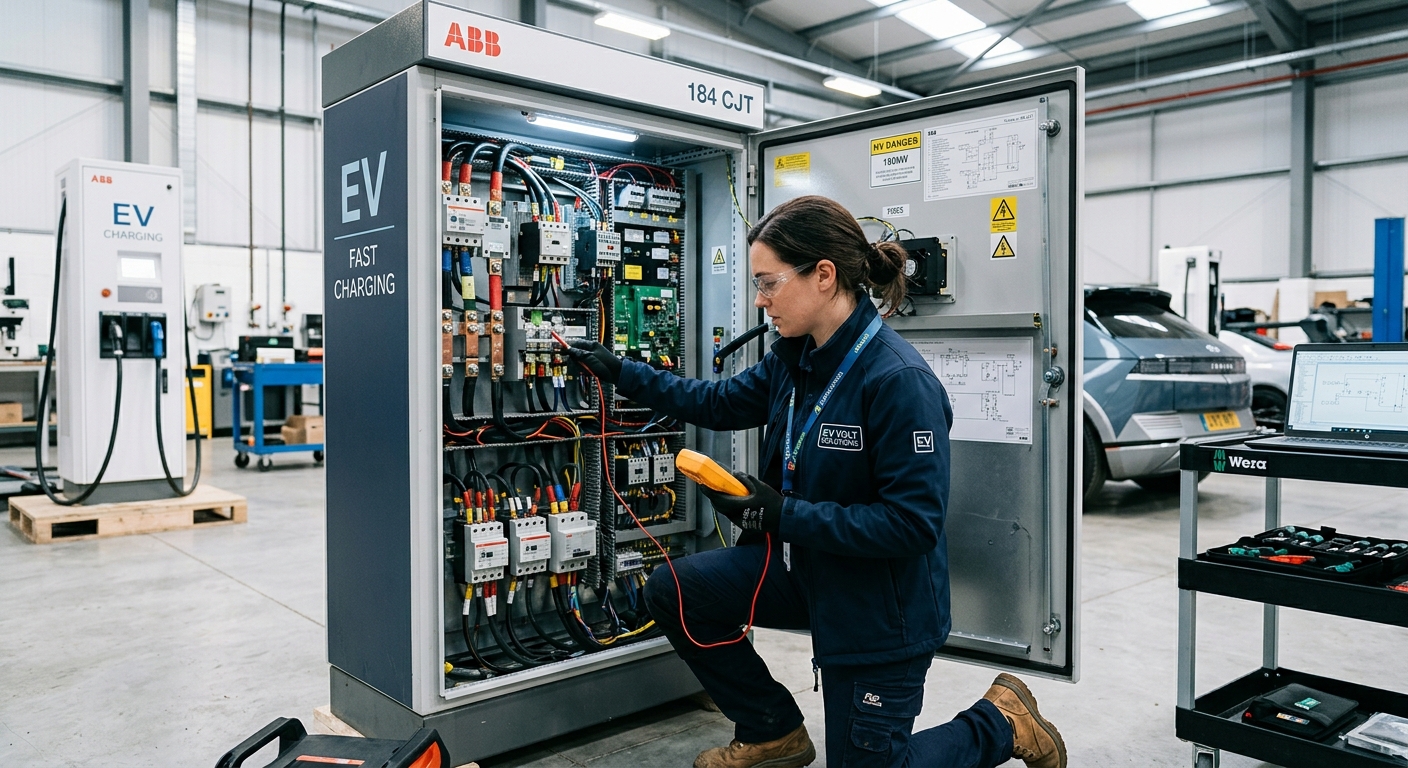
Technician inspecting an open EV charger cabinet during maintenance
What Distributors Should Ask OEM Partners
Before placing a bulk order, ask for salt spray test results specific to the exact coating and substrate combination used — not generic material data sheets. Ask whether the enclosure is die-cast, extruded, or welded sheet aluminum, since fabrication method affects seam integrity. And ask what the warranty actually covers on the enclosure itself, separate from the electronics warranty.
These are the same due-diligence questions worth raising in any OEM vs. ODM sourcing conversation — enclosure material and fabrication quality vary wildly between manufacturers even when the internal power electronics look identical on a spec sheet.
Subscribe the newsletter to get updated to news and promotions
Cookies give you a personalized experience,Сookie files help us to enhance your experience using our website, simplify navigation, keep our website safe and assist in our marketing efforts. By clicking "Accept", you agree to the storing of cookies on your device for these purposes. Click "Adjust" to adjust your cookie preferences.For more information, review our Cookie Policy