Multi-Unit Housing Charger Rollouts: Metering and Billing Models That Actually Work
Home / Blog / Guidelines / Multi-Unit Housing Charger Rollouts: Metering and Billing Models That Actually Work
15 Sep, 2026
condo EV charger metering
EV charger submetering apartments
multifamily EV charging billing model
The billing model that actually works for multi-unit housing charger rollouts is submetered per-kWh billing with a modest service fee layered on top — flat monthly fees fall apart once more than a handful of residents plug in, and pure utility pass-through creates regulatory headaches in most jurisdictions. Property managers who get this right treat metering as infrastructure, not an afterthought bolted on after installation. Get the metering hardware wrong on day one, and you’ll be retrofitting panels eighteen months later when resident complaints about fairness start piling up.
Why Flat-Fee Billing Breaks Down Fast
A flat $50/month EV charging fee sounds simple. It’s also the fastest way to create resentment between residents who drive 8,000 miles a year and residents who drive 25,000. One heavy user on a Level 2 charger can pull 300+ kWh a month; a light user might pull 60 kWh. Charge them both the same flat rate and you’re either overcharging the light user or subsidizing the heavy one — usually the latter, because buildings set fees low to avoid complaints.
Flat fees work fine when EV adoption in a building is under 10%. Once you cross that threshold, the math stops working. Buildings that stuck with flat fees past 15-20% penetration report the same pattern: light users start complaining they’re overpaying, and management ends up renegotiating the fee structure anyway — usually after months of friction. It’s cheaper to build submetering in from the start than to retrofit it under pressure.
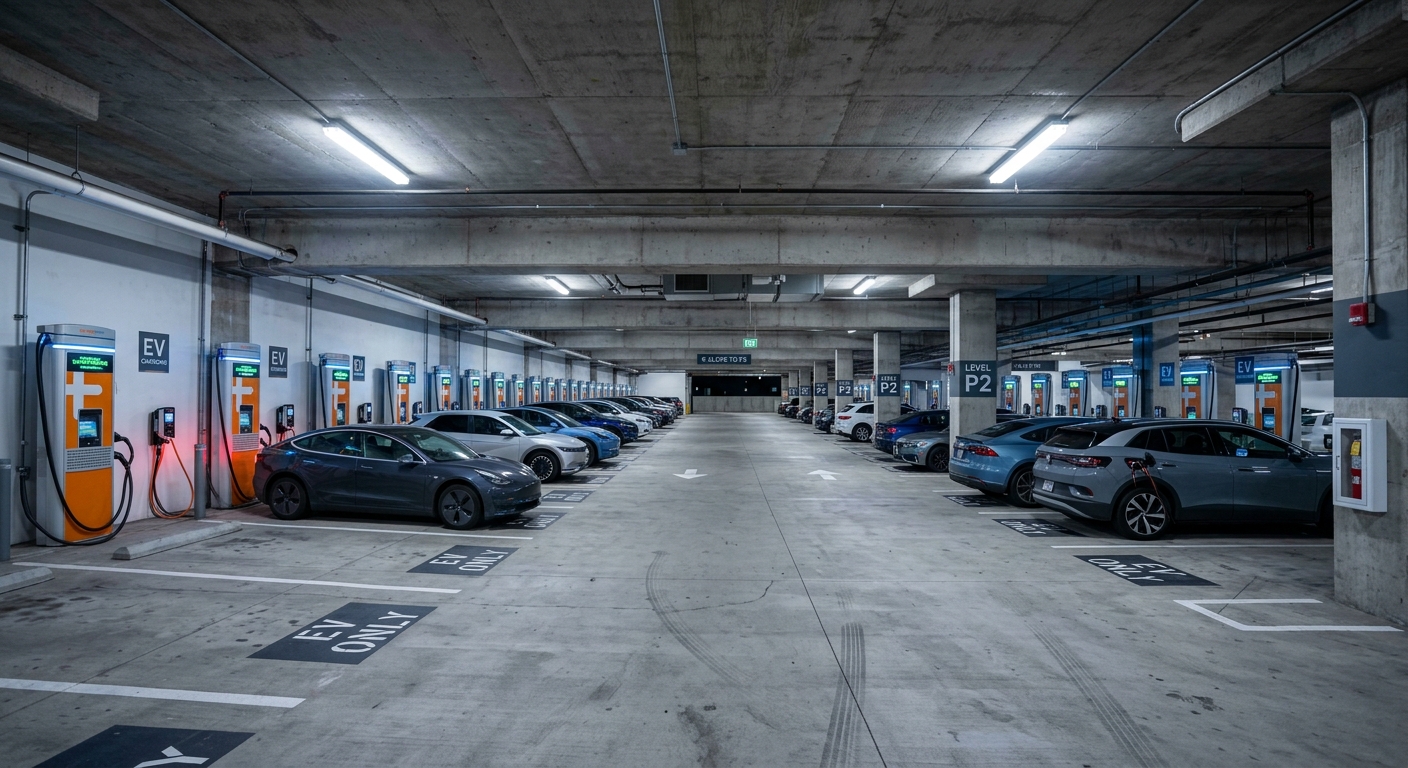
Underground parking garage with multiple EV charging stations and meter displays
Submetering: The Model Most Buildings Land On
Submetering assigns a dedicated, revenue-grade meter to each charging port or parking space, then bills residents based on actual kWh consumed — typically passed through at the building’s blended utility rate plus a small service margin (often $0.02-$0.05/kWh) to cover maintenance and network fees. This is the model most property managers converge on after their first year of operation, because it’s the only one that scales cleanly as EV adoption climbs from 10% to 50%+ of residents.
What Makes a Meter ‘Revenue-Grade’
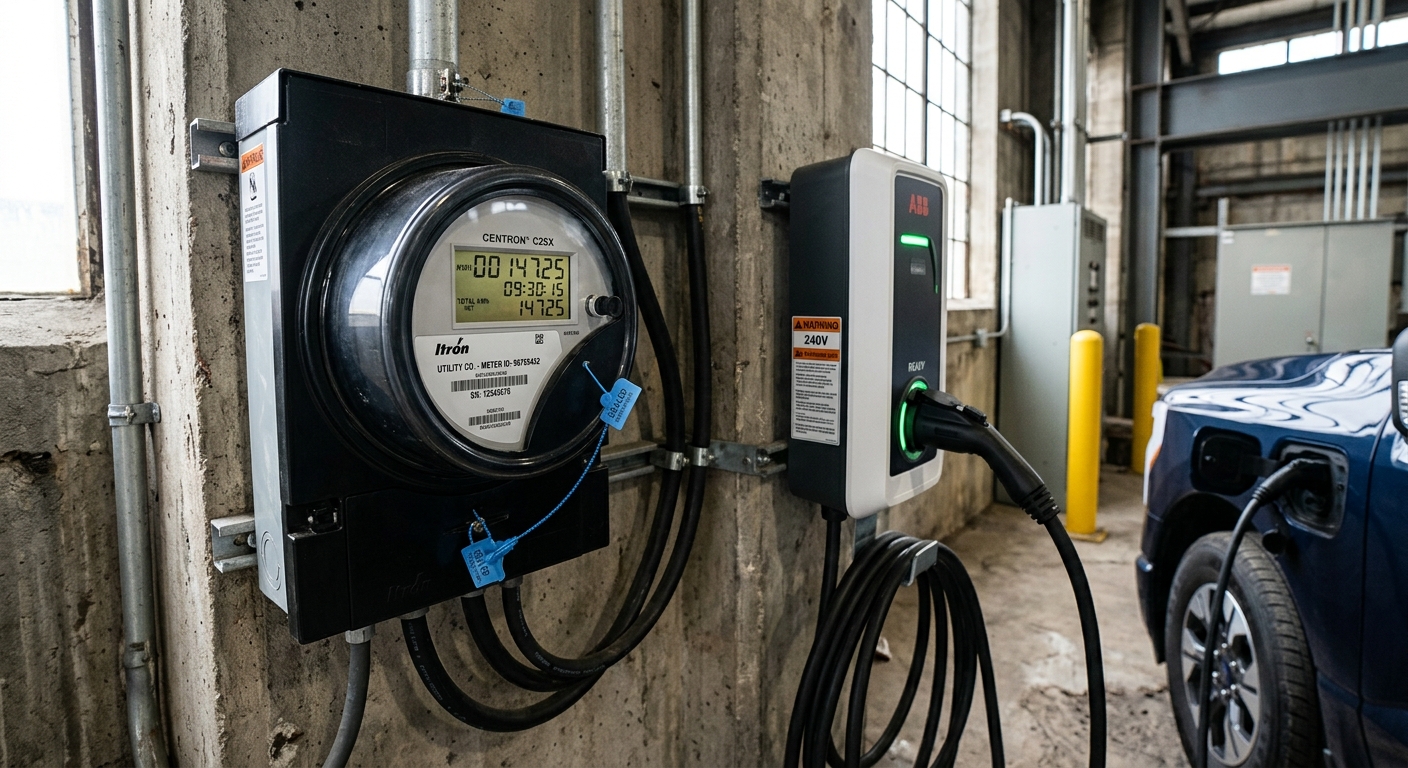
Not every meter embedded in a charger qualifies for billing purposes. Many jurisdictions — California, for instance, under Weights and Measures rules — require NTEP-certified or utility-approved metering accuracy (typically ±2% or better) before you can legally bill a tenant based on that reading. Cheaper chargers often include a basic current sensor that’s fine for load monitoring but not certified for commercial billing. This is exactly the kind of detail that gets missed during procurement and surfaces as a legal problem months later — a pattern covered in the hidden cost of cheap EV chargers.
Revenue-grade electric meter mounted next to an EV charger for billing accuracy
Time-of-Use Submetering: When It’s Worth the Complexity
Time-of-use (TOU) submetering charges residents different rates depending on when they charge — cheaper overnight, more expensive during peak grid hours (typically 4-9 PM in most US utility territories). It’s more complex to implement because it requires software that tracks timestamps against a rate schedule, not just cumulative kWh. But for buildings enrolled in utility demand-response programs, TOU billing is often the difference between qualifying for incentive payments and not.
For example, a 120-unit apartment complex in a California utility territory implemented TOU submetering paired with dynamic power sharing across its 40 charging ports. Residents who shifted charging to off-peak hours saved roughly 35% compared to flat-rate billing, and the building avoided a $180,000 transformer upgrade by capping simultaneous peak draw. That’s a real financial argument for TOU, not just a nice-to-have.
Utility-Owned Metering: Fewer Headaches, Less Flexibility
Some utilities — particularly in states pushing multifamily EV adoption like California, New York, and Massachusetts — offer programs where the utility installs and owns the meter, then bills residents directly at the standard residential rate through a sub-account. This removes the property owner from the billing relationship entirely, which sounds appealing until you realize it also removes their ability to add a service margin or subsidize charging as a resident amenity.
New construction projects benefit most from this model, since utility coordination can happen during the design phase rather than as a retrofit. If you’re speccing a new build, this is worth exploring alongside your charging station design process — not after panels are already in the wall.
The Panel Capacity Problem Nobody Budgets For
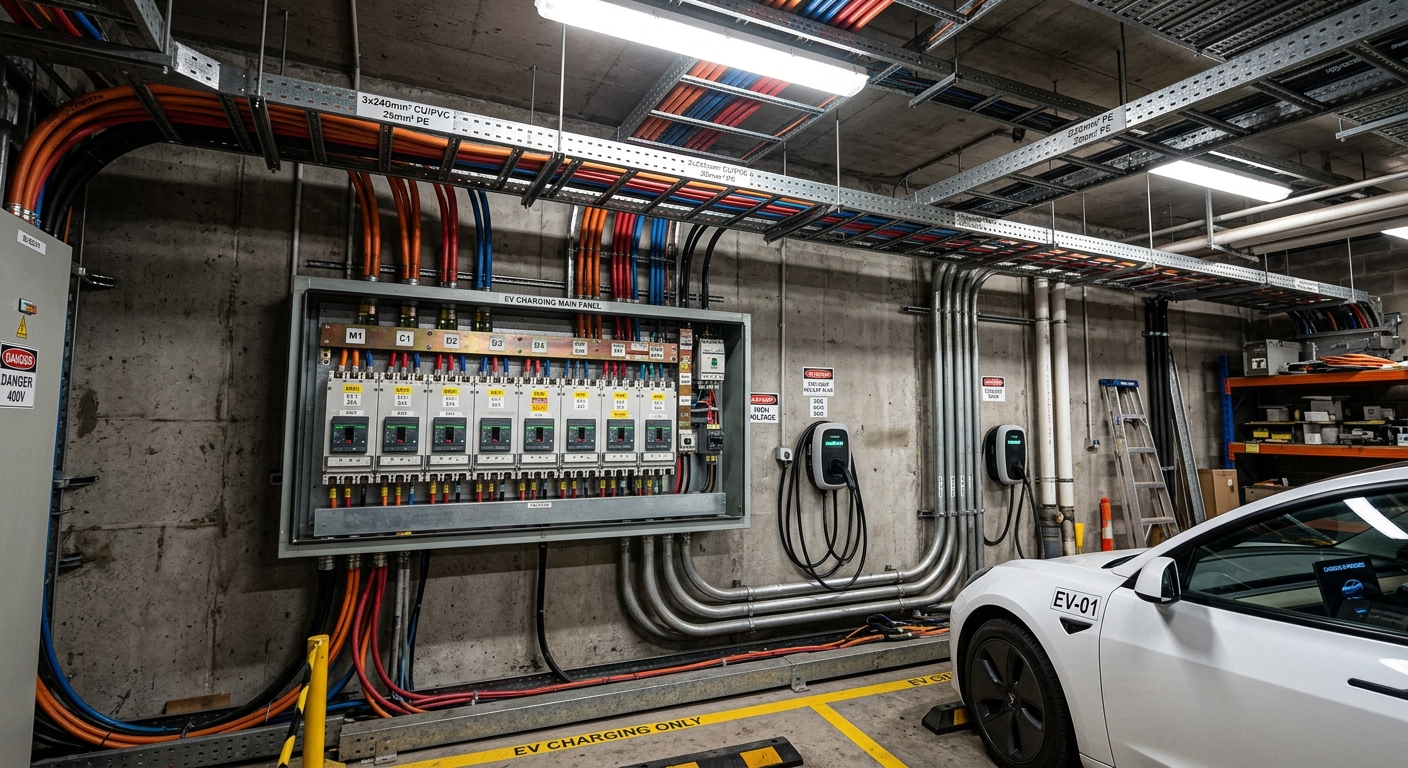
Here’s what catches most property managers off guard: metering model choice is downstream of a bigger constraint — panel and transformer capacity. A 60-unit building built in the 1990s often has a service panel sized for lighting and HVAC, not 30+ Level 2 chargers pulling 7.2 kW each. Do the math: 30 chargers at full simultaneous draw is over 200 kW, which most older multifamily buildings simply don’t have available without a utility service upgrade costing six figures.
This is where dynamic power sharing earns its keep. Instead of sizing infrastructure for worst-case simultaneous charging, load-balancing systems allocate available capacity across active sessions in real time, throttling individual chargers so the building never exceeds its service limit. This is often the single biggest cost lever in a MUD rollout — sometimes bigger than the metering decision itself.
Electrical panel room feeding a multi-unit EV charging installation
Choosing Between AC and Networked DC for Shared Parking
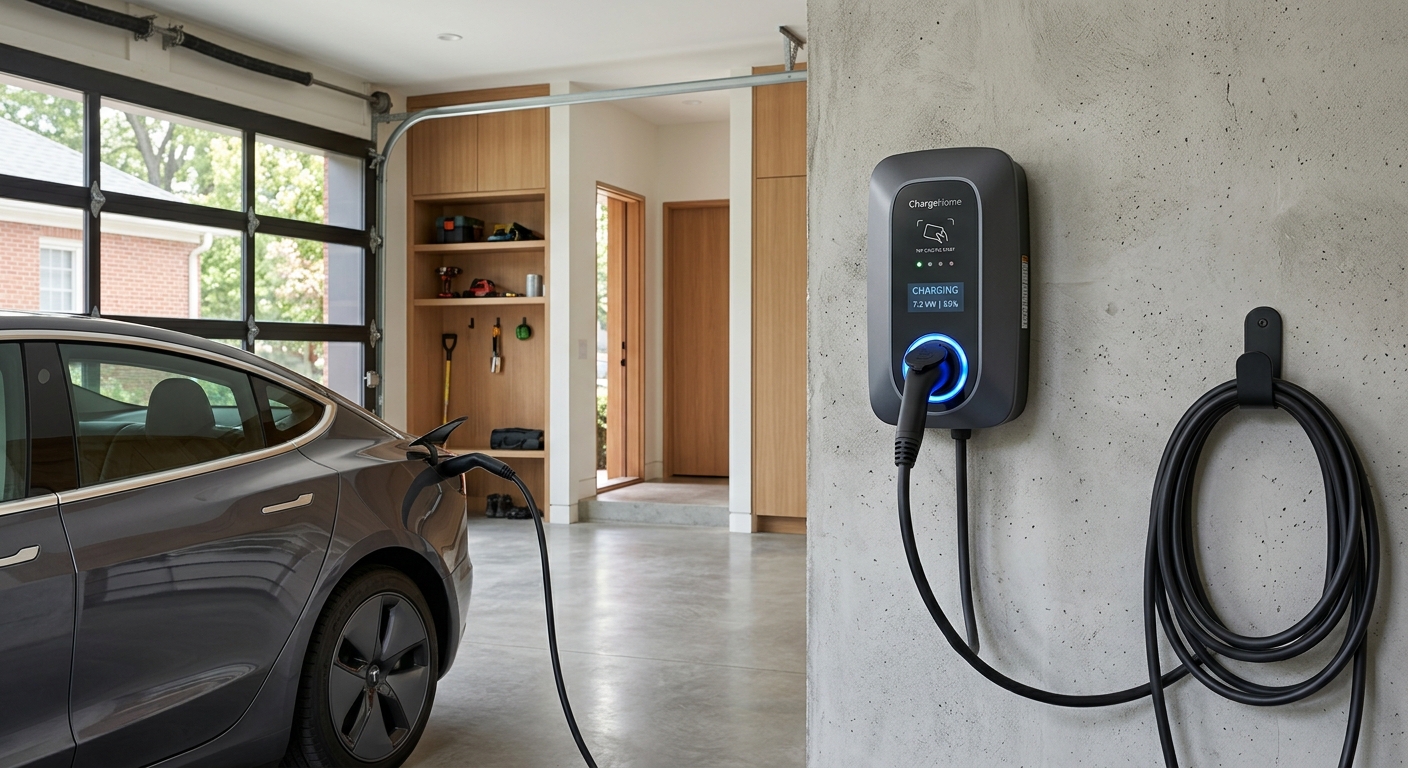
Almost every multi-unit housing rollout uses AC Level 2 chargers — DC fast charging is overkill for overnight residential use and dramatically more expensive per port. But the AC charger you choose still needs OCPP connectivity to support remote billing, session tracking, and per-resident authentication via RFID card or app. Chargers without this — the kind sometimes sold as ‘smart’ but lacking real backend integration — force buildings back toward flat-fee billing because there’s no way to track individual usage.
Reference our guide to AC chargers and Type 1 vs Type 2 selection before locking in hardware. And for buildings weighing network protocol requirements against billing platform compatibility, it’s worth understanding OCPP 1.6 vs OCPP 2.0.1 — the version matters for what billing features you can actually support down the line.
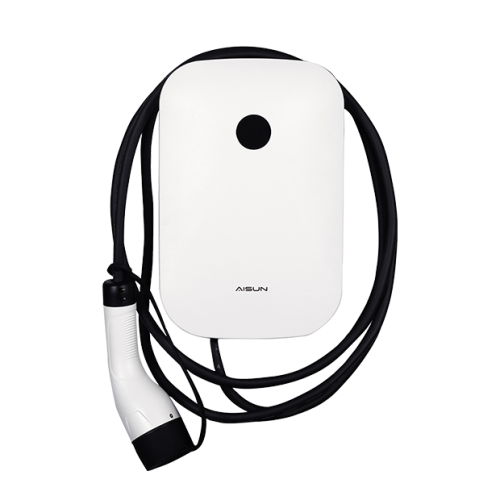
Wall-mounted AC EV charger with RFID card reader in a residential garage
Handling Guest and Visitor Charging Fairly
Resident-only billing systems often forget about visitors — and that’s a mistake. A property with 200 units and a handful of visitor parking spots still needs a way to bill non-residents who plug in, usually through a payment terminal or app-based one-time charge rather than a monthly account. Skipping this either means giving away free electricity to guests or blocking visitor charging entirely, both of which create friction.
Buildings bidding on mixed-use or amenity-driven properties should look at payment terminal integration approaches borrowed from public charging deployments — the same credit-card tap infrastructure works well for visitor parking without requiring a full resident account setup.
What Actually Fails in Real Deployments
The most common rollout failure isn’t hardware — it’s billing accuracy disputes. A resident sees a $40 charge they don’t recognize, disputes it with property management, and the meter data either supports the charge or it doesn’t. Without certified metering and clean session logs (timestamp, kWh delivered, port ID, resident ID), these disputes drag on and erode trust in the whole program.
Second most common failure: undersized service triggering nuisance breaker trips during peak evening charging, which is really a load balancing problem disguised as a hardware complaint. Get ahead of both by choosing suppliers who provide certified metering data logs and configurable power-sharing out of the box — check credentials early using our supplier selection guide.
Subscribe the newsletter to get updated to news and promotions
Cookies give you a personalized experience,Сookie files help us to enhance your experience using our website, simplify navigation, keep our website safe and assist in our marketing efforts. By clicking "Accept", you agree to the storing of cookies on your device for these purposes. Click "Adjust" to adjust your cookie preferences.For more information, review our Cookie Policy