Airport Ground Support Equipment Electrification: Charging Design for Tugs, GPUs, and Baggage Tractors
Home / Blog / Guidelines / Airport Ground Support Equipment Electrification: Charging Design for Tugs, GPUs, and Baggage Tractors
08 Sep, 2026
airport EV charging infrastructure
electric baggage tractor charging
GPU charging design
GSE electrification
Airport GSE charging design comes down to one constraint: turnaround windows are 25-45 minutes, not overnight. That means you’re sizing chargers around opportunity charging at the gate or a nearby stand — not just parking equipment in a depot at the end of a shift. Get the power delivery, connector layout, and ramp electrical infrastructure wrong, and you end up with tugs sitting at 40% state of charge when the next aircraft rolls in.
Why GSE Charging Isn’t Warehouse Charging
A forklift in a warehouse has predictable breaks — lunch, shift change, overnight. A pushback tug on an airport ramp doesn’t get that luxury. Between flights, it might have 20 minutes before it’s needed again, and that 20 minutes includes driving to the gate, hooking up, and driving back. There’s maybe 10-12 minutes of actual charging time available, if the schedule cooperates.
This is a fundamentally different duty cycle than the one covered in forklift charging infrastructure design, where you’re matching chargers to multi-hour shift gaps. On the ramp, you’re matching chargers to flight schedules that shift by the hour and get disrupted by weather, delays, and gate reassignments daily.
The practical result: GSE charging systems need higher C-rates and faster partial charging performance than most industrial equipment, even though the batteries themselves are often smaller.
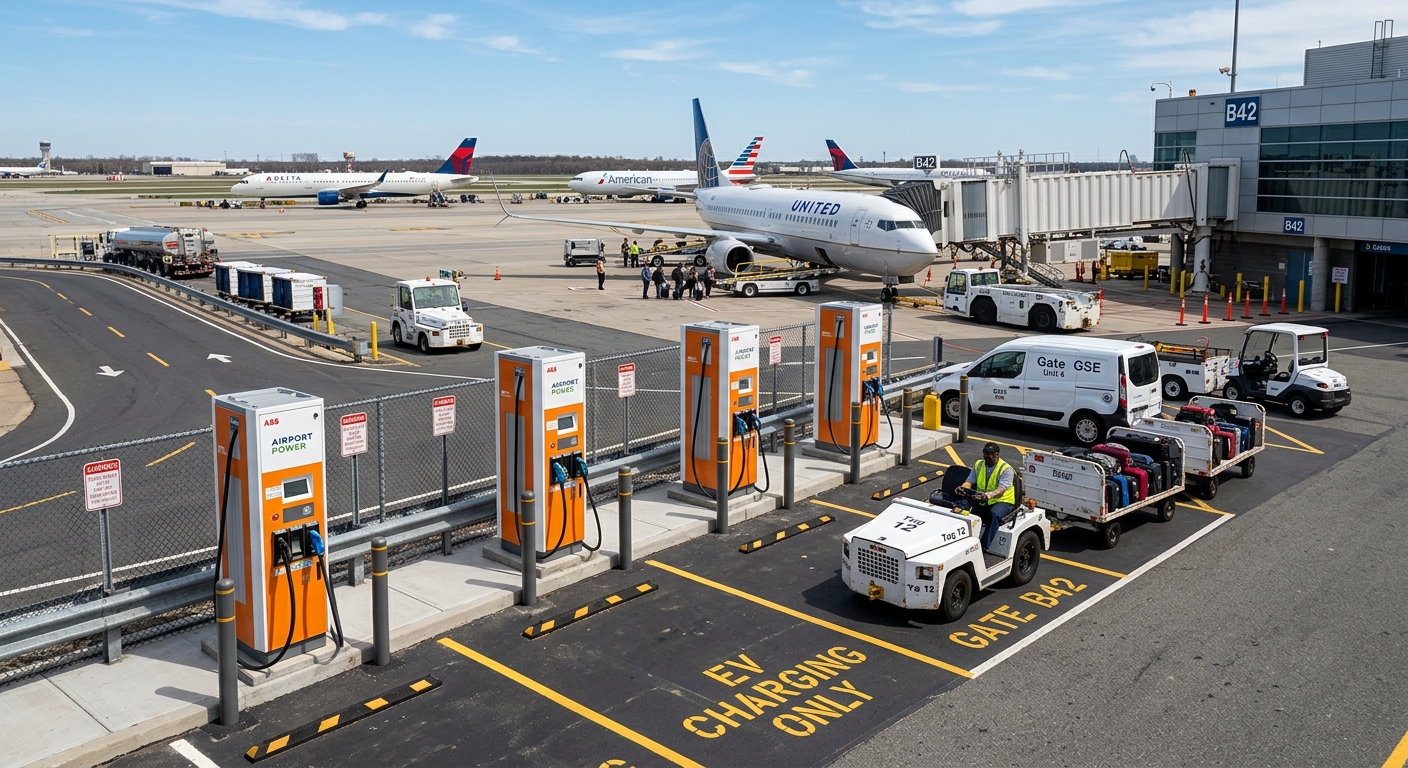
Electric baggage tractor charging near an airport gate during turnaround
Power and Voltage: What Tugs, GPUs, and Baggage Tractors Actually Need
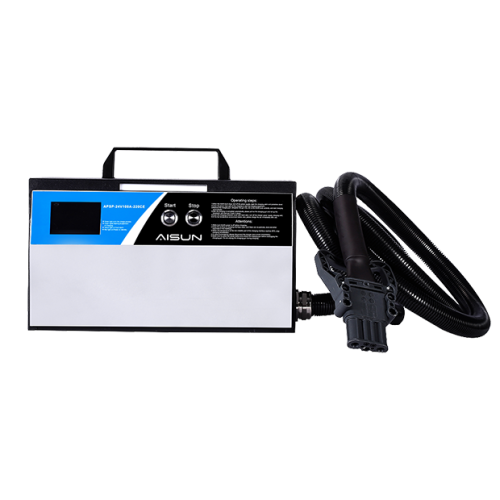
Most electric pushback tugs run on 80V battery systems rated between 300-600Ah, drawing 30-60 kW during opportunity charging to recover 20-30% state of charge in 10-15 minutes. Baggage tractors, being lighter duty, often use 48V-80V packs and need less — typically 15-30 kW is enough to keep them cycling all shift.
GPUs Are a Different Animal
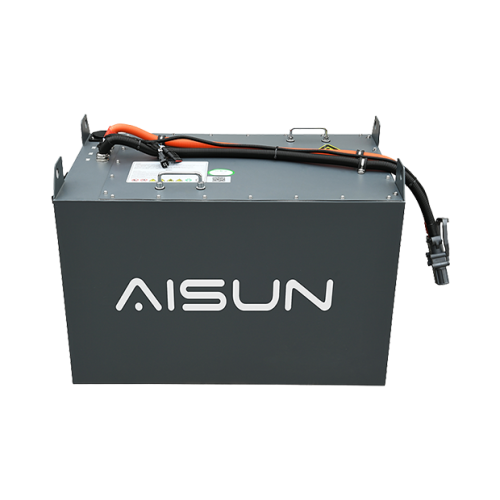
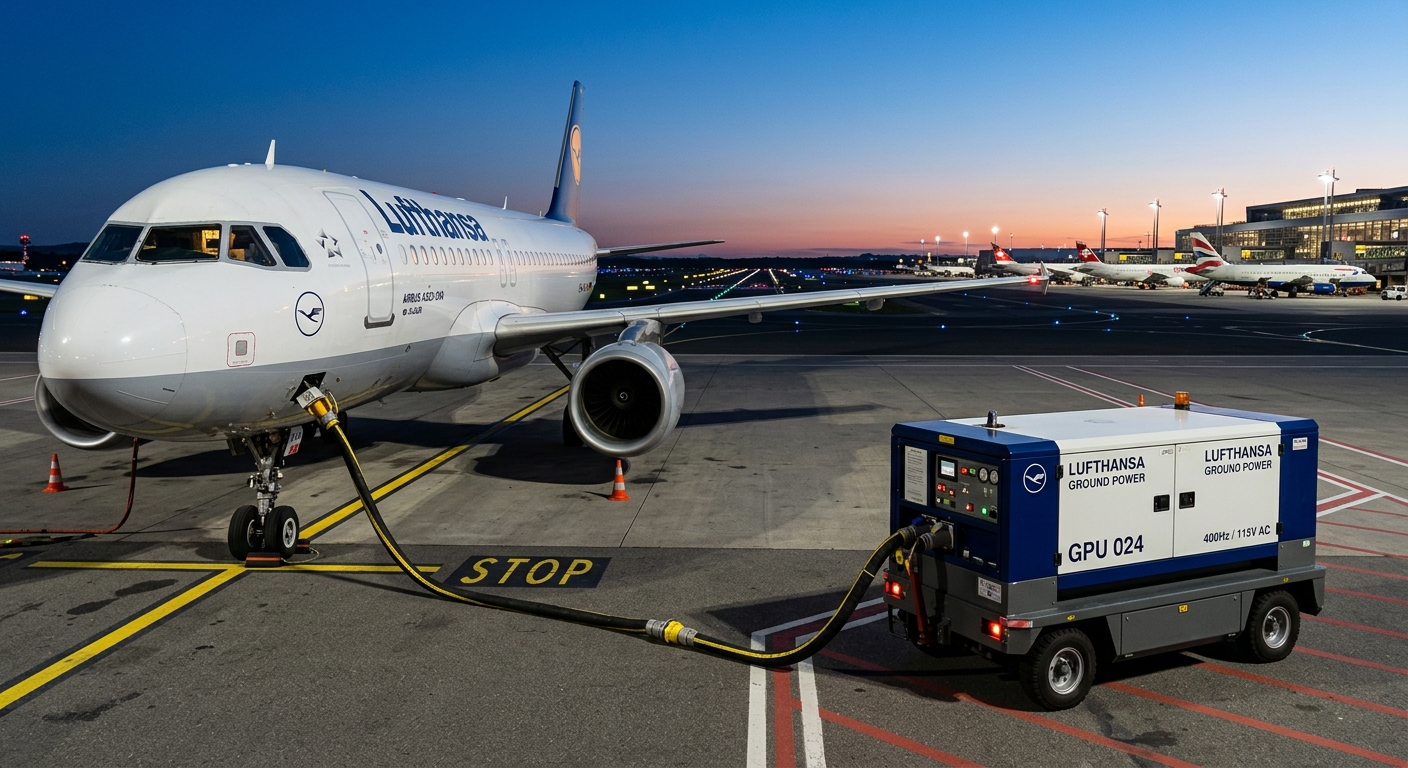
Ground power units are the outlier. A large GPU supplying 90 kVA of 400Hz power to a widebody aircraft can carry battery packs in the 200-400 kWh range, and recharging that overnight at a reasonable rate calls for 60-150 kW DC input. Undersize this and your GPU fleet never fully recovers between red-eye departures and early morning banks.
This is where charger selection matters as much as electrical capacity. Reviewing options across EV charger types, levels, and connectors helps clarify why a Level 2-equivalent charger simply can’t keep pace with GPU battery sizes — you need true DC fast charging architecture, not AC trickle.
Ground power unit connected to aircraft on airport apron
Opportunity Charging at the Gate vs. Centralized Depot Charging
The single biggest design decision for airport GSE electrification is where the chargers physically live — at the gate, or back at a central depot. Both have real tradeoffs, and most airports end up running a hybrid.
Gate-Side Opportunity Charging
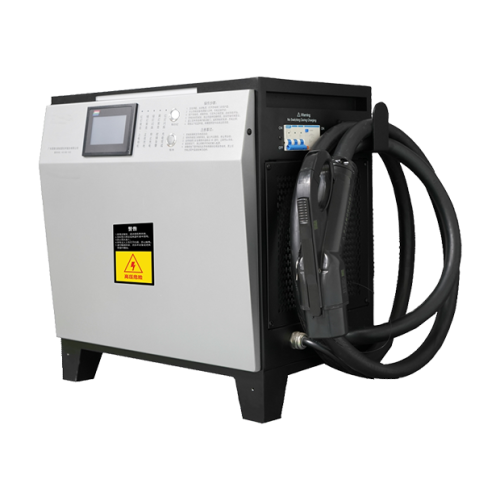
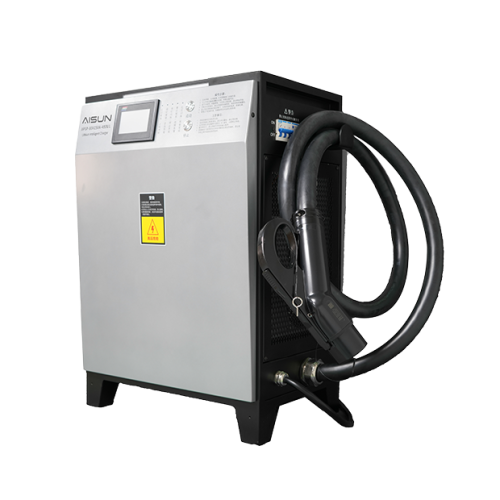
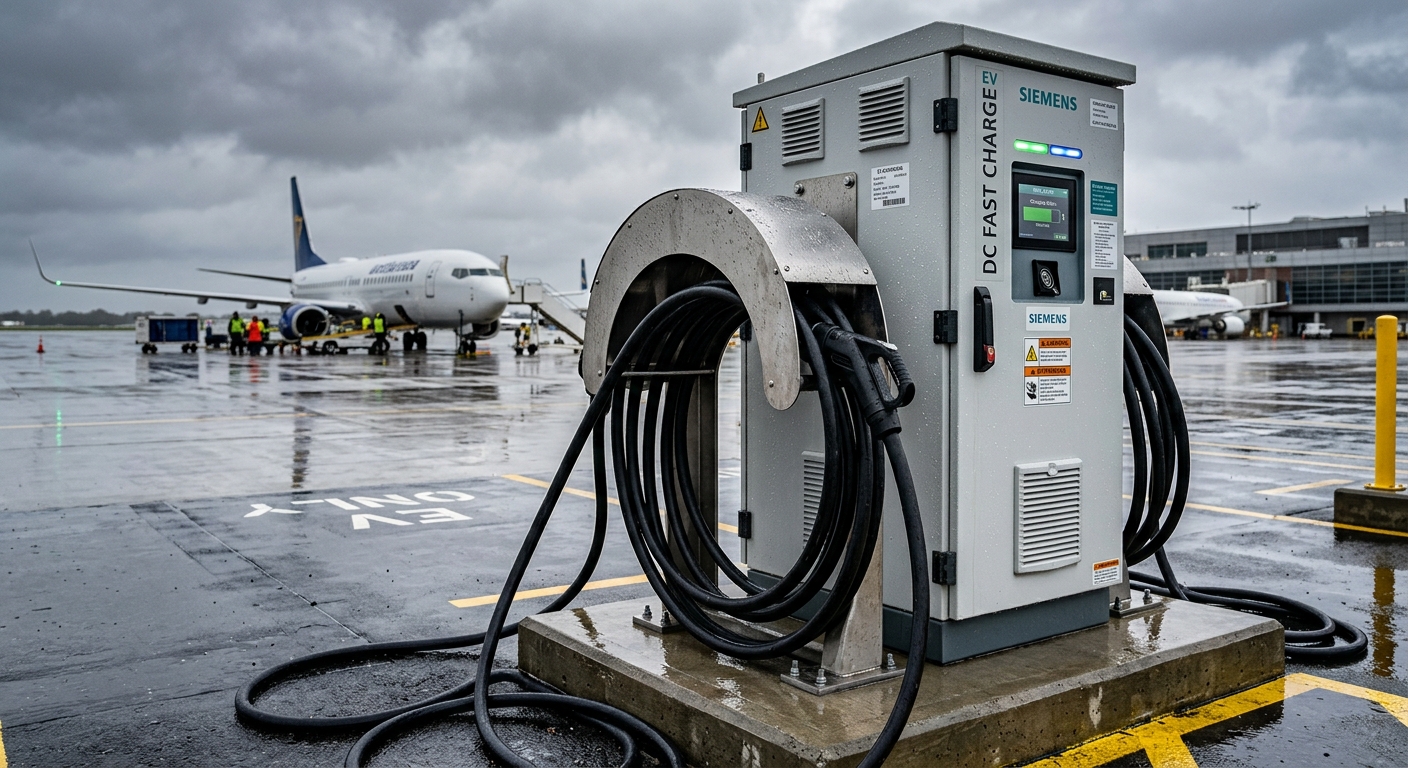
Installing DC fast chargers at or near gates lets tugs and tractors top up during the actual turnaround, without driving back and forth. The catch: ramp space is expensive, cable routing has to avoid foreign object debris (FOD) hazards, and every charger needs weatherproofing rated for jet blast exposure and de-icing fluid runoff.
Centralized Depot Charging
A depot model — similar in principle to overnight depot charging setups for 50+ vehicle fleets — is simpler electrically and easier to maintain, but it burns turnaround time driving equipment back and forth. For a hub airport running tight 25-minute turns, that round trip alone can eat half the available charging window.
Most efficient operations land on a split: baggage tractors and belt loaders opportunity-charge near the gate cluster, while GPUs and less time-critical equipment recharge at a centralized ramp depot overnight.
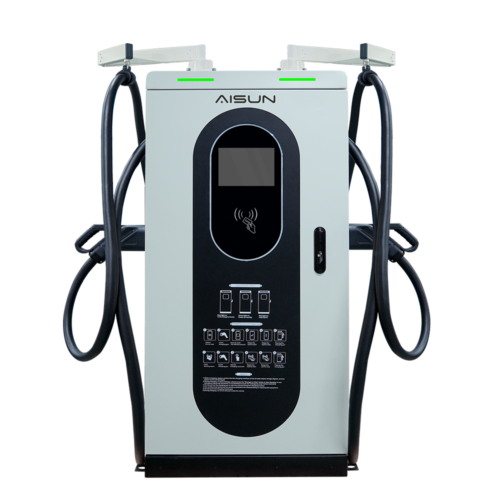
DC fast charging stations installed along an airport ramp near gates
Case Example: A Mid-Size Hub Reworking Its GSE Fleet
Consider a mid-size hub airport running 40 electric pushback tugs across six terminals. Initially, all charging happened at a single depot behind the maintenance hangar — convenient for technicians, terrible for turnaround times. Tugs were routinely arriving at gates below 50% charge during peak banks.
The fix: installing 45 kW DC chargers at four satellite charging clusters spread across the ramp, each serving 8-10 gates. Tugs now opportunity-charge for 8-10 minutes during each turnaround instead of making a 15-minute round trip to the depot. Average state of charge at gate arrival went from 48% to 71%, and the airport avoided adding four extra tugs to cover the gap — a real capital savings, not just an operational one.
The lesson generalizes: proximity beats charger count. Four modest 45 kW chargers spread across the ramp outperformed a handful of higher-power chargers concentrated in one spot.
Ramp Electrical Infrastructure: FOD, Weather, and IP Ratings
Ramp environments punish equipment in ways a parking garage never will. Jet blast, de-icing fluid, fuel vapor, and constant foot and vehicle traffic all factor into charger placement and enclosure design.
FOD prevention: Charging cables must retract or route through protected channels — a loose cable near an active taxiway is a safety violation, not just an inconvenience.
IP rating: Chargers need IP65 or higher, but as covered in why IP rating alone doesn’t predict outdoor charger lifespan, the rating alone doesn’t guarantee longevity — connector seal quality and drainage design under repeated wash-down cycles matter just as much.
Ground fault protection: Ramp charging stations see moisture exposure constantly from rain, de-icing runoff, and pressure washing. Wiring practices that would pass inspection in a warehouse often fail here — see the common mistakes outlined in ground fault errors in outdoor DC chargers.
Weatherproof outdoor DC charging cabinet on an airport ramp
Load Management Across a Multi-Charger Ramp
Adding 15-20 DC fast chargers across a ramp without dynamic load management is how airports end up with a transformer upgrade nobody budgeted for. Because GSE charging demand spikes in short bursts tied to flight banks — not evenly throughout the day — peak demand can be 3-4x the average draw.
Dynamic power sharing lets a charging cluster allocate available capacity across active sessions in real time, prioritizing tugs and tractors that are closest to their next assignment. This is the same principle detailed in load balancing and dynamic power sharing for EV charging, applied to a ramp instead of a parking lot. Without it, airports either oversize the site transformer — an expensive fix — or accept that some equipment charges slower during peak banks.
Connector and Communication Standards Aren’t Standardized Yet
Unlike road EVs converging on CCS or NACS, airport GSE equipment runs on a patchwork of proprietary connectors and voltage systems depending on manufacturer. A tug from one OEM might use a completely different plug than a baggage tractor from another, even on the same ramp.
This matters enormously for distributors and airport operators sourcing chargers, because a single-connector-type charger locks you into one equipment vendor. Reviewing charging connector types and plug standards is a useful starting point, but for GSE specifically, the safer long-term move is specifying multi-connector or field-adaptable charging heads — a lesson many procurement teams learn the hard way after locking into a single-vendor charging setup.
Subscribe the newsletter to get updated to news and promotions
Cookies give you a personalized experience,Сookie files help us to enhance your experience using our website, simplify navigation, keep our website safe and assist in our marketing efforts. By clicking "Accept", you agree to the storing of cookies on your device for these purposes. Click "Adjust" to adjust your cookie preferences.For more information, review our Cookie Policy