Mining and Quarry Electrification: Charging Heavy Off-Road Equipment in Harsh Environments
Home / Blog / Industry Applications / Mining and Quarry Electrification: Charging Heavy Off-Road Equipment in Harsh Environments
01 Sep, 2026
heavy equipment DC charging
mine site charging infrastructure
off-road EV charger
quarry electrification
Charging heavy off-road equipment at mines and quarries requires sealed IP65+ enclosures, liquid or filtered cooling, and vibration-rated components — because dust ingestion and thermal cycling, not power delivery, are what actually kill chargers on these sites. A standard commercial DC charger designed for a parking lot will typically fail within 6-12 months in an open-pit environment; equipment built specifically for mining duty cycles can run 5+ years under the same conditions.
Why Mine Sites Destroy Standard Chargers
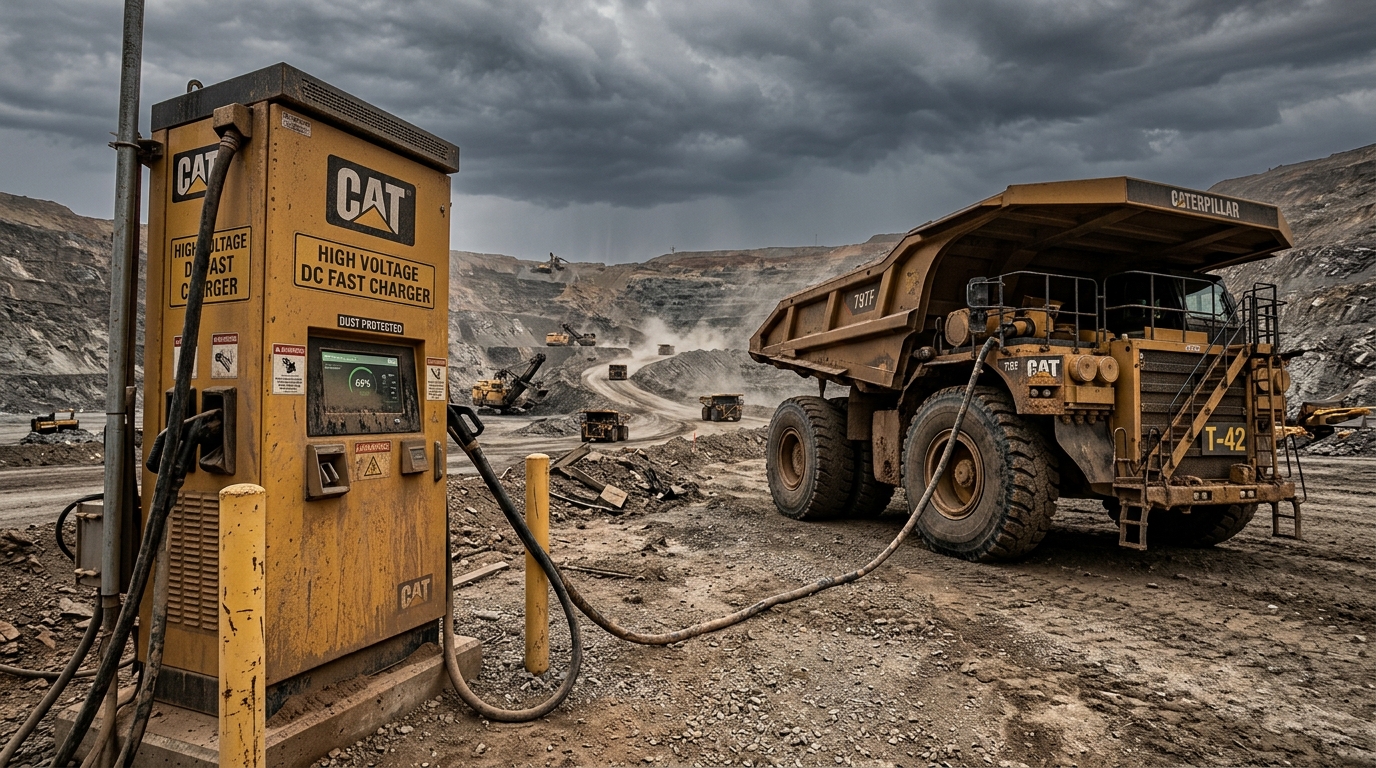
Silica dust is the silent killer. It’s abrasive, it’s everywhere, and it finds its way into anything with a fan intake. Unlike urban dust, quarry and mine dust is fine, mineral-hard particulate that behaves almost like sandpaper inside a charger’s cooling channels — clogging heat sinks, scoring bearing surfaces, and eventually causing thermal shutdowns that look like electrical faults but are actually airflow failures.
Then there’s vibration. A charger mounted near a haul road or crusher pad absorbs constant low-frequency shock from passing 400-ton trucks. Solder joints crack. Connectors loosen. Circuit boards that passed every bench test in the factory start throwing intermittent communication errors within weeks — a failure mode we’ve covered in detail in why EV chargers keep throwing communication errors, and mine sites accelerate this by an order of magnitude.
The Third Factor: Thermal Extremes at Altitude and Depth
Open-pit mines are often at elevation, where thinner air reduces convective cooling efficiency. Underground operations swing the other way — high ambient heat, poor ventilation, and confined installation space. Both extremes push charger components toward their derating thresholds, a phenomenon we explored for fast chargers generally in why DC fast chargers derate in summer. Mining sites just experience it year-round.
Industrial charger enclosure coated in fine mining dust under overcast sky
IP66 Isn’t Enough — What Sealed Design Actually Means
An IP rating tells you how a charger performed in a lab test, not how it behaves after 18 months of accumulated grit. That’s a distinction we detail in why IP rating alone doesn’t predict outdoor charger lifespan, and nowhere is it more relevant than mining.
What actually matters on a mine site is positive-pressure enclosure design — a small internal fan maintains slightly higher pressure inside the cabinet than outside, so dust can’t migrate in through seams or connector glands even as they age and gasket compression loosens. Combine that with liquid-cooled power modules (no external air path required at all) and you eliminate the dust-ingestion failure mode entirely rather than just slowing it down.
Connector and Cable Protection
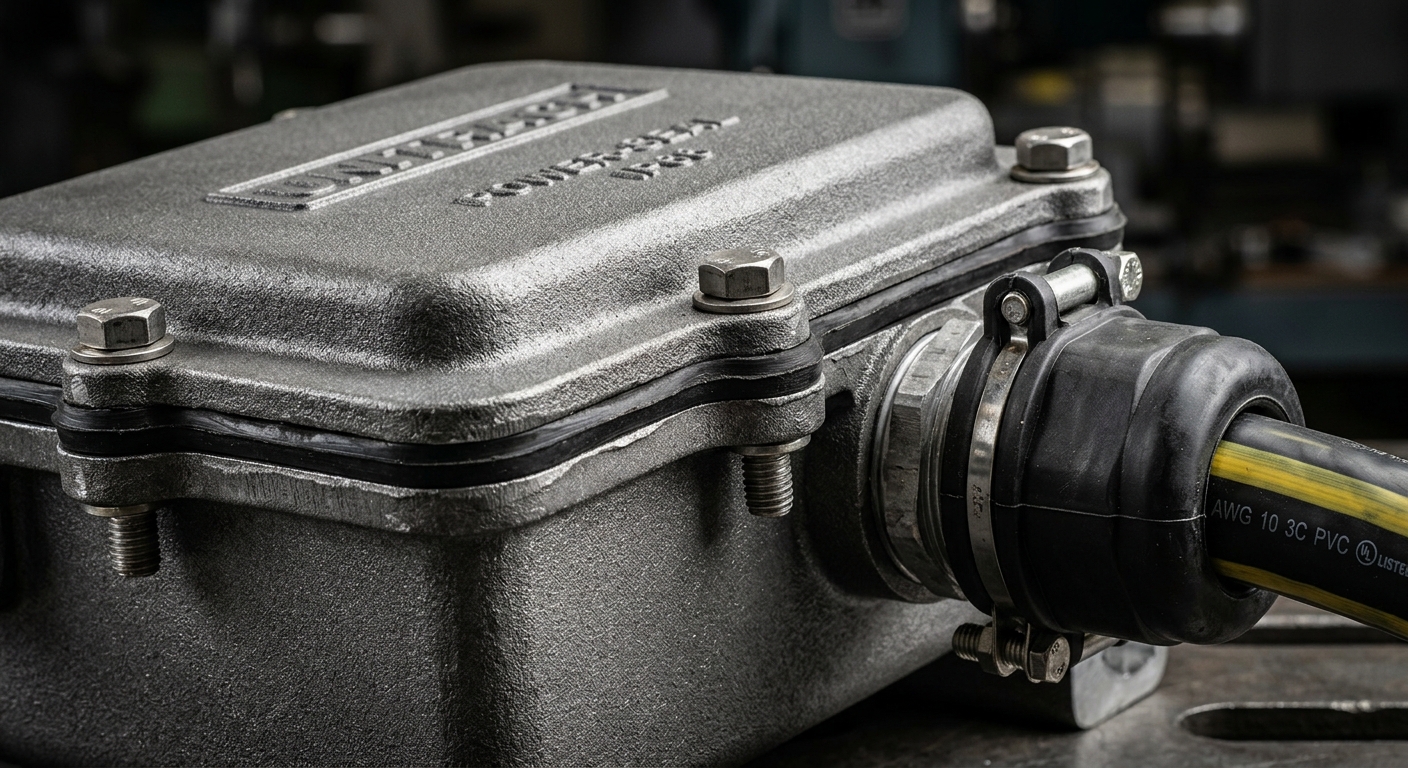
Charging connectors left dangling near a quarry floor accumulate dust and rock chips fast. Reinforced boots with auto-clearing mechanisms, plus liquid-cooled charging cables, handle the combination of high current and abrasive environment far better than standard air-cooled cable assemblies, which tend to crack at the jacket after repeated dust exposure and UV cycling.
Close-up of sealed connector boot and gasket seams on a mining-grade charger
Matching Chargers to Off-Road Equipment Duty Cycles
An electric haul truck and an electric drill rig have almost nothing in common in terms of charging profile, and treating them the same is a common and costly mistake. Haul trucks run continuous multi-hour cycles hauling material out of the pit, then need fast top-ups during shift changes — closer to the depot-style charging patterns discussed in charging heavy-duty electric trucks. Drill rigs and loaders, by contrast, often sit idle in short bursts between operations, making them better candidates for opportunity charging at lower power.
Example: A Quarry Operator’s Mixed Fleet
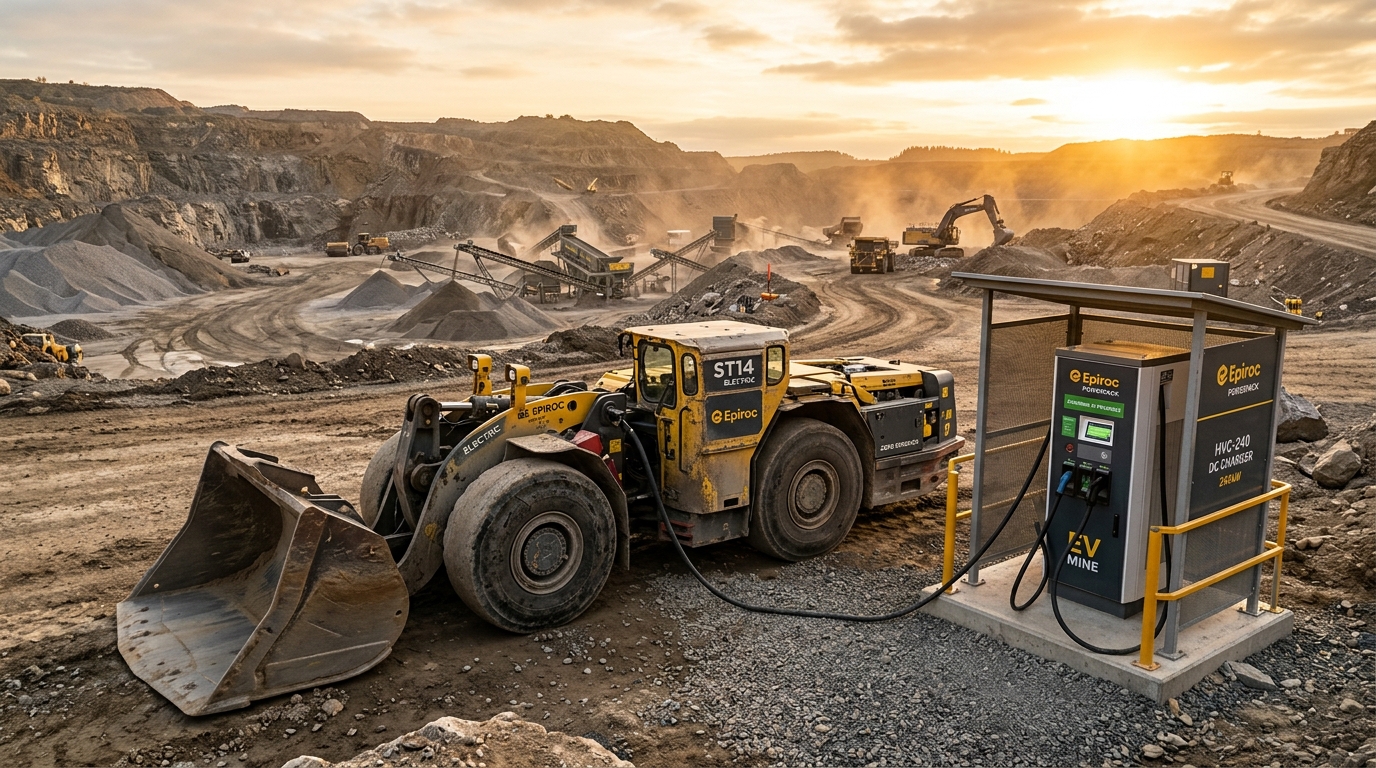
Take a mid-size aggregate quarry running six electric loaders and two haul trucks. The loaders get 60kW chargers positioned near stockpile zones for 20-minute opportunity charges between loads. The haul trucks get a dedicated 240kW DC bank near the shift-change area, sized so both vehicles can charge simultaneously without derating — a load management challenge similar to what’s covered in load balancing and dynamic power sharing. Get this segmentation wrong and you either starve the trucks of power during peak shift transitions or massively oversize the transformer for equipment that barely needs it.
Electric mining loader charging at a DC fast charging station in a quarry
Power Availability: The Real Bottleneck Underground
Most quarries and open-pit mines don’t have grid infrastructure anywhere near what a fleet of 300kW+ haul trucks demands. Underground operations face an even harder constraint — running new medium-voltage feeders down a shaft is expensive and sometimes physically impossible without major civil work.
This is where battery-buffered charging systems earn their keep. Instead of upgrading a substation, a battery buffer bank absorbs grid power steadily over hours and discharges it in high-power bursts during shift-change windows — the same logic explained in battery-buffered DC fast chargers vs. grid upgrades. For remote quarries running on diesel generators as primary power, this buffering also smooths out generator load spikes that would otherwise shorten generator lifespan.
Cold Starts, Heat Soak, and Component Derating
Mines operate in some of the most temperature-extreme locations on the planet — from -30°C in northern Canadian and Siberian sites to 45°C+ ambient in Australian and African open-pit operations. Both extremes cause real, measurable performance loss if the charger isn’t engineered for it.
Cold Climate Behavior
Below -20°C, power electronics need active heating just to reach safe switching temperatures before a charge session can even begin — the same startup reliability issue detailed in how cold climates break EV chargers. A charger that takes 15 minutes to warm up before delivering full power is a serious problem during a tight shift-change window.
Heat Soak in Open-Pit Sun
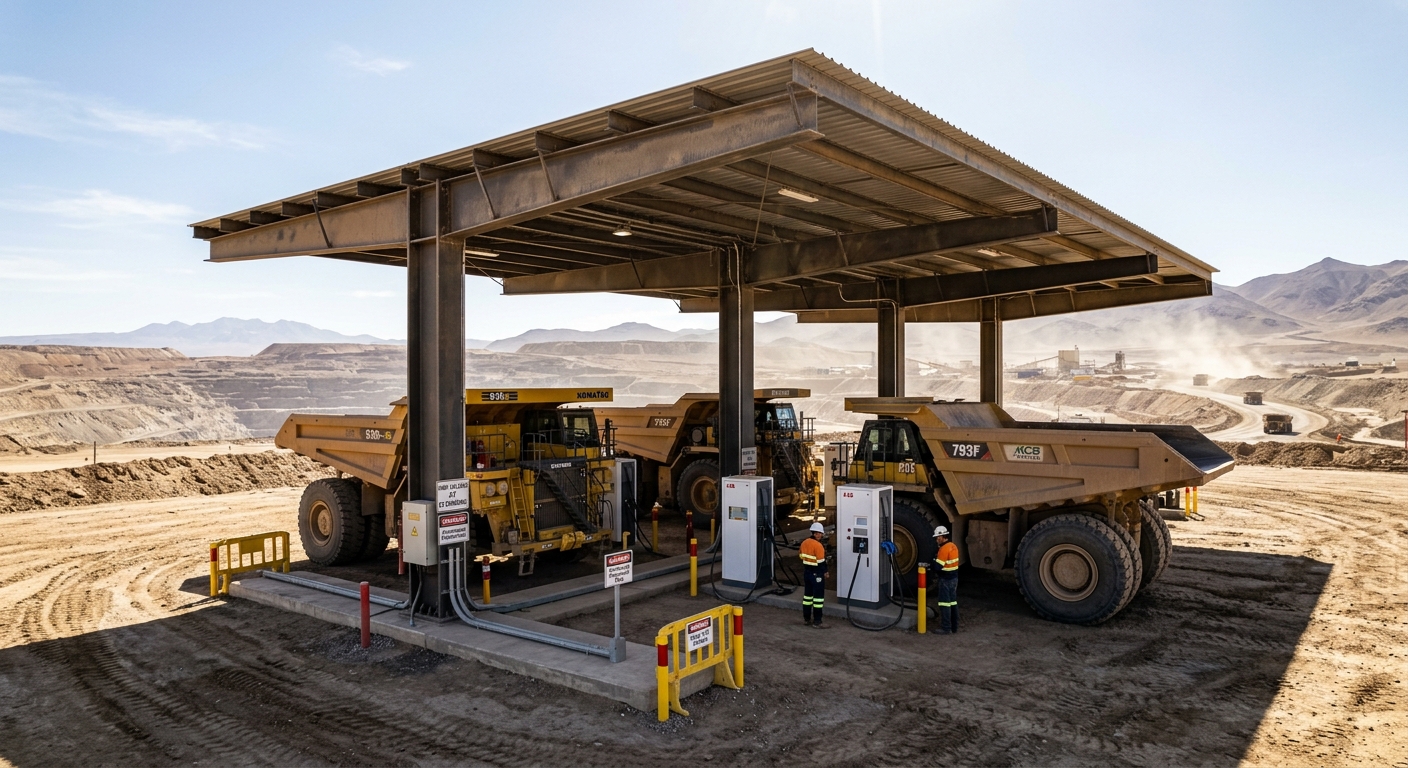
Conversely, a charger cabinet sitting in direct desert sun with no shade structure can reach internal temperatures that trigger thermal derating well before ambient air even hits 40°C. Simple mitigation — shade canopies, reflective cabinet coatings, oversized heat exchangers — buys back meaningful charging capacity during the hottest shift of the day.
EV charger installation shaded under a canopy in a hot desert mining environment
Vibration-Rated Mounting and Structural Design
Chargers near active haul roads or crusher stations need mounting that isolates them from ground-transmitted vibration, not just structural bolting. IEC 60068-2-6 vibration testing — standard for mobile and rugged equipment — should be a baseline requirement in any RFP for mining-site charging hardware, alongside the broader specification criteria covered in how to specify an EV charger RFP.
Internally, this means conformal-coated circuit boards, strain-relieved wiring harnesses, and connectors rated for repeated mechanical shock — not just electrical cycling. A charger that passes 10,000 electrical connect/disconnect cycles in a lab but hasn’t been shock-tested is still a liability once it’s bolted 15 meters from an active blast zone.
Communication Reliability in RF-Noisy Environments
Mining sites are electromagnetically messy. Large variable-frequency drives on crushers and conveyors, high-voltage switching equipment, and radio communication networks for autonomous haul trucks all generate electrical noise that can interfere with a charger’s OCPP communication link back to a management platform.
Choosing between OCPP 1.6 and OCPP 2.0.1 matters less here than physical-layer robustness — shielded communication cabling, isolated ground references, and fiber backhaul where distances or interference levels justify it. A charger that drops its network connection every time the crusher cycles on isn’t a software problem; it’s an EMI problem that needs to be solved at the wiring stage, not the firmware stage.
Subscribe the newsletter to get updated to news and promotions
Cookies give you a personalized experience,Сookie files help us to enhance your experience using our website, simplify navigation, keep our website safe and assist in our marketing efforts. By clicking "Accept", you agree to the storing of cookies on your device for these purposes. Click "Adjust" to adjust your cookie preferences.For more information, review our Cookie Policy