Retail and Shopping Center Charging: Sizing Stations for Dwell Time, Not Just Traffic
Home / Blog / Guidelines / Retail and Shopping Center Charging: Sizing Stations for Dwell Time, Not Just Traffic
09 Jul, 2026
dwell time EV charger
Level 2 vs DC fast charging retail
mall EV charging stations
shopping center EV charging
Size your retail charging stations around how long customers actually stay, not how many cars roll through the lot. A grocery store with 45-minute average dwell time needs fast DC charging to deliver a meaningful top-up in that window, while a shopping mall with 2-hour visits can run almost entirely on cheaper Level 2 AC and still turn over the same number of drivers per day. Get this backwards — install slow AC at a quick-stop pharmacy or overbuild DC at a mall — and you either frustrate customers or burn capital on power nobody uses.
Why Traffic Counts Are the Wrong Starting Point
Here’s a mistake we see constantly: a property manager pulls parking lot traffic data, sees 2,000 vehicles a day, and assumes that number should drive charger count. It shouldn’t. Traffic tells you demand for parking, not demand for charging throughput.
What actually determines how many chargers you need — and what type — is the product of dwell time and charging power. A shopper who stays 90 minutes on a 7 kW AC charger picks up roughly 10 kWh. That same shopper on a 60 kW DC charger for 90 minutes would need battery buffering they simply don’t have; most EVs taper charging speed well before that. In other words, past a certain dwell time, extra DC power is wasted money.
The real sizing question is: what’s the maximum useful kWh delivery for the average visit length at this location, and how many parking spaces need to hit that number simultaneously during peak hours?
Retail parking lot with EV charging bays and shoppers’ vehicles
Mapping Dwell Time to Charger Type by Retail Format
Not all retail is equal, and lumping “shopping center charging” into one category is where a lot of RFPs go wrong.
Grocery and pharmacy: short but frequent
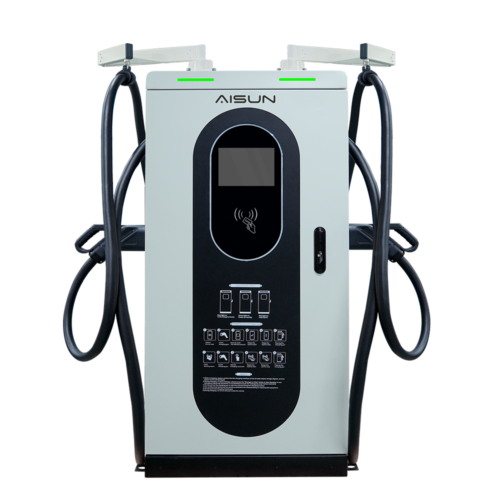
Average dwell time here runs 30–45 minutes. That’s tight. A 7 kW AC charger only delivers 3–5 kWh in that window — barely worth the trip for most drivers. This is one of the few retail formats where DC fast charging (30–60 kW) actually makes economic sense, because it can put 20–40 kWh into a battery during a routine grocery run.
Big box retail: the AC sweet spot
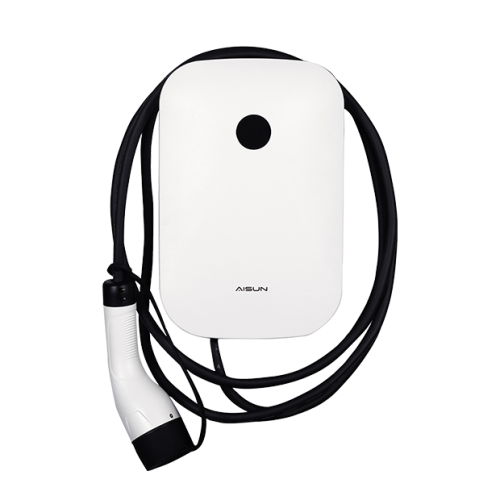
Home improvement stores, department stores, electronics retailers — dwell time of 45–75 minutes fits comfortably with 11–22 kW AC Level 2. You get meaningful charge delivery without the capital cost and grid demand of DC infrastructure.
Shopping malls: dwell time is your friend
Two to three hour visits are common at malls, especially with food courts and entertainment anchors. This is dwell time working in your favor — even 7 kW AC delivers 15–20 kWh over a typical visit. Malls should prioritize port count over per-port power, because the bottleneck is availability, not charging speed.
Quick-service and strip malls: DC or nothing
Ten to twenty minute visits mean AC charging is close to pointless. If you’re installing chargers at a strip mall anchored by a coffee shop or fast casual restaurant, go DC fast — anything less won’t move the needle for the driver.
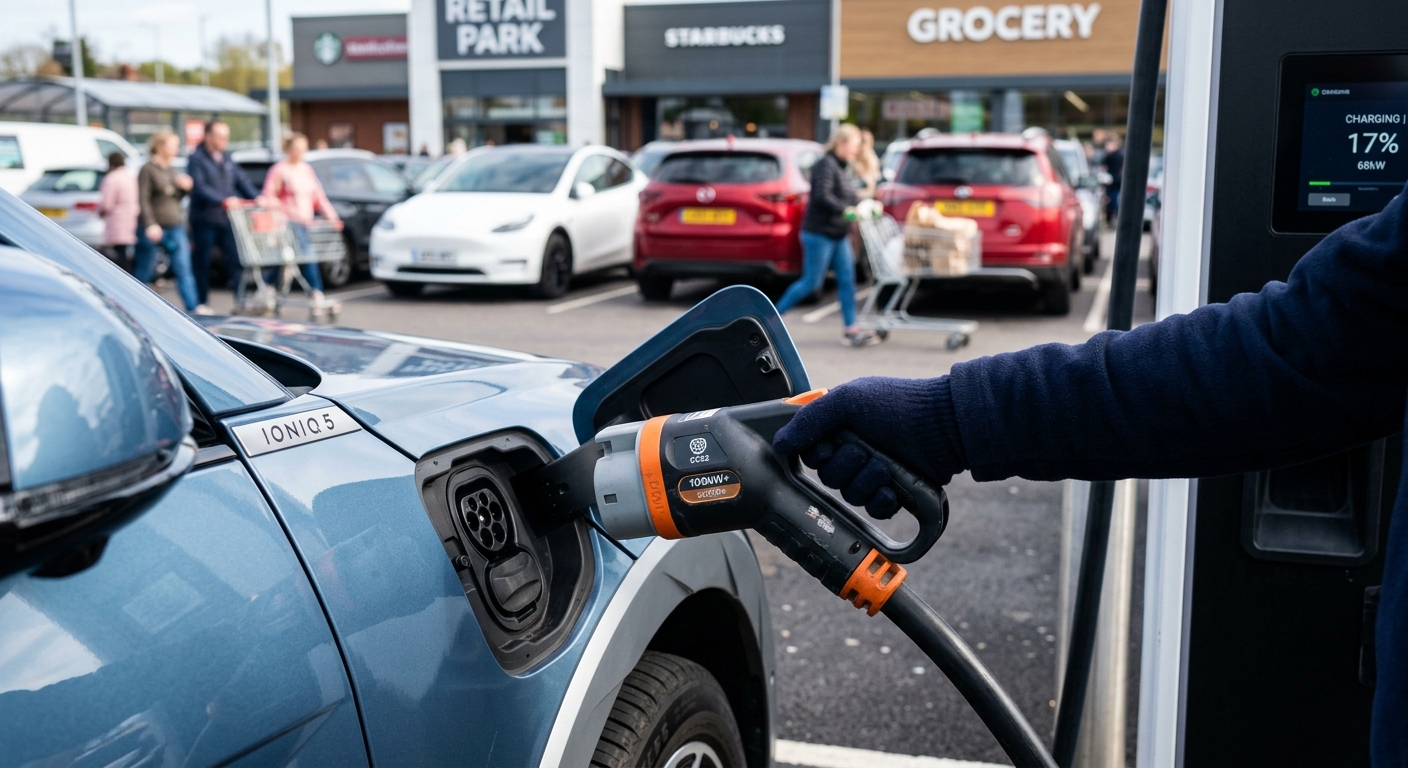
DC fast charger connector plugged into an electric vehicle at a retail location
A Real-World Sizing Scenario
Consider a mid-size shopping center anchored by a grocery store, a big box retailer, and a row of smaller shops — roughly 1,200 parking spaces total. A traffic-only approach might suggest 12–15 chargers spread evenly. A dwell-time approach looks completely different.
Near the grocery entrance, the developer installs four DC fast chargers (60 kW) — short dwell, high power, fast turnover, matching the 30-minute grocery run. Near the big box store, six Level 2 AC ports (11 kW) serve the 60-minute average visit. Near the smaller specialty shops with mixed dwell times of 20–90 minutes, a mix of two DC and four AC ports covers both quick-stop and lingering shoppers.
Total port count ends up similar to the traffic-based estimate — but the power mix is completely different, and so is the capital cost. Swapping four of those AC ports for DC fast chargers where they weren’t needed would have added six figures in electrical infrastructure and transformer upgrades for negligible throughput gain.
The Grid Reality Nobody Budgets For
Here’s what catches a lot of retail developers off guard: even a modest DC fast charging installation can push site power demand past what the existing transformer supports. Four 60 kW DC chargers running simultaneously is 240 kW of demand — comparable to a small industrial building.
Dwell-time sizing helps here too. Because you’re not defaulting to DC everywhere, you naturally reduce peak demand. But for the DC ports you do install, load balancing and dynamic power sharing lets you avoid oversizing the site transformer — the chargers negotiate available power in real time instead of each pulling full rated output simultaneously.
This matters more at retail than at, say, a fleet depot, because retail charging demand is spiky and unpredictable. A Saturday afternoon surge looks nothing like a quiet Tuesday morning.
Turnover Economics: Why More Ports Beat More Power at High-Dwell Sites
At a mall with 2-hour average dwell time, adding a second DC fast charger next to an existing one barely improves throughput — the bottleneck isn’t charging speed, it’s port availability. A driver who arrives and finds both spots occupied just leaves.
The math: an AC Level 2 port at a mall can realistically serve 3–4 vehicles per day given the 2-hour dwell cycle. A DC fast port at the same site, even though it charges faster, serves roughly the same number of vehicles per day because arrivals are still gated by parking turnover, not charging speed. So why pay 4–5x more for DC infrastructure that doesn’t move more cars through?
This is the core insight retail operators miss: past a certain dwell time, port count is your throughput lever, not power output.
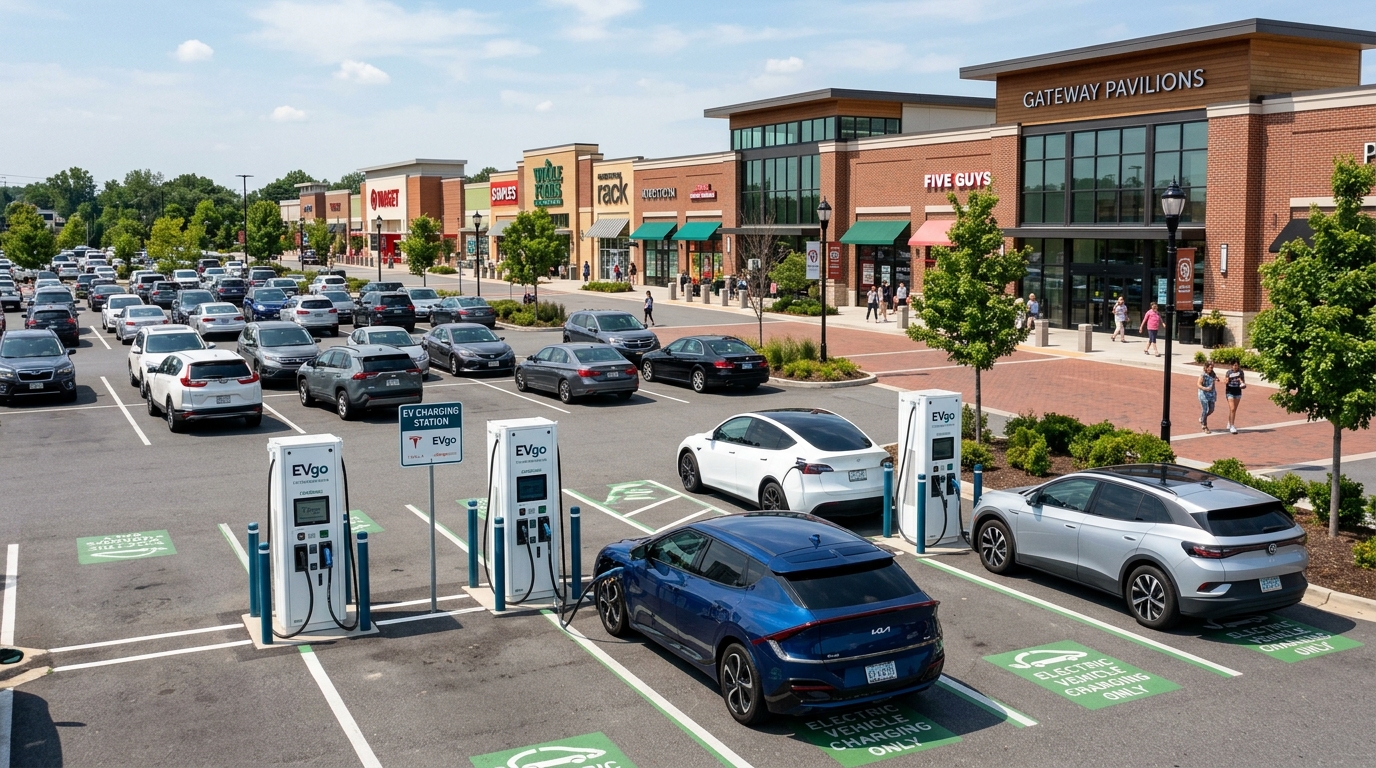
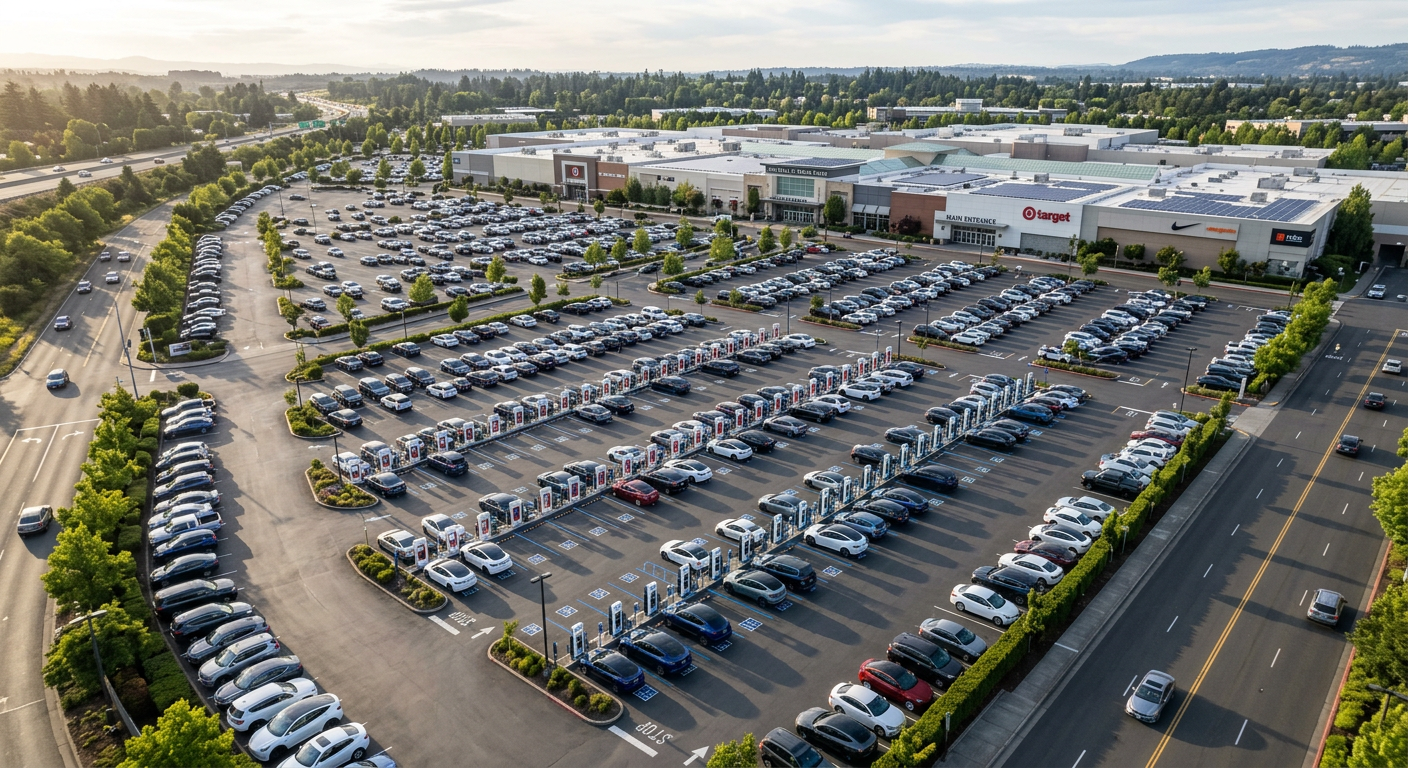
Aerial view of shopping mall parking lot with rows of EV charging stations
Building the Sizing Checklist
Before specifying equipment, retail developers and distributors should walk through this sequence:
Pull actual dwell time data — not traffic counts. Mobile location data or point-of-sale dwell estimates work better than parking counters.
Segment by anchor tenant — a single property often has multiple dwell-time zones (grocery vs. big box vs. food court).
Calculate useful kWh delivery for the dwell time at candidate power levels — don’t spec power beyond what the visit length can absorb.
Model peak concurrency, not average — Saturday at 2pm, not a Tuesday average.
Check grid capacity against your DC port count before committing to a layout.
Distributors advising retail clients on equipment mix should also weigh long-term serviceability — see our guide on the hidden cost of cheap EV chargers for why undersized or poorly built units cost more after the first warranty claim than the sizing mistake itself.
Where AC and DC Overlap — and When to Just Install Both
Mixed-use retail centers with restaurants, grocery, and specialty retail rarely fit one dwell-time bucket. In these cases, the smartest layout blends both technologies rather than picking a single standard for the whole site.
For teams still deciding equipment mix at the product level, our comparison of AC vs. DC EV chargers for maximum ROI breaks down the cost and margin tradeoffs distributors should factor in before committing to a retail inventory order. And for the underlying design principles that apply across any commercial site, real-world EV charging station design covers layout, cable management, and site planning basics that dwell-time sizing builds on top of.
Subscribe the newsletter to get updated to news and promotions
Cookies give you a personalized experience,Сookie files help us to enhance your experience using our website, simplify navigation, keep our website safe and assist in our marketing efforts. By clicking "Accept", you agree to the storing of cookies on your device for these purposes. Click "Adjust" to adjust your cookie preferences.For more information, review our Cookie Policy