Why IP Rating Alone Doesn’t Predict Outdoor Charger Lifespan
Home / Blog / Guidelines / Why IP Rating Alone Doesn’t Predict Outdoor Charger Lifespan
04 Jun, 2026
EV charger durability
IP rating EV charger
IP65 vs IP67 charger
outdoor charger reliability
An IP rating tells you how well an enclosure resists dust ingress and water spray under controlled lab conditions — nothing more. It says nothing about whether the gaskets will still seal after five summers of UV exposure, whether the PCB conformal coating can survive 3,000 thermal cycles, or whether the salt-laden air at a coastal site will eat through unprotected fasteners in 18 months. If you’re specifying outdoor EV chargers based on IP65 vs. IP67 alone, you’re optimizing for the wrong failure mode.
What an IP Rating Actually Measures (and What It Misses)
IP ratings come from IEC 60529, and the test is short — water jets for a few minutes, dust chambers for a few hours. It’s a one-time, brand-new-enclosure verification. It does not simulate 10 years of expansion, contraction, vibration, or gasket aging.
Here’s what IP testing skips entirely:
UV degradation of polycarbonate enclosures, screen overlays, and cable jackets.
Thermal cycling fatigue on solder joints, connectors, and seals.
Salt fog corrosion on internal hardware, busbars, and PCB traces.
Pollution Degree classification — how the design handles conductive contaminants like coal dust or industrial aerosols.
Insulation aging under continuous voltage stress.
A charger can pass IP67 on day one and still fail at 18 months because the EPDM gasket lost elasticity under thermal cycling. The rating was honest — it just answered the wrong question.
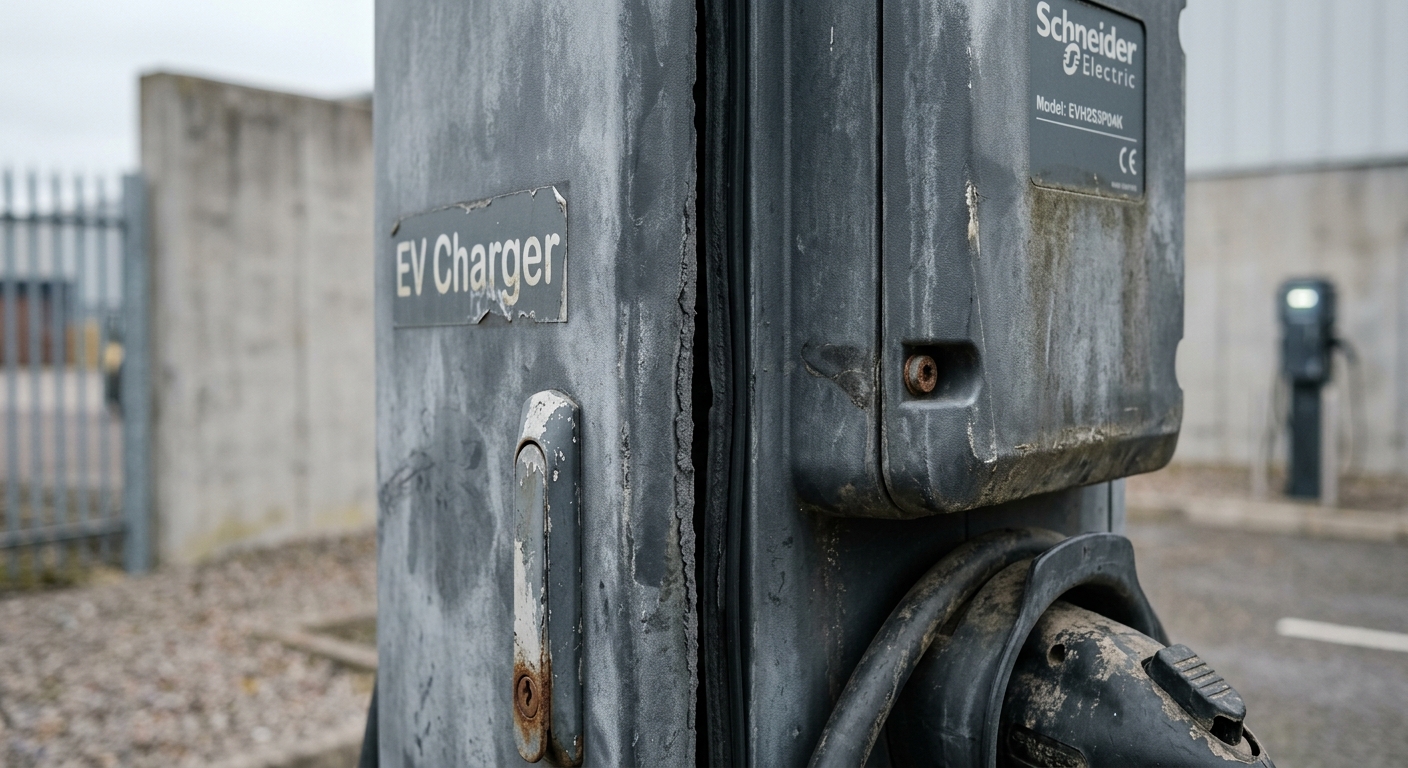
Close-up of weathered outdoor charger enclosure seam and gasket
Thermal Cycling: The Silent Killer of Outdoor Electronics
A charger installed in Chicago sees roughly 80 °C of annual temperature swing — from -25 °C in January to +55 °C surface temp under July sun. That’s about 3,650 thermal cycles over a 10-year deployment, and each cycle stresses every solder joint, every connector pin, and every gasket interface.
Why this matters more than water spray
Solder joint cracking is the leading cause of mid-life DC charger failures we see returned for warranty analysis. The IP rating doesn’t catch it. What does catch it is IEC 60068-2-14 thermal shock testing — typically 500 to 1,000 cycles between -40 °C and +85 °C — combined with power-on cycling. Ask your supplier for that test report. If they only have the IP certificate, that’s a red flag.
This is also why DC fast chargers derate in summer — the same thermal stress that causes long-term failure also forces real-time protection behavior.
UV and Polymer Aging: The 5-Year Cliff
Cheap polycarbonate enclosures yellow, embrittle, and crack within five years of direct sun exposure. Once micro-cracks appear in the housing or screen overlay, your IP67 rating is gone — but the certificate on the spec sheet still says IP67.
What separates a 10-year outdoor housing from a 4-year one:
UV-stabilized polycarbonate or PC-ASA blend with carbon black or titanium dioxide additives.
Powder-coated aluminum over QPQ-treated steel for structural panels.
Silicone gaskets instead of EPDM where UV exposure is direct (silicone holds up; EPDM hardens).
Optically bonded touchscreens with anti-UV laminate — not a stick-on film.
For example, a North African solar-plus-charging project we supported specified PC-ASA enclosures with silicone door seals after a previous deployment using standard PC housings showed visible cracking at month 28. The IP rating on both was identical. The lifespan was not.
Corrosion Class — The Spec Most RFPs Forget
ISO 12944 defines six corrosivity categories, from C1 (indoor, dry) to CX (offshore, splash zone). Coastal sites in Florida, Singapore, or the Mediterranean often sit in C4 or C5-M territory. A charger built to C2 standards — typical for “general outdoor” equipment — will show rust bleed at fastener heads within two years.
ISO 12944 corrosivity category (C3 minimum for most outdoor sites, C5-M for coastal).
Salt spray test duration per ISO 9227 — 720 hours is a reasonable benchmark for coastal use.
Stainless steel grade for external fasteners (A2/304 minimum, A4/316 for marine).
A port-electrification client we worked with on terminal charging infrastructure learned this the hard way: their first 24 chargers, all IP66-rated, showed surface corrosion at hinge points within 14 months because the supplier had used zinc-plated steel screws. The replacement units used 316 stainless throughout — same IP rating, completely different outcome.
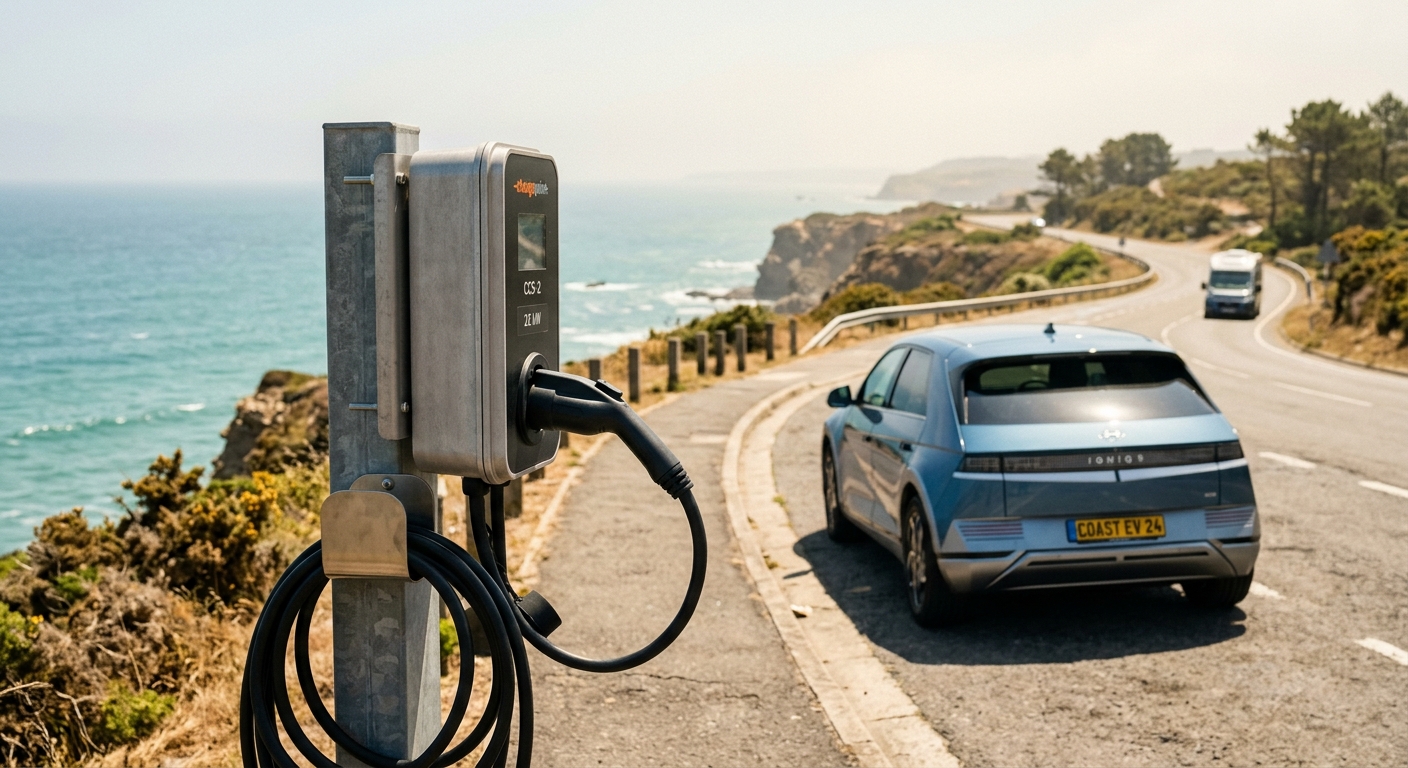
Outdoor EV charger under intense coastal sunlight
Component-Level Derating Inside the Box
Two chargers can carry the same IP67 sticker and ship with completely different internal lifespans. The difference lives in the component derating choices the engineering team made.
Capacitors, fans, and contactors
Electrolytic capacitors lose half their life for every 10 °C increase in operating temperature. A 105 °C cap running at 85 °C internal ambient might give you 40,000 hours. The same cap at 95 °C gives you 20,000. Inside a sun-baked enclosure with poor airflow, that difference is the warranty period.
Cooling fans rated for 50,000 hours at 40 °C drop to 25,000 hours at 60 °C. Contactors rated for 100,000 mechanical operations might only deliver 30,000 if switched under load every cycle. None of this shows up on the data sheet’s IP line.
The architecture matters
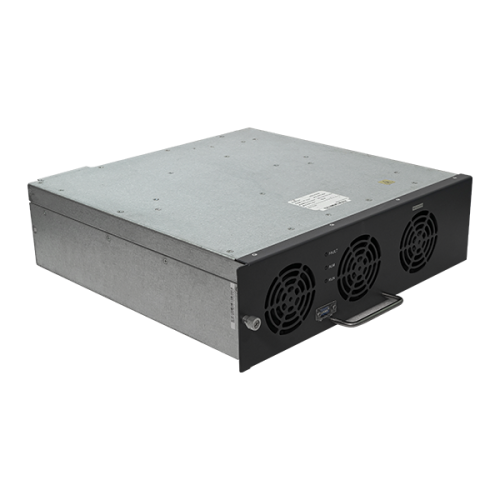
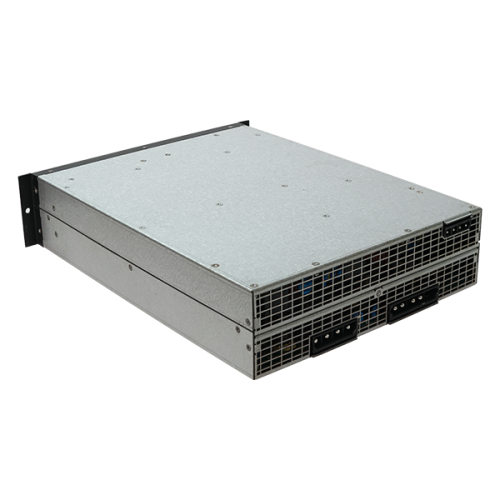
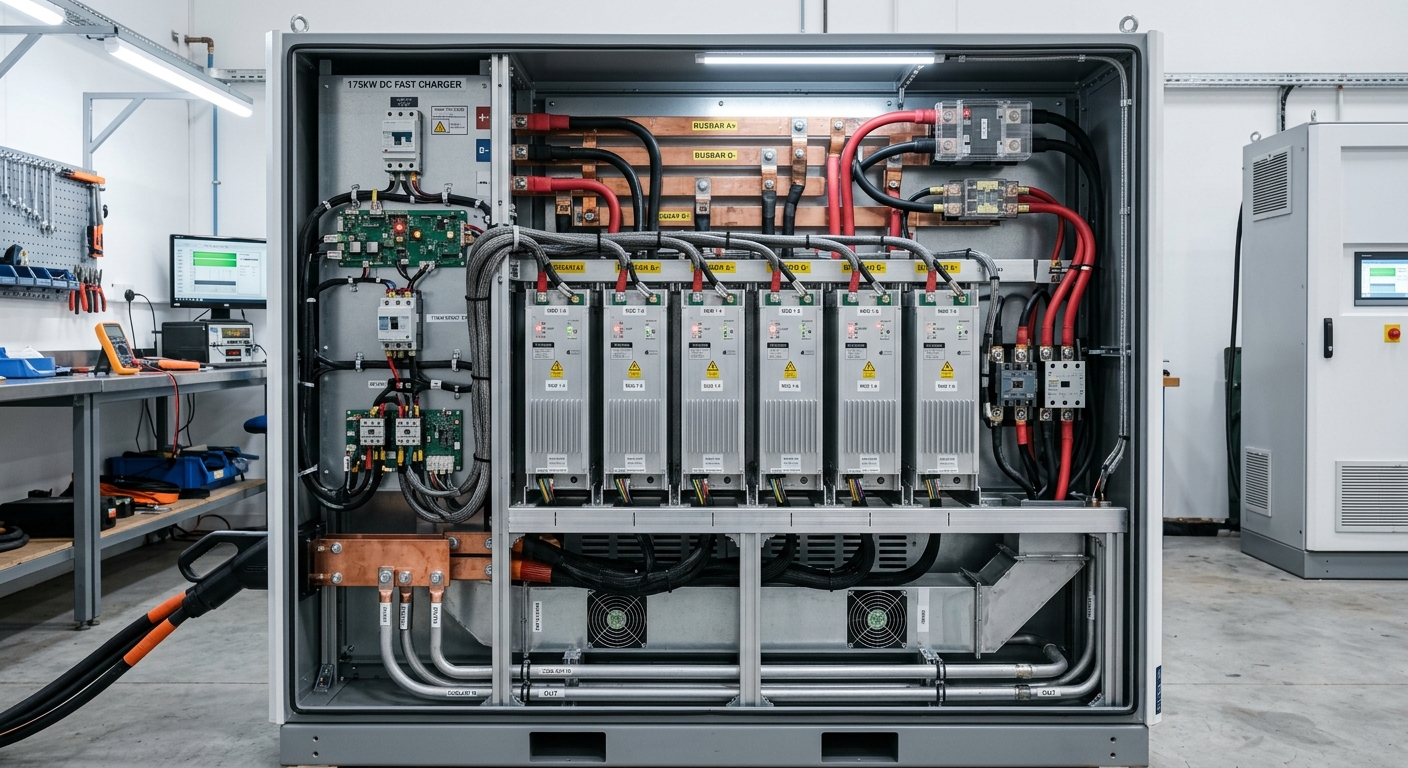
For DC fast chargers, the choice between centralized and modular power module architecture dramatically affects field serviceability and effective lifespan — a hot-swappable module design lets you replace a single 30 kW unit instead of decommissioning the whole charger.
Interior of a DC fast charger showing modular power architecture
Water Ingress Isn’t the Same as Condensation
Here’s a counterintuitive failure mode: chargers that pass IP67 sometimes fail because they’re too sealed. With no breathing path, internal humidity condenses on cold surfaces every morning. Over time, condensation drips onto PCBs, corrodes connector pins, and shorts low-voltage signal lines.
Well-engineered outdoor chargers use Gore-Tex–style pressure-equalization vents — membranes that let water vapor out but block liquid water and dust. They preserve the IP rating while solving the condensation problem the rating doesn’t acknowledge.
If you’ve ever pulled the cover off a 3-year-old outdoor charger and seen green crust on a connector that’s nowhere near a water entry path, you’ve seen this failure mode. It’s not a sealing problem — it’s a breathing problem.
Cable and Connector Lifespan — Often the First to Fail
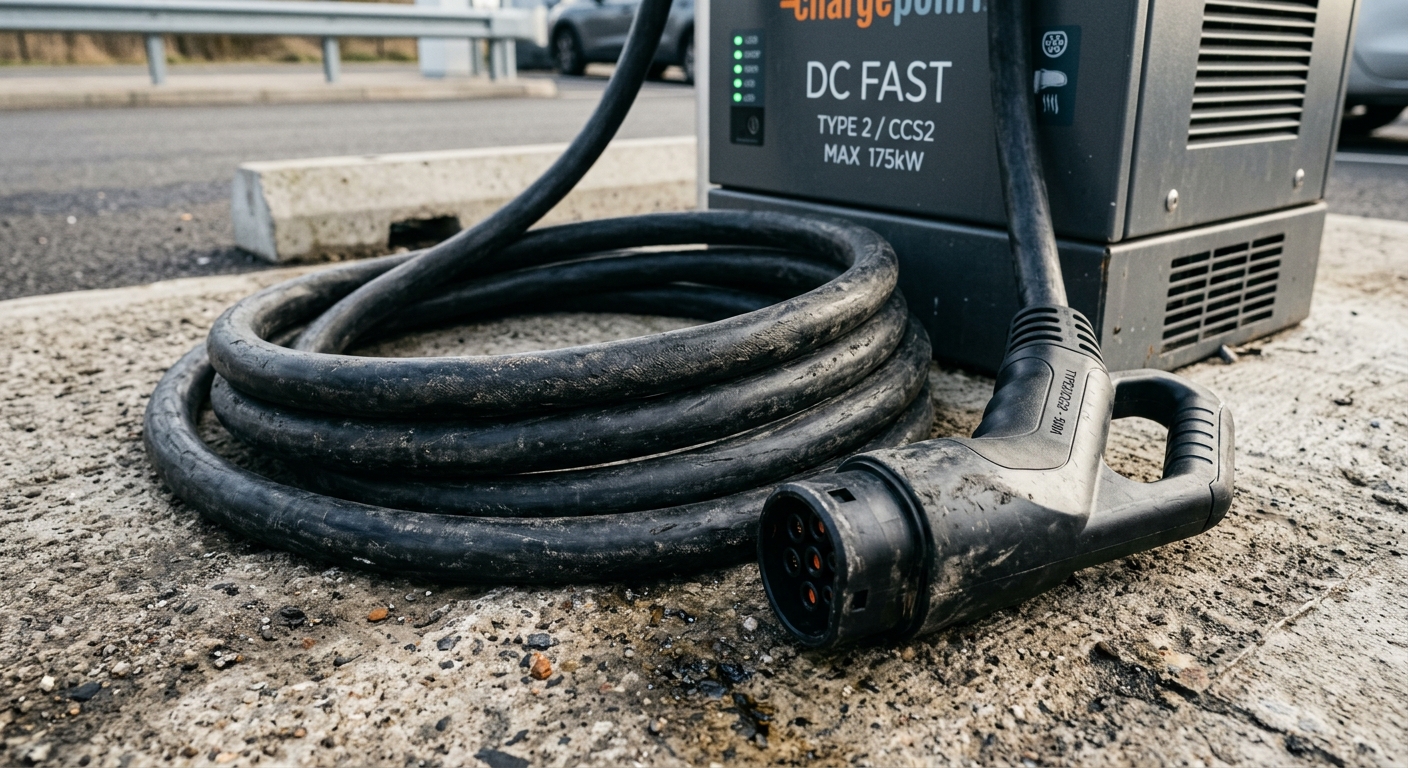
The charger housing might last 15 years. The cable usually doesn’t. Outdoor cables face UV, abrasion against the ground, cold-temperature stiffness, and thousands of plug-in cycles.
What to specify
Jacket material: TPE or TPU with UV stabilizers — not standard PVC, which cracks below -20 °C.
Plug cycle rating: CCS2 and NACS connectors are typically rated for 10,000 mating cycles. A busy public DC station can hit that in 3–4 years.
Cable management: Retractors and overhead booms dramatically extend cable life vs. cables that drag on the ground.
For high-throughput sites considering different connectors, our guide to connector standards covers durability differences between formats. And for high-power applications, liquid-cooled cable construction changes the failure mode entirely — the coolant loop becomes a serviceable consumable rather than a sealed-for-life assembly.
Heavy-duty DC charging cable detail at outdoor fast charger
How to Actually Specify Outdoor Charger Durability
Stop treating IP rating as the durability spec. Treat it as the bare minimum entry ticket. A real outdoor durability specification covers six dimensions:
Ingress protection: IP54 minimum for AC units in sheltered locations; IP65+ for DC fast chargers in open environments.
Thermal: Operating range -30 °C to +50 °C with derating curve disclosed; thermal shock per IEC 60068-2-14.
Corrosion: ISO 12944 category appropriate to site; minimum 720-hour salt spray for coastal.
UV: Materials tested per ISO 4892 (xenon arc) with documented color and mechanical property retention.
Vibration and shock: Per IEC 61851-1 minimum; tighter limits for installations near rail or heavy vehicle traffic.
Component derating: Documented MTBF, capacitor and fan life at maximum ambient.
Distributors writing tender responses should request these test reports up front. A supplier who can produce them quickly is engineering for lifespan. A supplier who responds with “it’s IP65, that’s all you need” is engineering for the spec sheet — and you’ll pay for the difference in warranty claims a few years in.
Building a 10-Year Outdoor Charger: The Engineering Trade-offs
Designing for a decade outdoors costs roughly 15–25% more in bill of materials than designing for the IP test alone. That premium buys you: PC-ASA or coated aluminum enclosures, 316 stainless fasteners, silicone gaskets, pressure-equalization vents, 105 °C industrial-grade capacitors, EC-rated cooling fans, conformal-coated PCBs, and TPE/TPU cable jackets.
For a public DC fast charger doing 8 sessions per day at $0.30/kWh margin, the additional CapEx pays back in less than two years of avoided downtime. For low-utilization private AC chargers, the math is tighter — but for any commercial outdoor installation, building to last is almost always the right call.
If you’re sourcing outdoor units for a large project — whether bus depots, fleet yards, or distributed public infrastructure — talk to our engineering team about specifying beyond the IP sticker. Browse our outdoor charger range or contact us for the test documentation that actually predicts field lifespan.
Subscribe the newsletter to get updated to news and promotions
Cookies give you a personalized experience,Сookie files help us to enhance your experience using our website, simplify navigation, keep our website safe and assist in our marketing efforts. By clicking "Accept", you agree to the storing of cookies on your device for these purposes. Click "Adjust" to adjust your cookie preferences.For more information, review our Cookie Policy