How to Specify an EV Charger RFP: A Procurement Checklist for Fleet and Site Operators
Home / Blog / Guidelines / How to Specify an EV Charger RFP: A Procurement Checklist for Fleet and Site Operators
02 Jun, 2026
charging infrastructure RFP
EV charger procurement checklist
EV charger tender requirements
fleet charging specification
A good EV charger RFP locks down four things in writing: the electrical specification, the communication and software stack, the service and warranty terms, and the acceptance criteria. Skip any one of these and you’ll end up either over-paying for capability you don’t need, or under-specifying and inheriting a depot full of chargers that can’t talk to your fleet management system. This checklist tells you exactly what to write into each section — and what to push back on when bidders try to wriggle around it.
Start With the Use Case, Not the Hardware
The most common procurement mistake? Writing an RFP that lists hardware before the use case is defined. You end up with bidders quoting whatever they happen to have in stock.
Before any kW figure goes on paper, document the duty cycle. How many vehicles? What battery capacity? What’s the dwell time at the depot? A last-mile delivery van returning at 8 PM with a 100 kWh pack and leaving at 5 AM doesn’t need a 350 kW charger — an 80 kW unit on a smart load-managed circuit will do the job and save you a six-figure transformer upgrade.
For example, a regional grocery chain we worked with originally specified 12×150 kW chargers for 40 delivery vans. After mapping the duty cycle, we shifted them to 8×60 kW units with dynamic power sharing. Same operational outcome, 38% lower CAPEX. The lesson: depot charging design should always start from vehicle schedules backwards.
Number of vehicles, broken down by battery size and connector type
Arrival/departure windows and minimum SoC at departure
Future fleet growth (3 and 5 years)
Site grid capacity in kVA — and any expansion limits
Fleet manager reviewing EV charging duty cycle data
Specify Electrical Performance — Not Just Peak kW
“150 kW chargers” is not a specification. It’s a marketing line. Peak output means nothing if the unit derates to 90 kW the moment ambient temperature hits 35°C.
Your RFP must request a documented power-versus-temperature derating curve from -20°C to +50°C. Ask for the curve at both 200 V DC (low-SoC) and 800 V DC (high-voltage platform) load conditions. This is where the engineering differences between vendors actually surface — and where many cheap chargers quietly fail. We’ve covered this in detail in our piece on summer derating.
Mandatory electrical clauses
Nominal and continuous output power (separately stated)
Output voltage range (e.g., 150–1000 V DC)
Output current per connector, continuous and peak
Efficiency at 25%, 50%, 75%, 100% load
Power factor at full load (should be > 0.99)
THD on AC input (< 5%)
Input voltage tolerance (±10% minimum)
Derating curve, fully documented
Lock Down the Communication Stack
If you don’t specify the OCPP version, you’ll get OCPP 1.6J — and you’ll regret it within 18 months. Smart charging features, ISO 15118 Plug & Charge, and security profile 3 all require OCPP 2.0.1.
Your RFP should require:
OCPP 2.0.1 with Security Profile 3 (TLS + certificate-based auth)
OCA (Open Charge Alliance) certification — request the certificate number
ISO 15118-2 support, with a clear roadmap to ISO 15118-20
Local controller fallback (chargers must keep operating if WAN drops)
API documentation for fleet management integration
Firmware update mechanism — OTA, signed, with rollback capability
Also: explicitly require the charger to interoperate with at least two named CPO/CSMS platforms. If a vendor can’t demonstrate live interoperability tests, that’s a red flag. Communication errors are the single most common post-deployment headache — see our breakdown of OCPP communication failures.
DC fast charger HMI screen showing OCPP communication status
Connectors, Cables, and Cooling — The Details That Bite
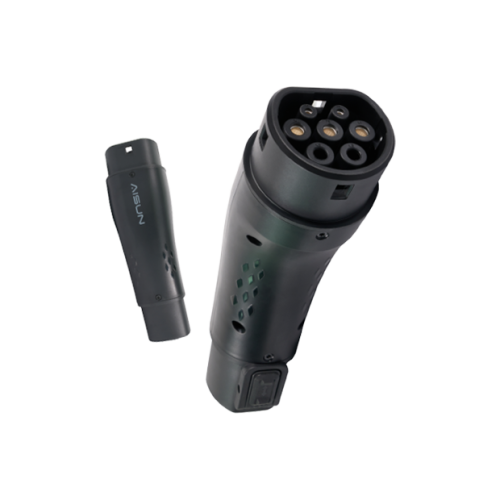
Cables wear out faster than the chargers themselves. In a busy fleet depot, a CCS2 cable handles 8–15 plug cycles per day. At 500 A, that’s a lot of mechanical and thermal stress.
Specify cable length (minimum 5 m for fleet use — 3 m is fine for retail but a nightmare in a depot), cooling type, and IP rating. For anything above 200 kW, require liquid-cooled cables — air-cooled cables at 350 A become unwieldy and limit throughput.
If your fleet mixes vehicle types, demand multi-standard support. A logistics yard with European tractors, Chinese-made yard trucks, and US-spec service vehicles may need CCS2, GB/T, and NACS within the same site. Our connector standards guide covers this in depth, and for general background see charging connector types.
Liquid-cooled CCS2 connector plugged into an electric truck
Service Level Agreements: Where Cheap Bids Die
Here’s a number that ends a lot of arguments: every hour of charger downtime in a 30-van delivery fleet costs roughly $800–$1,500 in lost productivity and overtime. So a 99% uptime SLA — which sounds great — still allows 87 hours of downtime per year. That’s serious money.
Push for 98% uptime measured monthly, not annually, with explicit penalty clauses. The SLA section should specify:
Mean time to respond (MTTR) for critical faults — 4 hours for urban, 24 for remote
Mean time to repair — typically < 48 hours
Spare parts stocking commitment — geographic location and quantity
Liquidated damages per hour of downtime past SLA
Remote diagnostics capability (vendor should resolve > 60% of issues without site visit)
For example, a port operator in Northern Europe wrote a clause requiring power modules and contactors to be stocked within 500 km of the site, with a 4-hour parts delivery commitment. The vendor balked at first — but it forced them to commit to a regional service hub, and the operator now sees average MTTR under 14 hours. Worth reading our note on warranty claims and hidden lifecycle costs before you sign anything.
Hardware Architecture Questions Worth Asking
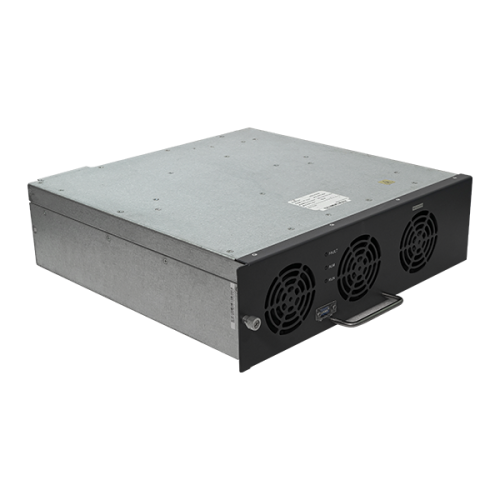
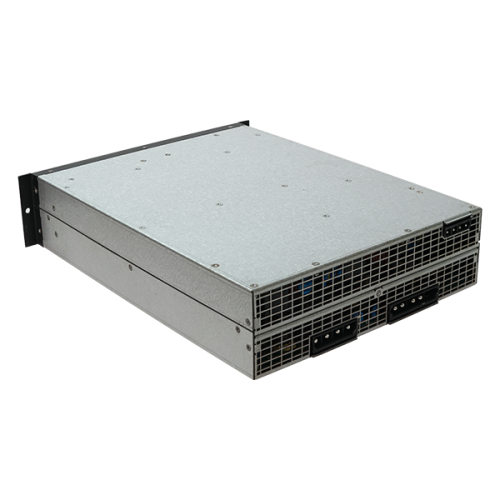
Most RFPs ignore the power module architecture entirely. That’s a mistake. A 360 kW charger built from 12×30 kW modules behaves very differently from one built with 6×60 kW modules — both at partial load and during failure.
Ask bidders to disclose
Power module rating and total module count
Module-level redundancy (N+1 architecture?)
Hot-swap capability — can a module be replaced without shutting down the cabinet?
Power sharing topology — fixed split, dynamic split, or fully pooled?
Cabinet IP rating (IP54 minimum for outdoor)
Cooling system — fan failure detection, filter accessibility
Our deep dive on 360 kW power module architecture explains why these details matter. Short version: pooled architecture with hot-swap modules will outlast and out-utilize cheaper monolithic designs by a wide margin.
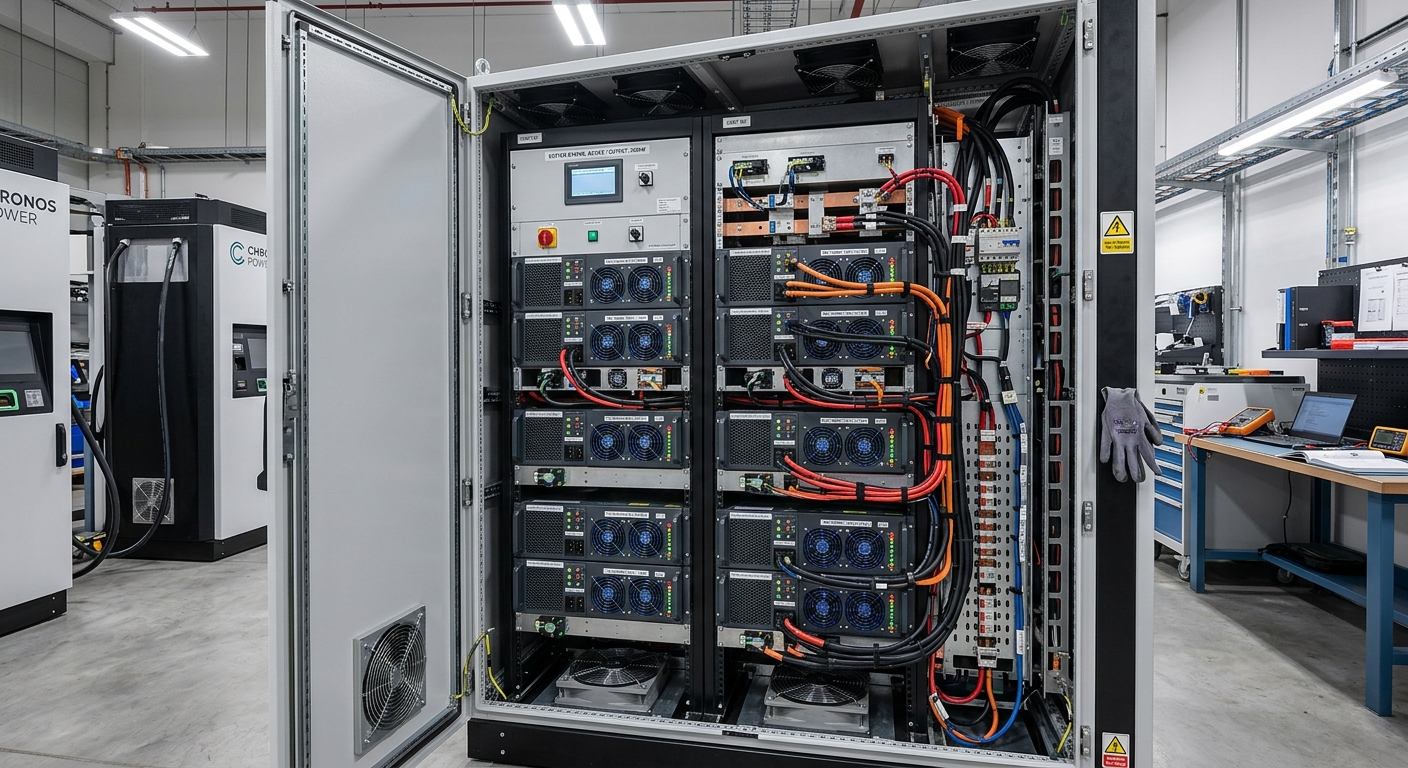
Modular power units inside a DC fast charger cabinet
Acceptance Testing: Don’t Skip the FAT and SAT
An RFP without explicit acceptance criteria is an invitation to disputes. Define both Factory Acceptance Testing (FAT) and Site Acceptance Testing (SAT) — and require signed test sheets before any payment milestone is released.
FAT should be witnessed by your engineer or a designated third party. At minimum it covers: full-load output verification, OCPP message exchange against your CSMS, emergency stop function, ground fault detection, insulation monitoring (IMD), and ambient temperature simulation.
SAT is performed after installation and includes: real-vehicle charging session with each connector type, communication handshake under your network conditions, load management response to simulated peak events, and a 72-hour burn-in run. Withhold 10–15% of payment until SAT is signed off. This single clause has saved more projects from delays than any other.
Compliance, Certifications, and Local Regulation
Certifications are not just paperwork — missing ones can stop your project at the inspection stage.
Region-specific safety: CE/UKCA for Europe, UL 2202 + UL 2231 for North America, CCC for China
EMC: EN 61851-21-2 or equivalent
Cybersecurity: ETSI EN 303 645, OCPP Security Profile 3
Metering: MID Annex VI (Europe) or NTEP (US) if you’re billing customers
Functional safety: IEC 61508 SIL-2 for safety-critical functions
If you’re billing — whether B2B inter-company or public retail — the metering certification is non-negotiable. We’ve seen entire deployments shut down because the chargers used uncertified meters. Always cross-check this against your local utility’s interconnection rules.
Commercial Terms That Protect Both Sides
The procurement section often gets reduced to “lowest price wins.” That’s how depots end up with a graveyard of unsupported chargers two years later.
Structure the commercial section around total cost of ownership over 7 years, not unit price. Require bidders to quote:
Capital cost per unit and per kW
Installation cost (or clear scope boundary)
Annual maintenance fee, years 1–7
Spare parts price list, locked for 5 years
Software/firmware subscription costs (if any)
End-of-life decommissioning plan
Also lock in firmware support duration — minimum 7 years from delivery. And request escrow of firmware source code for orphan-vendor protection. Sounds extreme? It’s standard in industrial PLC procurement, and EV charging is rapidly reaching the same criticality. If you’re a distributor sourcing from multiple suppliers, our OEM vs ODM guide covers commercial structuring in more depth.
Putting the Checklist to Work
A well-written EV charger RFP is your single biggest lever in the entire procurement process. Get the specification right and the rest of the project — installation, commissioning, operation — falls into place. Get it wrong and no amount of post-award negotiation will fix it.
Boil it down to four sections, write each one with specifics rather than adjectives, and require bidders to respond clause-by-clause. The bidders who refuse to engage at that level of detail are telling you something important about how they’ll behave when something breaks at 2 AM.
If you’d like a sanity check on your draft RFP — or want to see how our team approaches OEM and ODM charging solutions for fleet and site operators — get in touch. We’re happy to review your specification and flag the clauses most bidders try to soften.
Subscribe the newsletter to get updated to news and promotions
Cookies give you a personalized experience,Сookie files help us to enhance your experience using our website, simplify navigation, keep our website safe and assist in our marketing efforts. By clicking "Accept", you agree to the storing of cookies on your device for these purposes. Click "Adjust" to adjust your cookie preferences.For more information, review our Cookie Policy