Charging Heavy-Duty Electric Trucks: Site Design Lessons from Real Logistics Hubs
Home / Blog / Guidelines / Charging Heavy-Duty Electric Trucks: Site Design Lessons from Real Logistics Hubs
21 May, 2026
electric truck depot design
fleet charging site design
logistics hub EV charging
MCS charging infrastructure
Charging heavy-duty electric trucks is not a scaled-up version of charging passenger EVs — it's a different engineering problem. The hubs that actually work share a few non-negotiables: oversized utility service planned 10 years ahead, stall geometry designed around a 53-foot trailer, and a charger mix that matches dwell time rather than peak headline kW. Get those three right and the rest is detail work.
Start with the Duty Cycle, Not the Charger Spec Sheet
The single most common mistake at heavy-duty truck depots? Buying chargers before mapping the duty cycle. A 350 kW unit looks impressive in a brochure, but if your trucks return at 6 PM and leave at 5 AM, you have 11 hours of dwell time — and a 150 kW charger will do the job for half the capital cost and a third of the utility headache.
For instance, a regional grocery distributor running 40 day-cab tractors on 200 km loops will look completely different from a port drayage operator doing six short turns a day. The grocery fleet wants slow, cheap, overnight charging on time-of-use rates. The drayage operator needs opportunity charging at the gate, sized for 30-minute splash-and-dash sessions.
Before specifying anything, build a simple table: trucks per shift, average kWh per route, time on-site, time on-route. The shape of that table tells you whether you need fleet charging stations built around overnight depot logic or fast-turn opportunity charging.
Electric truck depot at dusk with multiple Class 8 tractors in charging bays
Utility Service: Size for Year 10, Not Year 1
Here's the brutal truth from operators already two or three years in: every single one wishes they had pulled more service capacity on day one. Utility upgrades take 18–36 months in most regions. Transformer lead times alone now stretch past 60 weeks for anything above 2 MVA.
A working rule of thumb: if you're electrifying a 50-truck depot, plan the service for 100 trucks. The marginal cost of a 2.5 MVA transformer over a 1.5 MVA unit is small. The cost of trenching the yard twice is enormous.
One European 3PL operator we worked with electrified 12 tractors in phase one, sized utility for 30. Eighteen months later they were at 28 trucks and scrambling to add a second feeder. The second utility connection ended up costing more than the first — same trenching, same switchgear, but now with operations running across the yard.
What to ask the utility on day one
Available capacity at the nearest substation, in MVA
Lead time for a new dedicated feeder vs. tapping the existing one
Whether demand charges or coincident peak charges apply
Interconnection requirements for behind-the-meter storage
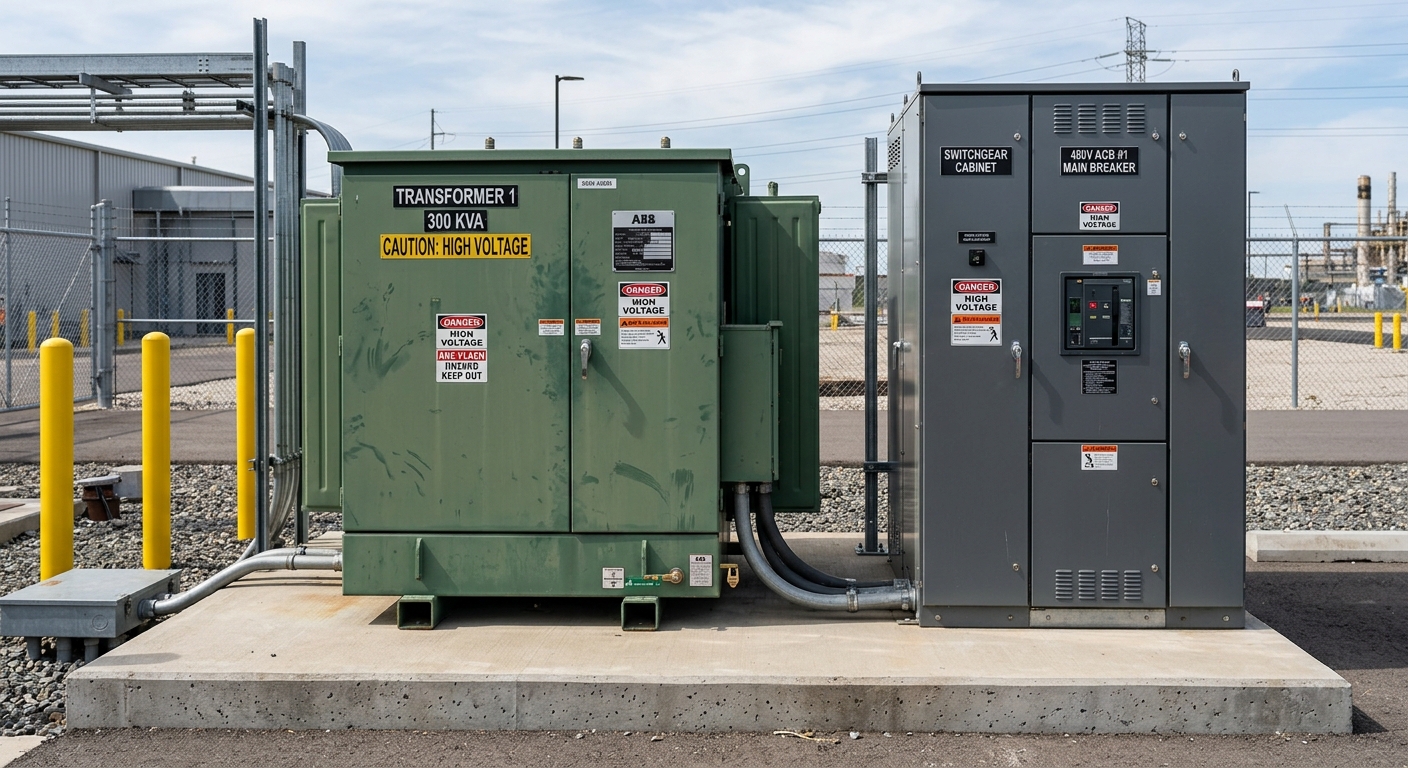
Pad-mounted utility transformer feeding an electric truck charging yard
Stall Geometry: The 53-Foot Problem
Passenger EV stalls are 2.7 m wide and 5 m deep. A tractor-trailer needs roughly 3.7 m wide and 25 m deep, and it needs to pull through — backing a loaded 40-tonne combination into a charging stall every night is a non-starter for drivers and a safety risk for equipment.
Pull-through stalls are the standard for a reason. They cost more in real estate but eliminate damaged dispensers, save 5–10 minutes per truck on connection time, and let you keep a trailer attached during charging. For yards that absolutely cannot accommodate pull-through, drop-and-hook layouts with bobtail-only charging zones are the workable compromise.
Cable management is half the design
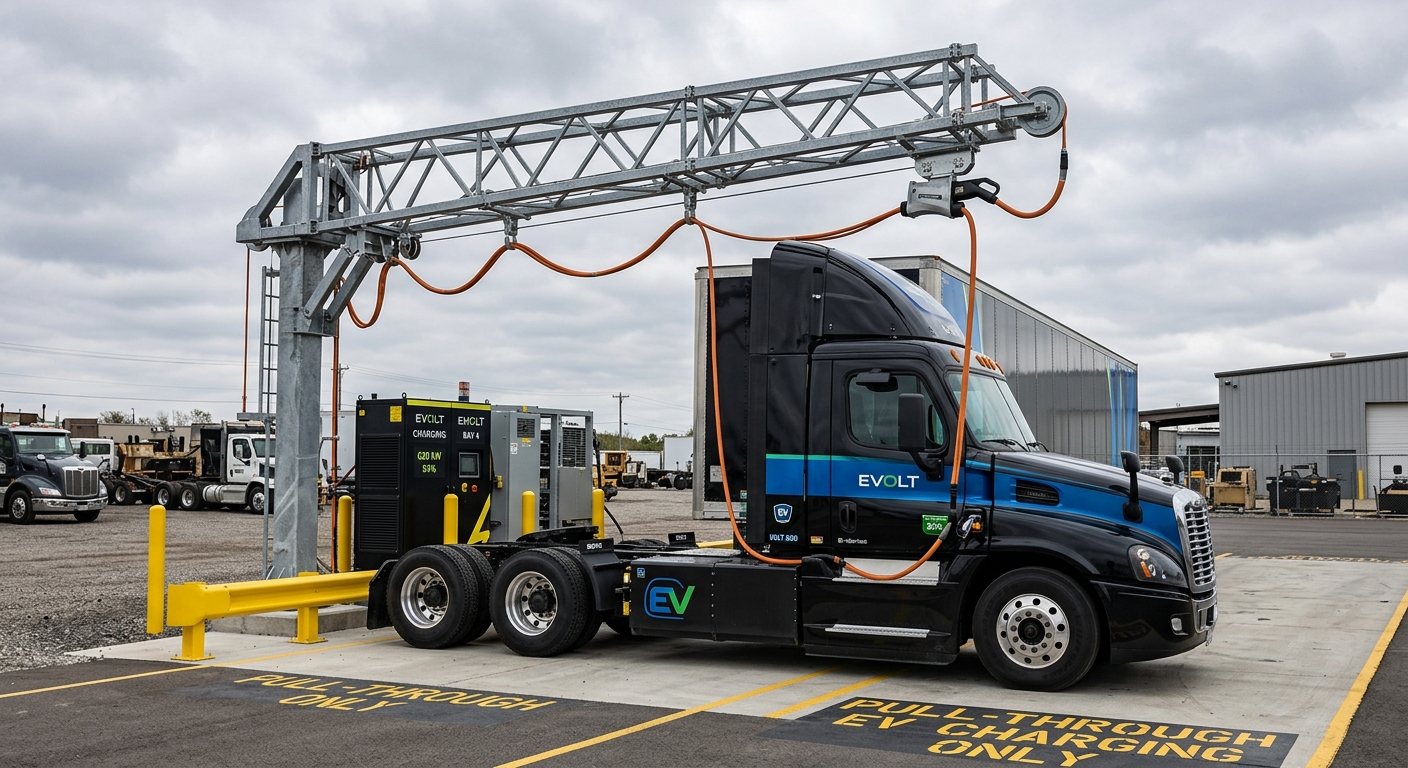
A 350 kW liquid-cooled cable weighs 8–12 kg before you add the connector. Drivers handling that cable 200 times a month will get injuries — and they will damage cables. Overhead cable retractors, pantograph systems, or boom arms aren't luxuries on heavy-duty sites; they're a workplace safety requirement. Budget for them from the start.
Pull-through charging lane with overhead cable boom for a Class 8 electric truck
Picking the Right Charger Mix
No serious heavy-duty depot runs a single charger model. The economics force a tiered mix.
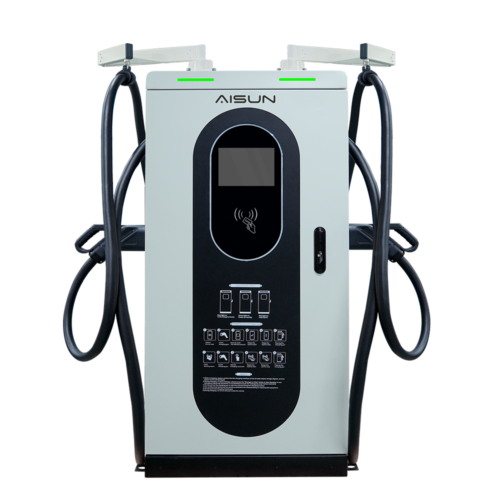
A typical 30-truck regional depot might look like: 24 × 150 kW dual-port chargers for overnight, 4 × 360 kW units for mid-day top-ups and visiting trucks, and pre-conduit for two future MCS bays once the standard matures. That mix uses cheap kW where dwell time is long and expensive kW only where it pays off.
For background on how DC charging differs from AC and where each fits, our overview of EV charger types, levels and connectors is a useful primer for distributor teams onboarding new clients.
MCS is coming — but don't wait for it
The Megawatt Charging System (MCS) is real, standardized, and shipping in pilot quantities. But for 90% of logistics use cases — return-to-base operations under 400 km daily — 350 kW CCS2 is more than enough. Build conduit and pad space for MCS now, energize it when the second-generation hardware is field-proven and your trucks actually have MCS inlets.
Load Management Beats Brute-Force Capacity
Here's a number that surprises engineering teams every time: at a 30-truck depot, the connected charger capacity might be 6 MW, but the actual coincident peak rarely exceeds 2.5 MW. Trucks return staggered, batteries arrive at different SoC, and chargers naturally taper above 80%.
Smart load management — sometimes called dynamic power sharing — lets you commit to a smaller utility service and a smaller transformer without slowing operations. The key is a charge management system that knows each truck's departure time and required SoC, then dispatches power accordingly. Trucks leaving at 5 AM get prioritized at midnight; trucks leaving at noon can wait.
This is also where understanding the broader picture of logistics fleet EV charging challenges and solutions pays off — load management failures are almost always operational, not technical. The chargers can share power fine. What breaks is the integration between the fleet scheduling system and the charge management system.
Fleet charging management dashboard showing real-time power allocation
Battery Storage: Worth It or Not?
Behind-the-meter battery storage at truck depots is genuinely useful in three cases: high demand charges (above $15/kW/month), constrained utility service that can't be quickly upgraded, or sites pairing solar with charging. Outside those cases, the payback is rough — 8–12 years is typical, longer than most operators want to plan around.
Where storage shines is shaving the demand peak when three trucks happen to plug in simultaneously. A 500 kWh / 250 kW battery bank can flatten that spike and let you keep a smaller utility connection. Pair it with rooftop solar if the yard has shade-free roof area, and the case gets stronger. For a deeper look at how renewables fit into charging infrastructure, see how renewable energy drives sustainable EV charging.
One caution: lithium battery systems at logistics yards need their own fire suppression strategy and clearance from combustible storage. Don't tuck them next to the diesel tank you're trying to retire.
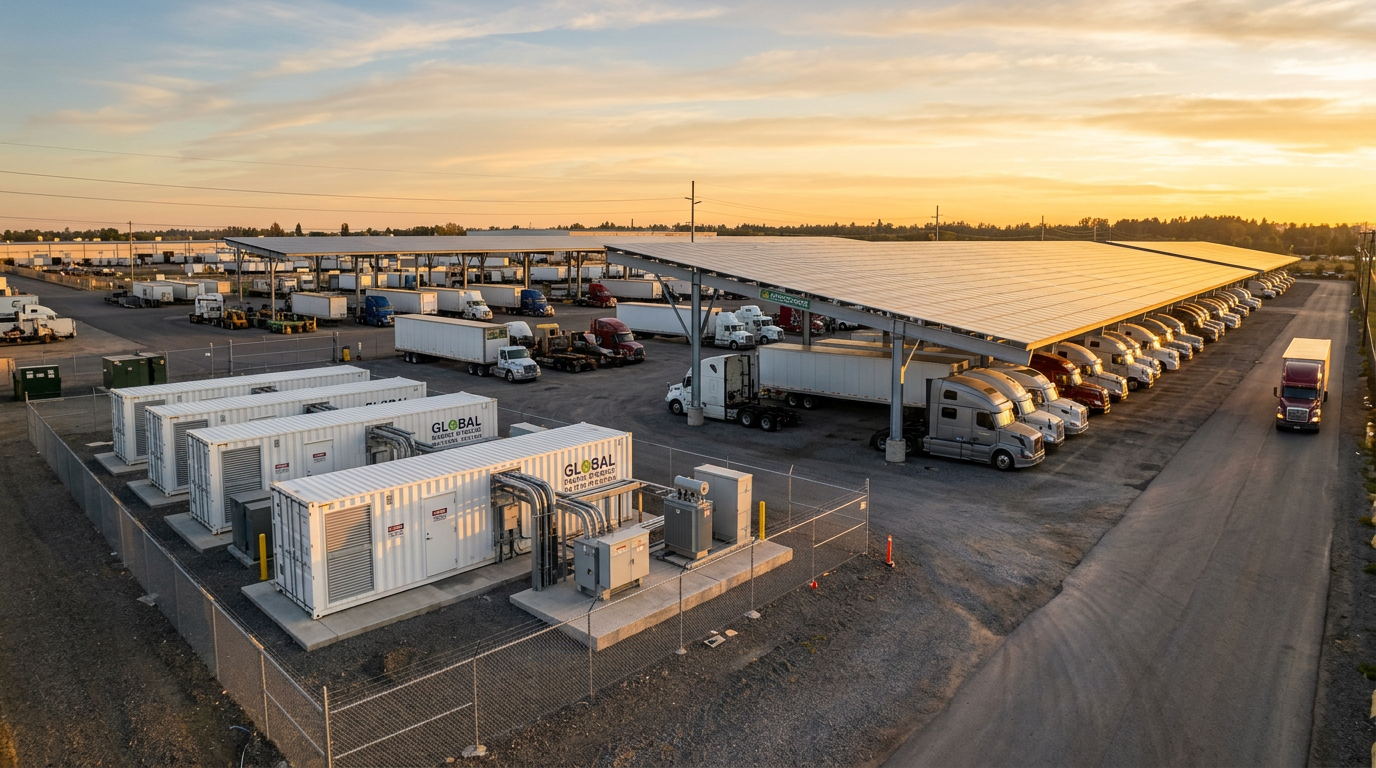
Battery energy storage container next to solar carport at a truck depot
Maintenance Access — The Lesson Everyone Learns the Hard Way
Chargers fail. Cables fray. Connectors get bent. At passenger EV stations, a broken charger is annoying. At a truck depot, a broken charger means a truck doesn't roll, and a truck that doesn't roll costs $800–$1,500 per day in lost revenue.
Design for maintenance access from day one. That means: 1.5 m of clearance behind every charger cabinet, removable bollards on at least one side, and spare-parts storage on-site for connectors, contactors, and cable assemblies. The best-run hubs we've seen keep one spare charger fully wired and ready to swap — not stored in a crate, but mounted on a spare pad with conduit and breaker waiting.
Service contracts matter more than spec sheets. Before signing for any hardware, ask the manufacturer: what's the mean time to spare-part delivery in your country? If the answer is “ex-works China, 6 weeks,” that's a problem. Local stocking depots and certified field technicians are worth a 10–15% premium on hardware cost.
Pitfalls We See Repeatedly
A few patterns show up at almost every troubled site:
Connector mismatch — buying CCS1 hardware for a fleet that ends up running CCS2 trucks, or vice versa. Confirm the inlet standard with the OEM before ordering, not after.
Underspecified ventilation — DC chargers reject 5–8% of throughput as heat. A row of eight 350 kW units in a closed canopy needs real airflow design, not just a roof.
Ignoring derating curves — that 350 kW rating is at 25°C ambient. At 40°C in a Texas summer, you're often getting 240 kW. Size for the worst-case site temperature, not the nameplate.
No metering granularity — if you can't measure per-stall energy delivered, you can't bill back to specific routes or detect a failing charger drawing extra losses. Sub-metering is cheap insurance.
Forgetting the gate — security, ANPR, driver authentication, and yard management system integration all need to talk to the charger network. Retrofitting this is painful.
Bringing It Together: A Phased Build Plan That Works
The hubs that scale smoothly almost always follow a phased plan:
Phase 0 — utility and civil: Pull a service sized for the 5-year truck count. Trench conduit for every stall you'll ever build. Pour pads. This is the cheapest phase to overbuild.
Phase 1 — energize 30–40% of stalls: Match initial truck deliveries. Use this phase to debug software integrations, driver workflows, and maintenance routines while the operational stakes are low.
Phase 2 — fill to capacity: Add chargers as trucks arrive. Now is when load management and storage decisions pay off, because peak coincidence becomes real.
Phase 3 — MCS or high-power expansion: Activate the conduit you laid in phase 0. Replace early chargers as they reach end-of-life with higher-power units if duty cycles have shifted.
This sequencing keeps capital light early, when route data is still uncertain, and front-loads the things you can't easily change later — utility, civil, and stall geometry.
Where to Go from Here
Designing a heavy-duty truck charging hub is mostly about discipline: oversize the boring infrastructure, undersize the headline-grabbing kW until the duty cycle demands more, and treat maintenance as a first-class design constraint. The operators we see succeeding aren't the ones with the flashiest chargers — they're the ones who spent six months on the load study before placing a hardware order.
If you're scoping a logistics hub or specifying chargers for a fleet client, evaisun supports OEM and ODM projects across the 60 kW–600 kW DC range, with MCS-ready platforms in pilot. We're happy to review your duty cycle data and site plans before you commit to hardware — reach out through evaisun.com and we'll route the conversation to the right engineering contact.
Subscribe the newsletter to get updated to news and promotions
Cookies give you a personalized experience,Сookie files help us to enhance your experience using our website, simplify navigation, keep our website safe and assist in our marketing efforts. By clicking "Accept", you agree to the storing of cookies on your device for these purposes. Click "Adjust" to adjust your cookie preferences.For more information, review our Cookie Policy