Fleet Depot Charging: How to Design a Reliable Overnight Charging Setup for 50+ Vehicles
Home / Blog / Guidelines / Fleet Depot Charging: How to Design a Reliable Overnight Charging Setup for 50+ Vehicles
29 Jun, 2026
commercial fleet charging setup
depot charging 50 vehicles
fleet charging load management
fleet EV charging infrastructure
overnight fleet charging
A reliable overnight charging setup for 50+ fleet vehicles comes down to three non-negotiable pillars: right-sized electrical infrastructure, intelligent load management, and a physical layout that matches your dispatch workflow. Get any one of these wrong and you will face either stranded vehicles at 5 AM or a six-figure utility bill you never budgeted for. This guide walks through the complete design process — from calculating your actual power demand to selecting charger hardware and configuring the software that ties it all together — so every vehicle rolls out fully charged without overloading your grid connection.
Why Overnight Depot Charging Is the Backbone of Fleet Electrification
Most fleet operators assume DC fast charging is the answer to everything. It isn't — at least not for depot-based fleets. When vehicles return to a central location every night and sit for 6–10 hours, you have a massive charging window that makes slower, cheaper AC charging not just viable but strategically superior.
Here is the math that matters: a 60 kWh delivery van charged at just 11 kW reaches full from 20% state of charge in roughly 4.5 hours. That is well within a typical overnight window, and the charger hardware costs a fraction of a DC unit. Multiply that logic across 50+ vehicles and the savings on infrastructure alone can exceed $1 million compared to a DC-heavy approach.
Overnight depot charging also extends battery life. Consistent, slower charging reduces thermal stress on lithium cells — a factor that compounds over hundreds of thousands of cycles across a large fleet. For operators looking at the long-term benefits of fleet electrification, depot charging is where the economics truly stack up.
Step 1: Calculate Your Actual Power Budget — Not the Theoretical One
The single biggest mistake in fleet depot design is sizing the electrical service for simultaneous full-power charging of every vehicle. That scenario almost never happens, and designing for it wastes hundreds of thousands of dollars on transformer and switchgear capacity you will never use.
Start With Real Route Data
Pull actual daily energy consumption from your fleet telematics or OBD data. A last-mile delivery van covering 120 km per day might consume 25–35 kWh. A medium-duty truck on a 200 km regional route might need 80–120 kWh. These numbers — not the battery’s total capacity — determine your nightly charging demand.
Apply a Diversity Factor
Not every vehicle arrives at the same state of charge. Not every vehicle needs a full charge. Industry data shows that a realistic diversity factor for overnight fleet charging sits between 0.5 and 0.7, meaning your peak simultaneous demand is 50–70% of the theoretical maximum. For a 50-vehicle depot with 11 kW chargers, that drops your peak from 550 kW to roughly 275–385 kW — a transformative difference for your utility interconnection costs.
Account for Growth
Design your electrical backbone (conduit, switchgear, transformer pad) for your 3–5 year fleet size, even if you install chargers in phases. Trenching and transformer work are the most expensive items to redo. Running extra conduit during initial construction adds maybe 10–15% to civil costs but saves you from tearing up pavement later.
Aerial view of electric delivery vans charging overnight at a fleet depot parking lot
Step 2: Choose the Right Charger Type and Power Level
For overnight depot applications, the charger selection decision is more nuanced than “AC vs. DC.” The right answer depends on your vehicle mix, dwell time, and grid constraints.
AC Level 2: The Workhorse
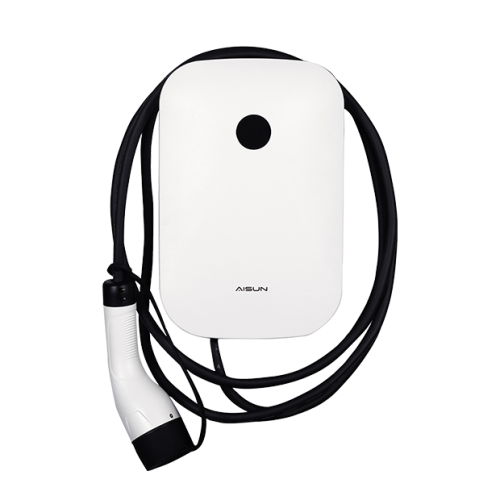
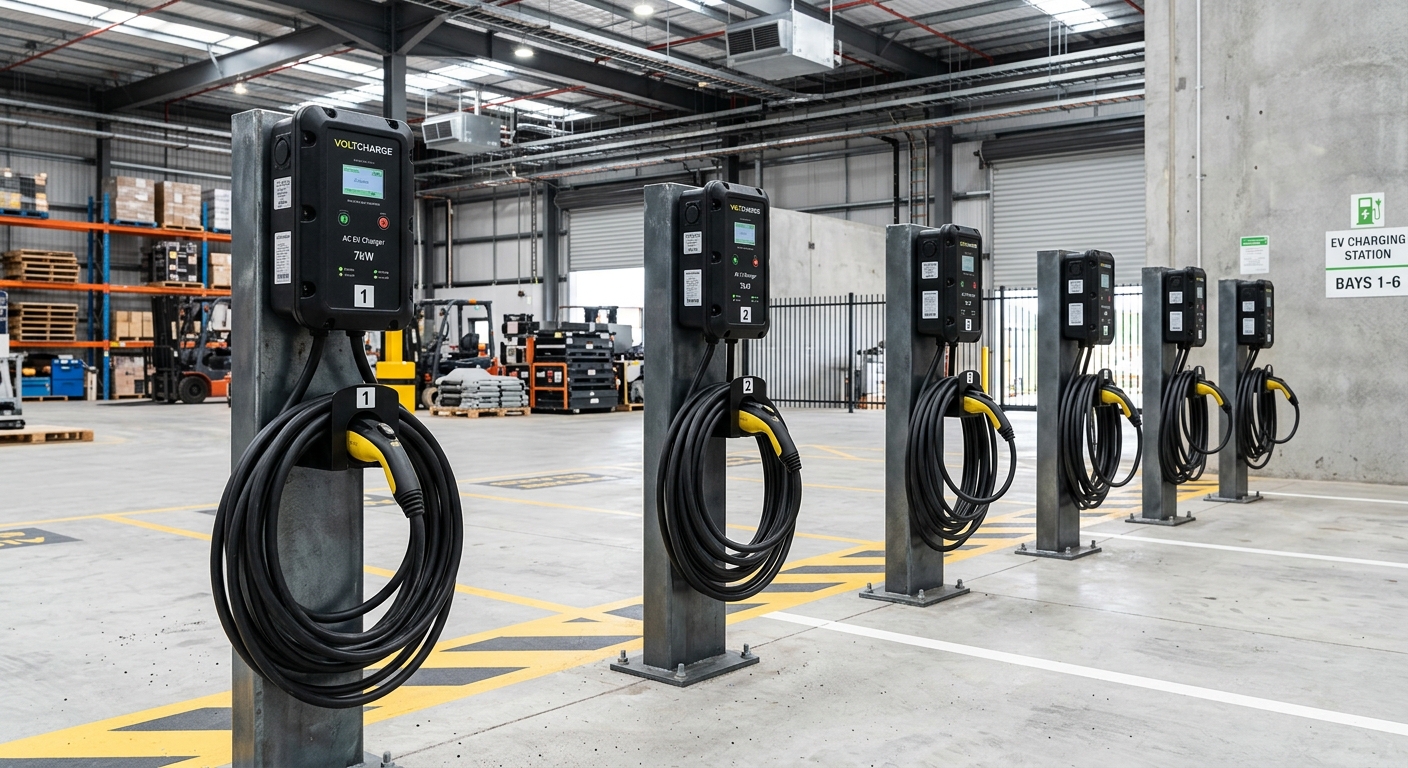
For fleets with 6+ hours of dwell time and battery capacities under 100 kWh, three-phase AC chargers rated at 7–22 kW are the sweet spot. They are compact, reliable, and inexpensive per port. A 22 kW unit can deliver roughly 150 kWh over a 7-hour window — more than enough for most light-duty and many medium-duty vehicles.
DC Fast Charging: The Exception, Not the Rule
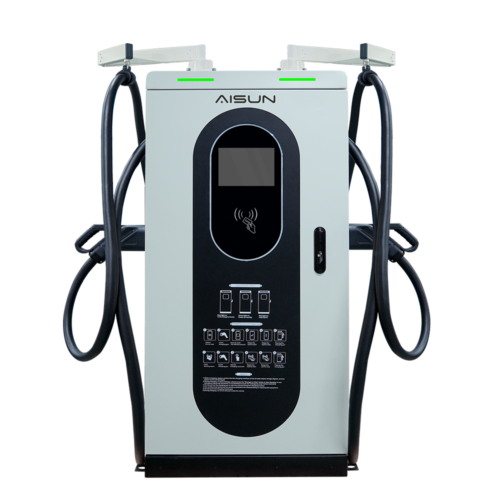
DC units (50–150 kW) make sense for a small subset of vehicles that arrive late, depart early, or carry oversized batteries (think electric buses or Class 6+ trucks). Budget for 2–5 DC ports as “rescue chargers” rather than making them the backbone of your depot. The cost difference is stark: a single 120 kW DC charger can cost more than ten managed AC units.
Managed AC With Load Balancing: The Smart Play
This is where modern depot design gets interesting. Managed AC chargers equipped with backend load management software let you install more ports than your electrical service would otherwise support. The system dynamically allocates power based on each vehicle’s departure time, current state of charge, and priority level. It is the single most effective way to serve 50+ vehicles without a massive grid upgrade. We will dig deeper into this in the load management section below.
For a detailed breakdown of how different fleet charging infrastructure components fit together, that guide covers the full ecosystem.
Row of commercial AC EV chargers mounted on pedestals in an industrial fleet depot
Step 3: Design the Physical Layout Around Your Dispatch Workflow
A charging layout that ignores how vehicles actually move through your depot is a layout that will fail. Charging infrastructure is not an afterthought bolted onto existing parking — it should be designed around your operational flow.
Back-In Parking With Rear-Mounted Ports
Most fleet vehicles have charge ports on the left rear quarter or rear bumper. Design your stalls so vehicles back in, placing the charge port closest to the charger. This minimizes cable length (reducing trip hazards and voltage drop), speeds up the plug-in process for drivers, and allows vehicles to pull straight out for morning dispatch without disconnecting gymnastics.
Zone by Departure Time
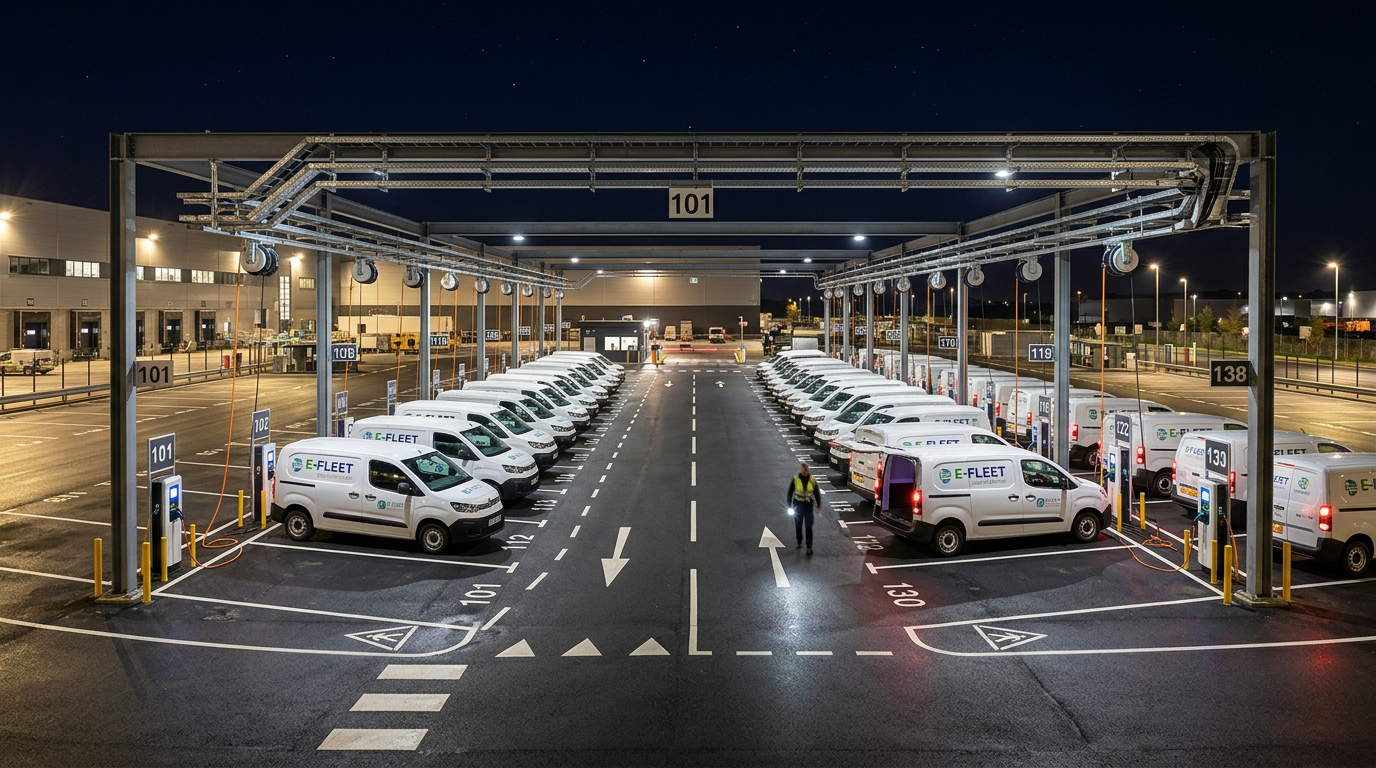
Group charging stalls by dispatch priority. Early-departure vehicles (4–5 AM) get first-priority power allocation in the load management system and should be parked in zones closest to the depot exit. Late-departure vehicles park further back and receive power later in the night after high-priority vehicles reach their target SOC.
Cable Management Matters More Than You Think
At 50+ stalls, loose cables become a genuine safety and maintenance issue. Overhead cable management systems or retractable reels keep cables off the ground, reduce damage from vehicle tires, and make the depot dramatically easier to maintain. Budget $200–$500 per stall for proper cable management — it pays for itself in reduced cable replacements within the first year.
Well-organized fleet depot at night with electric vans in numbered charging bays with overhead cable management
Step 4: Implement Intelligent Load Management — This Is Non-Negotiable
Load management is not a nice-to-have for depots with 50+ vehicles. It is the single technology that makes the entire project financially viable. Without it, you are either massively over-provisioning your grid connection or leaving vehicles uncharged.
How Smart Load Management Works
A central energy management system (EMS) communicates with every charger via OCPP (Open Charge Point Protocol) and dynamically distributes available power. The system ingests each vehicle’s current SOC, target SOC, scheduled departure time, and priority tier, then calculates the optimal charge curve for every port — updating every few minutes as conditions change.
Real-World Example: A 60-Vehicle Logistics Depot
Consider a parcel delivery company operating 60 electric vans from a single depot. Each van has a 60 kWh battery and typically returns at 40% SOC, needing roughly 36 kWh per night. With 60 x 11 kW chargers, the unmanaged peak demand would be 660 kW. But the EMS staggers charging across the 8-hour overnight window: the first wave of 20 high-priority vans charges from 8 PM to midnight, the second wave from midnight to 3 AM, and the final wave from 3 AM to 6 AM. Peak demand never exceeds 250 kW. The depot avoids a costly 800 kVA transformer upgrade and instead operates comfortably on a 400 kVA service — saving over $150,000 in infrastructure costs alone.
Key Features to Require in Your EMS
OCPP 1.6J or 2.0.1 support — ensures vendor-agnostic charger compatibility
Departure-time scheduling — so the system knows when each vehicle must be ready
Priority tiers — critical-route vehicles always get charged first
Demand response integration — curtail charging during utility peak events to earn incentive payments
Real-time dashboard — fleet managers need visibility into every port’s status at a glance
Step 5: Electrical Infrastructure — Transformers, Panels, and Protection
The chargers get all the attention, but the upstream electrical infrastructure is where projects succeed or stall. A 50+ vehicle depot is a significant electrical load, and the design of your service entrance, distribution panels, and protection devices determines long-term reliability.
Transformer Sizing
Work with your utility early — ideally 6–12 months before construction. For a managed 50-port AC depot, you are typically looking at a 300–500 kVA dedicated transformer. If you plan to scale to 100+ ports within 5 years, spec the transformer pad and primary conductors for 750–1,000 kVA even if you install a smaller unit initially. Transformer lead times can stretch to 20+ weeks in some markets, so this is a critical-path item.
Panel and Circuit Design
Each charger circuit needs appropriately rated breakers (typically 32A for an 11 kW three-phase unit or 40A for 22 kW). Group chargers onto sub-panels by zone, with each sub-panel feeding 8–12 chargers. This modular approach simplifies troubleshooting and allows you to isolate a zone for maintenance without shutting down the entire depot.
Surge Protection and Grounding
Fleet depots are often located in industrial zones with noisy electrical environments. Install Type 2 surge protection devices (SPDs) at the main panel and Type 3 SPDs at each sub-panel. Proper grounding — including a dedicated ground bus for the charging infrastructure — prevents nuisance GFCI trips that can leave vehicles uncharged overnight with no one aware until morning dispatch.
Step 6: Network Connectivity and Monitoring Architecture
A charger that cannot communicate is a charger you cannot manage. For a 50+ port depot, network reliability is as important as electrical reliability.
Wired Ethernet Over Wi-Fi — Always
Wi-Fi might work for 5 chargers in a parking garage. It does not scale reliably to 50+ outdoor chargers spread across a depot. Run Cat6 Ethernet to every charger. The incremental cost of Ethernet drops during construction is trivial compared to the operational headaches of intermittent Wi-Fi connections causing chargers to fall offline and miss their charge windows.
4G/LTE as Failover
Each charger should have a cellular modem as a backup communication path. If your local network switch fails at 2 AM, the chargers can still receive load management commands via cellular. This dual-path approach is standard in mission-critical depot designs.
Centralized Monitoring Dashboard
Your fleet operations team needs a single pane of glass showing every charger’s status, every vehicle’s current and target SOC, and any fault alerts. The best systems send push notifications for critical events — a charger fault, a vehicle that will not reach target SOC by departure, or a grid curtailment event. This visibility turns overnight charging from a “hope it works” scenario into a managed, predictable process.
Comparing Depot Charging Approaches: AC vs. DC vs. Managed AC
The table below summarizes the three main approaches to depot charging. For most fleets with overnight dwell times, managed AC with load balancing delivers the best balance of cost, scalability, and battery health. DC fast charging has its place — but as a supplement, not a foundation.
The numbers make it clear: managed AC lets you serve 50+ vehicles on a fraction of the grid capacity that unmanaged or DC-heavy approaches would require. That is not a minor optimization — it is often the difference between a project that pencils out and one that dies in the utility interconnection phase.
For a deeper look at what drives commercial EV charging station costs, including utility demand charges and hardware pricing, that breakdown is worth reviewing alongside your depot design.
Resilience Planning: What Happens When Things Go Wrong at 3 AM
Designing for normal operations is the easy part. The real test of a depot charging system is how it handles failures — because at 3 AM, nobody is watching.
Charger Redundancy
Plan for a 5–10% charger failure rate at any given time. If you need 50 vehicles charged nightly, install 53–55 chargers. The marginal cost of a few extra AC ports is negligible compared to the operational cost of a vehicle missing its morning route.
Automatic Failover in the EMS
If a charger faults mid-session, the EMS should automatically reassign that vehicle’s charging priority to a nearby available port — and alert the driver or depot manager to move the vehicle. This requires the software to maintain a real-time map of port availability and vehicle assignments.
Power Outage Scenarios
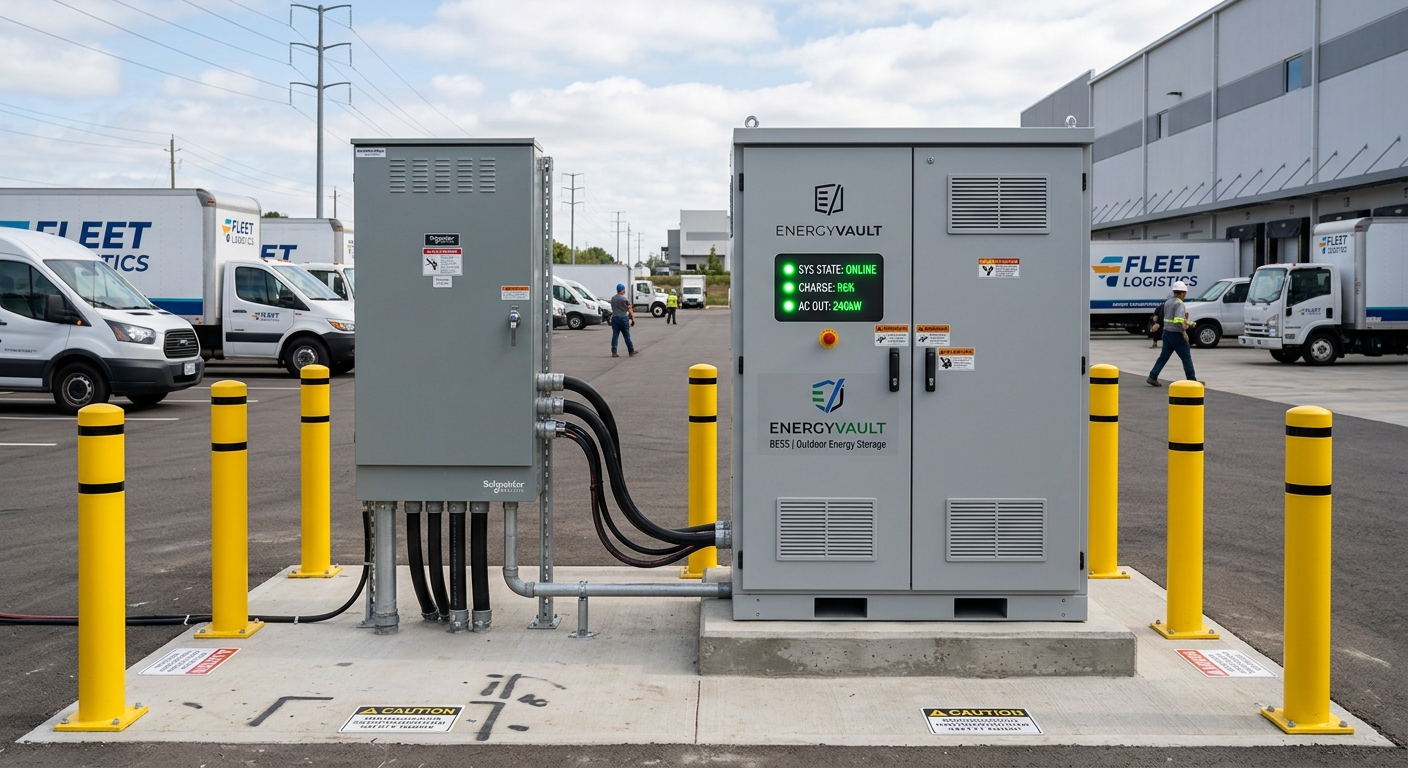
For depots in areas with unreliable grid power, consider a backup generator or battery energy storage system (BESS) sized to maintain critical charging loads. A 200 kWh BESS can keep 10–15 high-priority chargers running for 1–2 hours during a grid outage — enough to cover most short interruptions. Some operators are also exploring vehicle-to-grid (V2G) configurations where partially charged vehicles can supply power to charge critical-route vehicles, though this technology is still maturing for fleet-scale applications.
Battery energy storage system installed at a commercial fleet charging depot for backup power
Getting Your Fleet Depot Charging Right the First Time
Designing overnight charging for 50+ vehicles is fundamentally an exercise in systems engineering, not just charger procurement. The charger is the visible component, but the transformer sizing, load management software, network backbone, physical layout, and resilience planning are what determine whether your fleet dispatches on time every morning.
The key takeaways: size your electrical service using real route data and diversity factors, not worst-case theoretical peaks. Choose managed AC charging as your foundation and reserve DC for edge cases. Design your layout around vehicle flow and departure priority. And invest in intelligent load management — it will pay for itself many times over in avoided infrastructure costs.
At evaisun, we design and manufacture charger hardware purpose-built for fleet depot environments, with OCPP-compliant communication, robust load management integration, and the durability to handle nightly use across hundreds of charge cycles per year. If you are planning a depot charging deployment, reach out to our team for hardware specifications and system design support tailored to your fleet size and operational requirements.
Subscribe the newsletter to get updated to news and promotions
Cookies give you a personalized experience,Сookie files help us to enhance your experience using our website, simplify navigation, keep our website safe and assist in our marketing efforts. By clicking "Accept", you agree to the storing of cookies on your device for these purposes. Click "Adjust" to adjust your cookie preferences.For more information, review our Cookie Policy